Cicada Killer Wasps: Do They Sting, and Should You Worry?
A very large wasp — 1.5 to 2 inches long, black with yellow bands — cruising low over your lawn in July or August is almost certainly a cicada killer, a solitary wasp that digs burrows in bare or sandy soil and hunts cicadas. Despite their alarming size, cicada killers are among the least dangerous stinging insects in your yard: males can't sting at all, and females sting only if grabbed or stepped on barefoot.
Most likely causes
- Huge wasp flying low, zigzag patrols over turf — a male cicada killer guarding territory (no stinger)
- U-shaped dirt mound with a finger-width hole in bare or thin turf — a female's burrow
- Wasp dive-bombing you or hovering at face height — territorial males bluffing; they cannot sting
- A wasp dragging a large green insect across the ground — a female hauling a paralyzed cicada
- Several wasps in one sandy area — solitary nesters that happen to like the same soil, not a colony
Not quite what you're seeing? Answer four quick questions and the clue finder will point you to a closer match.
Compare the possible causes
| Possible cause | Key signs | When it happens | How likely |
|---|---|---|---|
| Male cicada killers patrolling and dive-bombing | Large wasps hovering 1–3 feet off the ground, chasing each other, and buzzing anything that enters the area — including you | Late June through August, peaking in July; active on warm, sunny days | Very common |
| Female burrows — the U-shaped dirt mound | A horseshoe- or U-shaped pile of excavated soil around a clean hole roughly the width of a large pencil or your finger, usually in bare, dry, or sandy ground | Mid to late summer; fresh soil appears as females dig, sometimes overnight | Very common |
| A female carrying a cicada | A big wasp gliding down from a tree or dragging an insect nearly her own size across the grass toward a hole | July and August, matching the annual cicada season | Common |
| Females near the burrow (the only ones that can sting) | A large wasp entering and exiting a single mound-ringed hole, ignoring people entirely | Mid-summer, for roughly six weeks | Common |
| Look-alikes: European hornets and bald-faced hornets | Similar-size insects that behave differently — European hornets fly at night and bang into lit windows; bald-faced hornets are black and white and come from a gray paper nest | Summer through fall | Less common |
Visual clues to check
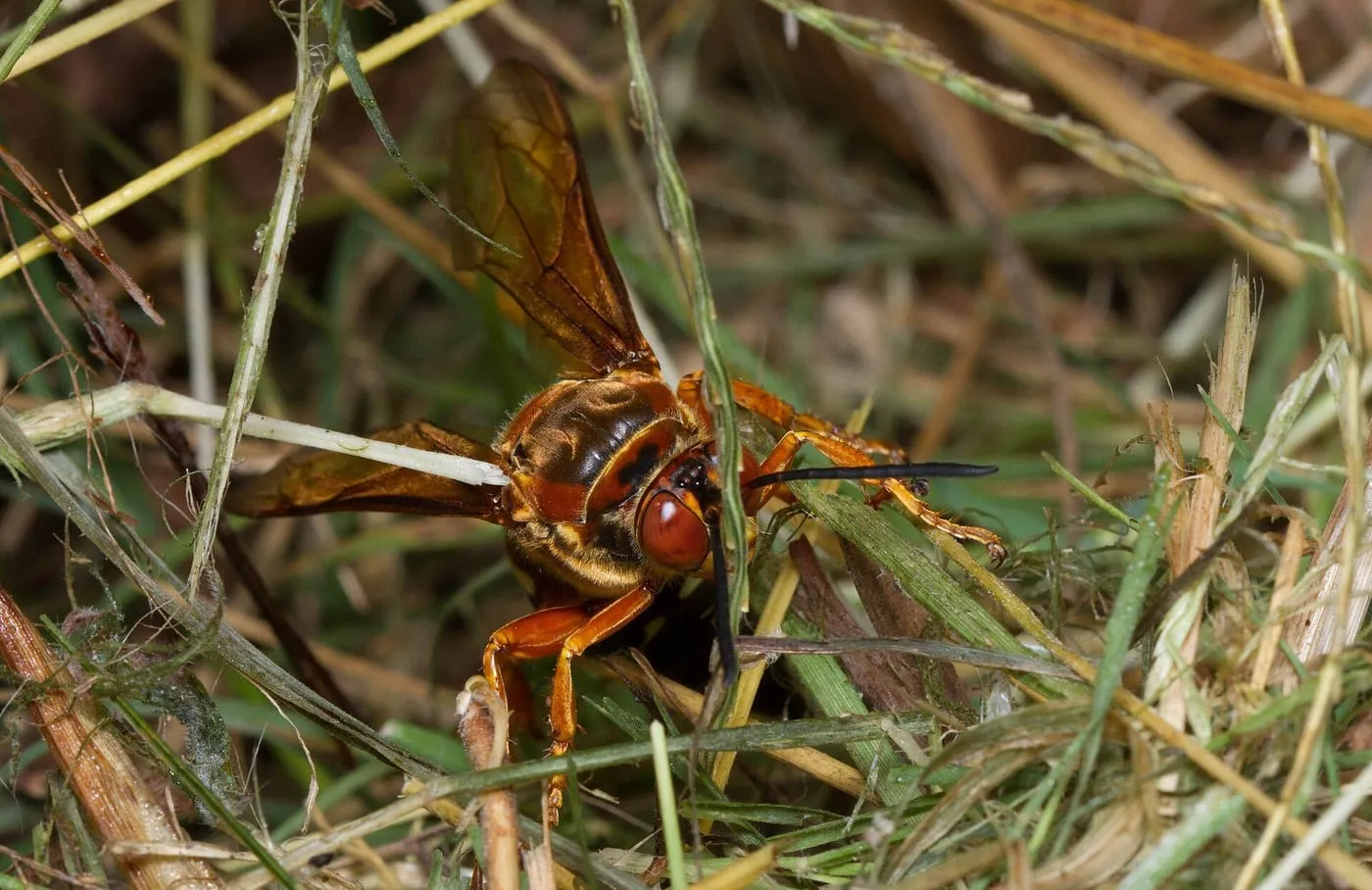
- Check the size and colors: cicada killers run 1.5–2 inches with a black body, yellow bands, and rusty-amber wings — far bigger than any yellowjacket
- Look at the hole: a single finger-width opening with a U-shaped soil mound on one side is a cicada killer burrow; a plain hole with fast, steady traffic of many smaller wasps is a yellowjacket nest
- Count the wasps per hole: cicada killers are solitary — one female per burrow, low traffic; dozens of insects sharing one entrance means a colony
- Watch the flight pattern: low zigzag patrols and hovering face-offs are harmless males; yellowjackets fly direct lines in and out of the nest
- Note the ground: cicada killers pick bare, sandy, dry, sunny soil — check thin lawn edges, play areas, and slopes
- Look for prey: a wasp carrying a cicada settles the identification on the spot
The causes in detail
Male cicada killers patrolling and dive-bombing
The dramatic aerial behavior that scares people is almost entirely male. Male cicada killers stake out territory near burrow sites and investigate anything that moves — other males, birds, pets, lawn mowers. It's pure bluff: males have no stinger and are physically incapable of stinging. They can bump you, but they cannot hurt you.
Female burrows — the U-shaped dirt mound
Each female digs her own burrow, often 10 inches or more deep with side chambers, kicking soil out behind her into that signature U-shaped mound. She stocks each chamber with one to three paralyzed cicadas and lays an egg on them. Females prefer bare, well-drained, sunny spots — thin lawns, sandy patches, the edges of driveways and sandboxes — which is why thick, healthy turf almost never gets them.
A female carrying a cicada
This is the behavior the wasp is named for. The female stings a cicada high in a tree, paralyzes it, and glides or drags it back to her burrow as food for her larvae. It looks alarming but is completely uninterested in you — a female hauling prey will not break off to defend anything. This is also useful natural pest control, since annual cicadas feed on tree roots and sap.
Females near the burrow (the only ones that can sting)
Female cicada killers can sting, but they are famously reluctant — stings essentially only happen when a wasp is grabbed with bare hands, trapped in clothing, or stepped on barefoot. There is no colony to defend, so there is no group attack response the way there is with yellowjackets or hornets. Entomologists routinely walk through active nesting areas without incident.
Look-alikes: European hornets and bald-faced hornets
The other insects big enough to be confused with a cicada killer are true colony builders, and the distinction matters. European hornets are brown and yellow, active after dark, and drawn to porch lights. Bald-faced hornets are black with white face markings and defend an enclosed gray paper nest aggressively. A giant wasp coming out of a hole in the ground with a U-shaped dirt mound is a cicada killer; a stream of smaller wasps pouring in and out of a plain hole in the ground is a yellowjacket colony — treat those very differently.
When to worry
- Steady, heavy traffic of many smaller wasps in and out of a single unadorned hole — that's a yellowjacket colony, not cicada killers, and it will defend itself
- Burrowing that undermines pavers, a retaining wall, or the edge of a sand-set patio — many burrows in one spot can loosen the base
- Anyone in the household with a known wasp or bee sting allergy — even a low-risk insect deserves a wider margin
- Dozens of burrows in a play area or sandbox where barefoot kids are stepping — the one realistic sting scenario
What to do now
- Confirm the U-shaped mound and finger-width hole before doing anything — identification is the whole game with large wasps
- Wait them out if you can: adults are active for only about six weeks and are gone by early fall, and they won't return to a spot that stops suiting them
- Fix the real cause — bare soil: overseed thin turf, water it, raise your mowing height, and mulch bare bed edges; cicada killers rarely nest in dense grass
- Run a sprinkler on the nesting area regularly during nesting season — females avoid consistently damp soil
- Rake burrow mounds flat and fill holes after the season ends, then repair the turf
- If burrows are dense in a spot you can't avoid, or you're not certain they aren't yellowjackets, have a licensed pest control professional confirm and treat
What not to do
- Don't swat at or grab a patrolling wasp — being handled is essentially the only way a female stings
- Don't pour gasoline, boiling water, or bleach into burrows — dangerous, bad for the soil, and unnecessary for an insect that leaves in six weeks
- Don't blanket-spray the lawn with insecticide; you'll harm pollinators and beneficial insects without fixing the bare soil that attracted the wasps
- Don't assume every ground-nesting wasp is harmless — confirm it's not a yellowjacket colony before mowing over or disturbing the area
Frequently asked questions
Do cicada killers sting people?
Almost never. Males — the ones doing the dive-bombing — have no stinger at all. Females can sting but only do so if grabbed, trapped in clothing, or stepped on with bare feet, and because they're solitary, there's no nest-defense swarm. The sting itself is reported as milder than a honey bee's.
What does a cicada killer look like?
It's one of the largest wasps in the U.S.: 1.5 to 2 inches long, with a rusty-red head and thorax, a black abdomen banded in yellow, and amber-tinted wings. Size alone usually gives it away — it dwarfs yellowjackets and paper wasps, and only European and bald-faced hornets come close.
How do I get rid of cicada killer wasps?
The lasting fix is taking away the bare, dry soil they need: thicken the lawn by overseeding and watering, mow higher, and mulch exposed bed edges. Keeping the nesting area damp with a sprinkler during their six-week season also pushes females elsewhere. Insecticide is rarely warranted; if burrows are dense in a high-traffic spot, have a professional treat the individual holes.
How long do cicada killers stay around?
About six weeks. Adults emerge in late June or July, nest through August, and die off by early fall. The next generation spends the fall, winter, and spring underground as larvae and pupae, so you won't see wasps again until the following July.
Are cicada killers actually good for my yard?
Yes, on balance. Each female removes dozens of cicadas that would otherwise feed on your trees, the adults are minor pollinators, and their digging aerates soil. The main downsides are cosmetic mounds and nervous houseguests — both temporary.