Ant Hills All Over the Lawn: Which Ants, and What to Do
A lawn dotted with ant hills is usually hosting turfgrass ants or field ants, which are more of a mowing nuisance than a threat. The critical exception is in the southern US, where dome-shaped mounds with no visible entrance hole can be red imported fire ants — an aggressive, painfully stinging species that changes the response from 'rake and relax' to 'treat and keep kids away.'
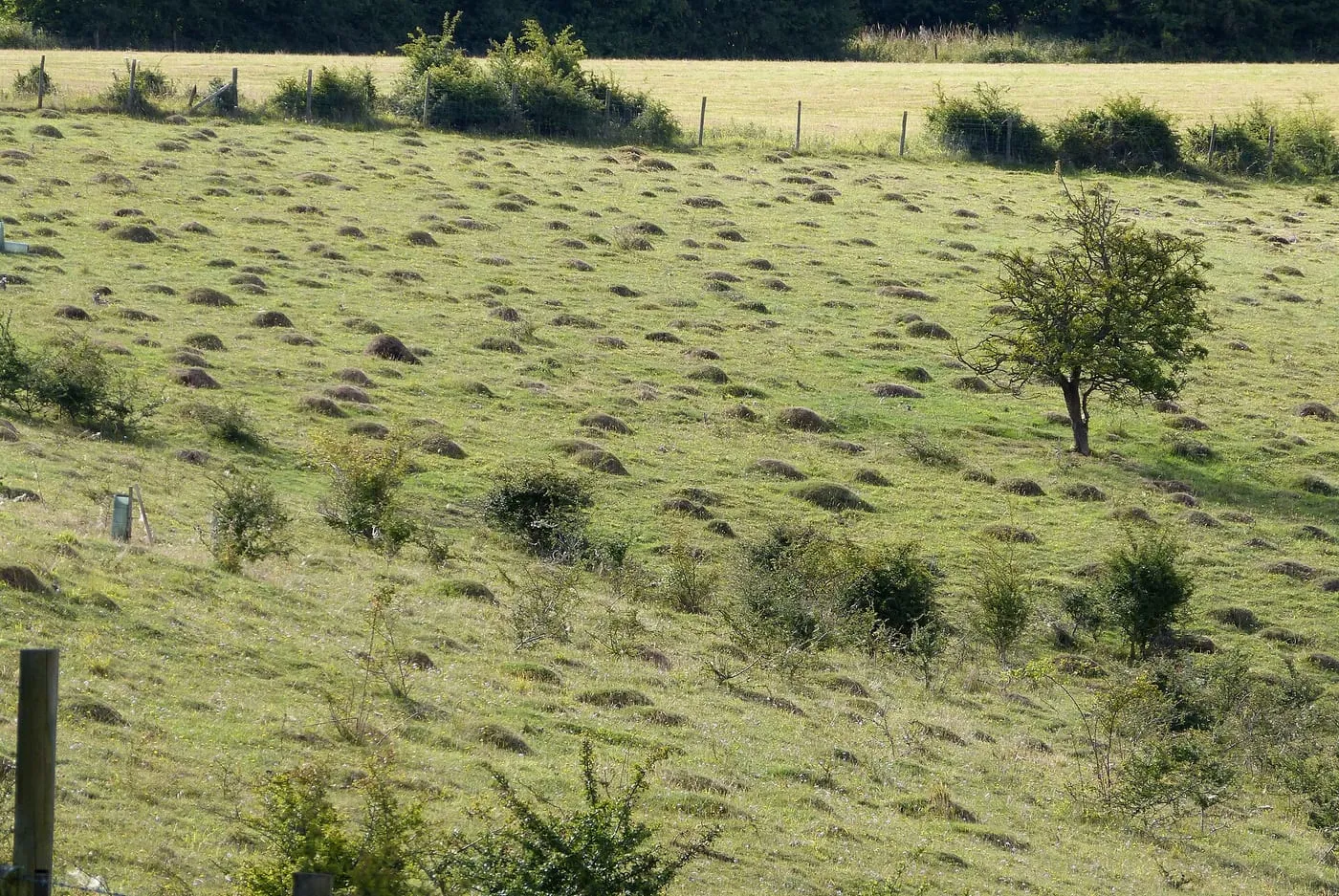
Most likely causes
- Turfgrass ants — many small crumbly soil piles scattered across the lawn, worst in spring
- Field ants — fewer but larger low mounds, often near lawn edges, trees, or fences
- Pavement ants — little soil craters tracing driveway, sidewalk, and patio edges
- Fire ants (South) — fluffy dome mounds up to 18 inches with no center hole, ants boil out when disturbed
Not quite what you're seeing? Answer four quick questions and the clue finder will point you to a closer match.
Compare the possible causes
| Possible cause | Key signs | When it happens | How likely |
|---|---|---|---|
| Turfgrass ants | Dozens of small, crumbly soil piles a few inches across, each with a central hole, peppering otherwise healthy lawn | Most visible in spring and early summer, and again after rain | Very common |
| Field ants | Larger, low-profile mounds up to a foot or more across, built of soil and thatch, usually near lawn edges, fence lines, stumps, or shrubs | Active spring through fall; mounds enlarge over the season | Common |
| Pavement ants | Small volcano-like craters of fine soil erupting between pavers and along driveway, sidewalk, and patio seams | Spring through summer, with winged swarmers appearing on warm days | Common |
| Red imported fire ants | Dome-shaped mounds of fluffy, worked soil up to 18 inches wide with no visible entrance hole; disturb one slightly and ants swarm out within seconds | Year-round in the South, with mounds most visible in spring and fall and after rain | Common |
Visual clues to check
- Look for the entrance: a visible center hole points to native lawn, field, or pavement ants; a smooth dome with no hole is a fire ant red flag in southern states
- Poke the mound edge with a long stick and step back: a slow trickle of ants is normal; an instant boiling swarm racing up the stick means fire ants
- Size up the ants: turfgrass and pavement ants are tiny (about 1/8 inch); field ants are large (1/4 to 1/2 inch); fire ants are reddish-brown and come in mixed sizes from the same mound
- Map the mounds: tracing hardscape edges suggests pavement ants; scattered across open turf suggests turfgrass or fire ants; parked at the yard margins suggests field ants
- Check after rain: a crop of fresh mounds the day after a soaking is classic fire ant behavior in the South
- Count over time: a few stable mounds is a colony or two; steadily multiplying mounds means expanding pressure worth addressing
The causes in detail
Turfgrass ants
When a lawn suddenly looks like it has a case of the measles — lots of little dirt piles everywhere — small mound-building lawn ants are the usual answer. Each pile is soil excavated from nesting tunnels below. They rarely harm the grass itself; the piles just smother small spots of turf and dull mower blades. A stiff rake or broom levels them in minutes, and colonies often relocate on their own.
Field ants
Field ants are big reddish-brown-to-black ants that build sprawling, gently rounded mounds, most often at the quiet margins of a yard. They don't sting, though they can bite and spray formic acid if you stand on the nest — a startling but minor experience. Because field ants prey on other lawn pests, an out-of-the-way mound is often worth tolerating. They're also the ants most often mistaken for fire ants by worried northern homeowners.
Pavement ants
If the 'hills' concentrate where lawn meets hardscape, pavement ants are your architects. They nest under slabs and push excavated soil up through cracks and edge gaps. They're a cosmetic issue outdoors, but colonies near the foundation sometimes forage indoors for sweets and grease, which is when homeowners decide the truce is over. Sealing entry cracks and keeping crumbs cleaned up handles most indoor incursions.
Red imported fire ants
Across the Southeast, Texas, and increasingly the Southwest, multiple fresh mounds after rain deserve the fire ant test — from a safe distance. Native ant mounds have a central hole; fire ant mounds don't, because the colony enters through underground tunnels. Fire ants attack en masse, each ant stinging repeatedly with venom that raises burning white pustules. A heavily infested lawn is genuinely unsafe for barefoot kids and curious pets, and it's the one ant situation where treatment is strongly recommended rather than optional.
When to worry
- You're in the South and mounds have no entrance hole and erupt with ants when barely disturbed — treat as fire ants until proven otherwise
- Anyone in the household is allergic to insect stings; fire ant stings can trigger severe reactions requiring emergency care
- Mounds are multiplying near play areas, sandboxes, patios, or dog runs
- Ants are trailing steadily into the house, garage, or outdoor kitchen from nests along the foundation
- Winged ants swarm from the lawn toward the house on warm days — worth confirming they're ants and not termites
What to do now
- Identify before acting: photograph a mound and a few ants up close (zoom, don't crouch over a suspect fire ant mound)
- For harmless turfgrass and field ant piles, rake or sweep mounds level when dry, before mowing — that alone solves the cosmetic problem
- Mow high and water properly; thick, healthy turf shades soil and makes lawns less inviting for mound builders
- Fix what feeds them: manage aphids on nearby plants (ants farm their honeydew), clean up greasy spills, and keep trash sealed
- In fire ant country, ask your county extension service about the proven two-step approach and its timing — extension offices publish region-specific guidance every year
- Wear closed shoes and socks while working near any suspect mound, and keep kids and pets clear until it's identified
- Call a licensed pest professional for fire ant infestations, mounds near electrical boxes or AC units (fire ants are drawn to them), or any allergy in the household
What not to do
- Don't stand on, kick, or shovel into a suspect mound to 'see what happens' — fire ants swarm up legs in seconds and sting in unison
- Don't pour boiling water or gasoline on mounds; gasoline is dangerous and illegal to dump, and boiling water scalds turf while usually missing the queen
- Don't rely on home remedies like grits, coffee grounds, or dish soap for fire ants — none reach the queen, and the colony just relocates a few feet away
- Don't treat every ant hill reflexively; native field and turfgrass ants aerate soil and eat pest insects, and killing them can open territory for fire ants in the South
- Don't let kids play barefoot in a southern lawn with fresh, unidentified mounds
Frequently asked questions
Why does my lawn suddenly have so many ant hills?
Rain is the usual trigger: saturated soil pushes colonies to rebuild upward, so a flush of fresh mounds appears within a day or two of a good soak. Spring nest expansion and dry weather (which drives ants deeper, moving more soil) cause similar bursts. More mounds doesn't always mean more colonies — one colony can maintain several.
How can I tell fire ant mounds from regular ant hills?
Check for an entrance from a safe distance. Regular ant hills have a visible hole in the middle; fire ant mounds are smooth domes of fluffy soil with no opening, since the colony comes and goes through underground tunnels. The behavior test confirms it: barely disturb a fire ant mound and workers boil out aggressively within seconds.
Do ant hills damage the lawn itself?
Mostly no. The ants aren't eating grass — the piles just bury small patches, which yellow if left for weeks, and mounded soil dulls mower blades. Rake piles level when dry and the turf recovers. The meaningful damage cases are large field ant mounds smothering turf and fire ant mounds making the lawn unusable.
Will vinegar, boiling water, or grits get rid of ant hills?
Not reliably. These treatments kill some surface workers but almost never the queen, who sits deep below — so the colony pops up a new mound nearby, often within days. For nuisance native ants, raking and healthy turf are usually enough. For fire ants, properly timed baiting per your extension office's guidance or a licensed professional is what actually works.
When should I call a professional about lawn ants?
Call when you've confirmed or strongly suspect fire ants, when mounds cluster around play areas or AC and utility equipment, when someone in the home has a sting allergy, or when DIY baiting hasn't reduced mound counts after a full season. For ordinary field and turfgrass ants, a professional is rarely necessary.