Red and Black Bugs on Your House: What Are They?
Red and black bugs clustered on your house are most likely boxelder bugs, which gather by the hundreds on warm, sunny walls in fall while looking for winter shelter. Milkweed bugs, firebugs, and tiny red velvet mites are the usual look-alikes. None of them bite, sting, or damage the structure — the real nuisance is the ones that slip inside, and the ones you squash can leave stains.
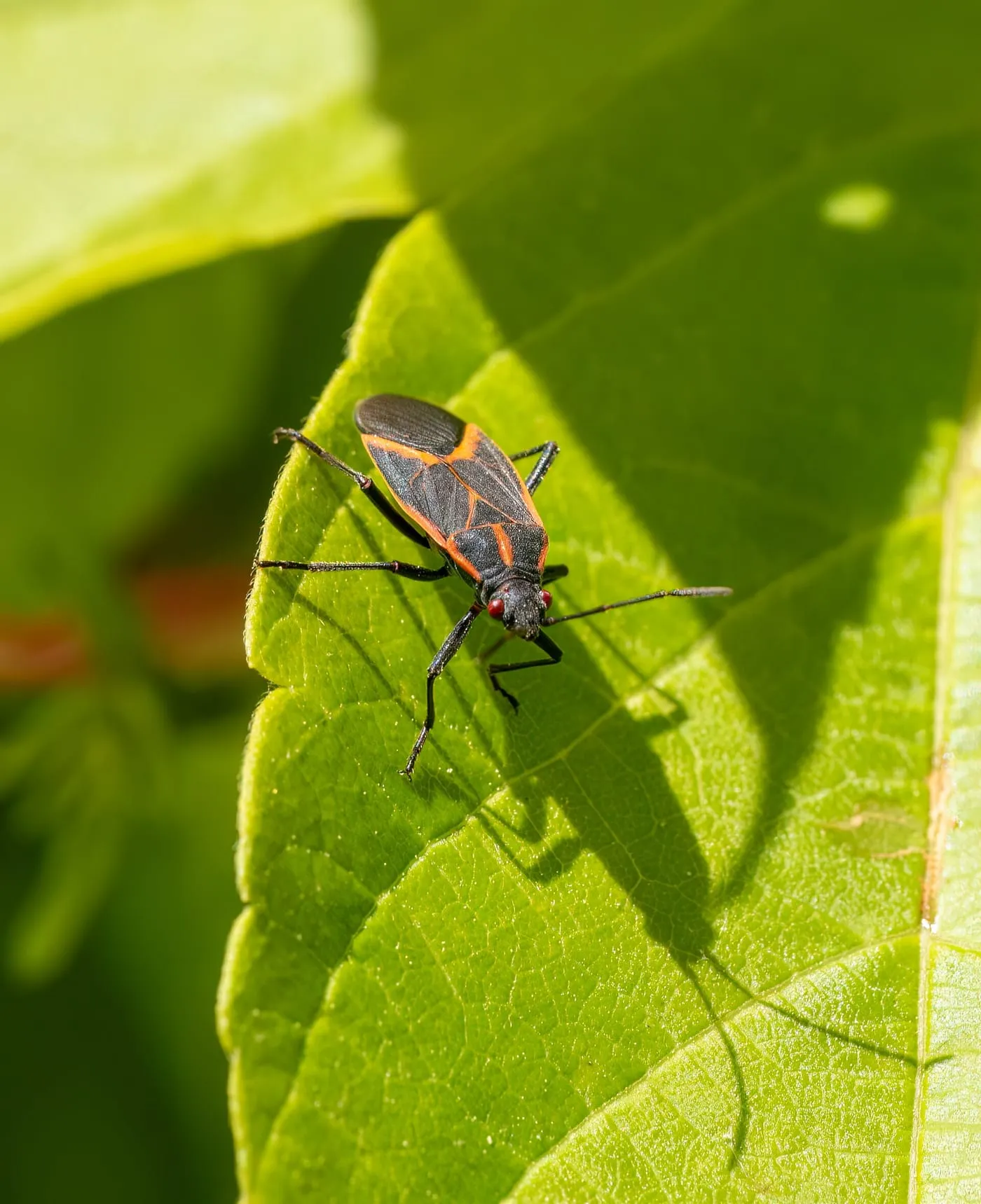
Most likely causes
- Boxelder bugs — half-inch black bugs with red edging, massing on sunny south and west walls in fall
- Milkweed bugs — orange-red and black, found near milkweed patches rather than on walls
- Firebugs — rounder and redder, often in dense groups at the base of walls and tree trunks
- Red velvet mites — tiny, plush, entirely red, wandering alone on masonry after rain
Not quite what you're seeing? Answer four quick questions and the clue finder will point you to a closer match.
Compare the possible causes
| Possible cause | Key signs | When it happens | How likely |
|---|---|---|---|
| Boxelder bugs | Flat, elongated bugs about 1/2 inch long, black with thin red-orange lines outlining the wings, gathered in dense sunlit clusters | Most noticeable in fall on warm afternoons; reappear at windows on sunny winter and early spring days | Very common |
| Large milkweed bugs | Orange-red bugs with a black band across the middle of the back, usually on or near milkweed pods rather than the house itself | Mid summer through fall, peaking when milkweed seed pods ripen | Common |
| Firebugs | Rounder, redder bugs with a bold black dot-and-triangle pattern, packed in dense groups at wall bases, tree trunks, and sidewalk edges | Spring and fall, especially on sun-warmed ground and masonry | Less common |
| Red velvet mites | Tiny, brilliant red, velvety creatures the size of a pinhead to 1/8 inch, walking singly on patios, foundations, and soil | Spring and after summer rains | Less common |
| Asian lady beetles | Rounded, dome-shaped beetles in orange to red with variable black spots, gathering at windows and light-colored walls in October | A brief, intense window in mid to late fall, often on the first warm day after a frost | Common |
Visual clues to check
- Check which wall they're on: boxelder bugs and firebugs overwhelmingly choose sunny south- and west-facing surfaces
- Look at the pattern: thin red outlines on a black body point to boxelder bugs; a black band on an orange body points to milkweed bugs; bold dots and triangles point to firebugs
- Judge the size: the wall-massing species are about 1/2 inch; anything pinhead-sized and solid red is a mite
- Follow the trail: boxelder bugs usually mean a seed-bearing boxelder, maple, or ash tree within a couple hundred feet
- Note the season: big wall aggregations in September and October are overwintering behavior, not a breeding population in the house
- Watch where they disappear: bugs slipping behind siding, under sill plates, or into weep holes are showing you the exact gaps to seal
The causes in detail
Boxelder bugs
Boxelder bugs spend the summer feeding on the seeds of boxelder, maple, and ash trees, then converge on warm vertical surfaces in fall — classically the south- or west-facing wall of a light-colored house. From there they work into gaps around siding, windows, and soffits to overwinter, which is why a few keep showing up indoors on sunny winter days. They don't breed inside, don't bite, and don't eat anything in your home; they're a sealing problem, not an infestation.
Large milkweed bugs
If you grow milkweed for monarchs, the clusters of red-and-black bugs on the pods are almost certainly milkweed bugs feeding on the seeds. They occasionally wander onto nearby walls in fall but rarely mass on houses the way boxelder bugs do. They're harmless to people, pets, and the plant itself beyond reducing seed set, so most gardeners simply leave them alone.
Firebugs
The European firebug is a newer arrival that has been spreading through parts of the United States, and it congregates even more densely than boxelder bugs — sometimes in carpets of hundreds at the base of a sunny wall or linden tree. Like its look-alikes, it doesn't bite or damage buildings. If you're in an area where firebugs are still new, your state extension office may appreciate a photo report.
Red velvet mites
If the red things on your house are tiny, plush-looking, and traveling alone rather than in clusters, they're likely velvet mites — soil predators that surface after rain. They're beneficial, feeding on insect eggs and small pests, and they don't bite people or infest homes. Their much smaller cousin, the clover mite, also shows up on sunny walls by the thousands in spring and leaves a red smear when crushed.
Asian lady beetles
Not truly red-and-black patterned like the bugs above, but Asian lady beetles mass on houses for exactly the same reason and at the same time of year, so the two problems are often confused. They can pinch skin lightly and give off a yellowish, odorous fluid when disturbed, which stains paint and fabric. The playbook is the same as for boxelder bugs: seal openings and vacuum up the stragglers.
When to worry
- Large numbers appearing inside living spaces daily in fall — the exterior gaps they're using are big or numerous
- Bugs emerging indoors all winter, which means a substantial number are overwintering in the walls or attic
- Red stains on curtains, walls, or furniture from crushed bugs or lady beetle fluid
- You're seeing dense red masses of much tinier bugs at ground level — clover mites can invade in the thousands through the smallest cracks
What to do now
- Vacuum clusters off walls and window sills — indoors and out — and empty the canister or bag outside promptly
- Knock outdoor masses off the wall with a strong jet of water from the hose on sunny fall afternoons
- Seal the entry points before the fall rush: caulk around window and door frames, utility penetrations, and where siding meets the foundation, and repair torn screens and door sweeps
- Install or repair screening behind gable vents and weep-hole covers where practical
- If a boxelder tree on your property drives huge numbers every year, an arborist can advise on whether removing a female (seed-bearing) tree is worthwhile
- If interior numbers stay overwhelming despite sealing, have a pest control professional do a targeted exterior perimeter treatment in early fall rather than treating indoors
What not to do
- Don't squash them on walls, curtains, or carpet — boxelder bugs and lady beetles leave reddish stains that are hard to remove
- Don't fog or bomb the house interior; it won't reach bugs tucked in wall voids and coats your living space with pesticide for no benefit
- Don't spray bugs already inside wall voids — the die-off can attract carpet beetles and other pantry pests that create a second problem
- Don't panic-remove landscape trees before confirming which species is actually the source
- Don't bother with traps and zappers — these bugs aren't strongly attracted to them
Frequently asked questions
Why are the bugs only on one side of my house?
They're following warmth. In fall, boxelder bugs and firebugs congregate on the surfaces that hold the most afternoon sun — usually south- and west-facing walls, especially light-colored ones that reflect heat. The sunny side is also where they'll probe for gaps to overwinter in, so it's the side to prioritize when sealing.
Will boxelder bugs damage my house or my plants?
No meaningful damage either way. They feed on tree seeds, not on wood, fabric, or food, and they don't reproduce indoors. The only real harm is cosmetic — reddish stains if they're crushed and specks of waste on light surfaces where large numbers rest.
Why do they keep appearing inside in the middle of winter?
The bugs that got into your walls or attic in fall go dormant, but a stretch of sunny weather or indoor heat wakes some of them, and they follow warmth and light into your rooms. It feels like a new invasion but it's the same fall group trickling out. Vacuum them up as they appear; the supply is finite.
Do I need an exterminator for boxelder bugs?
Usually not. Vacuuming, hosing clusters off the wall, and sealing exterior gaps solves most cases. A professional perimeter treatment applied in early fall is worth considering only if you get overwhelming numbers indoors every year despite good sealing.