White Fuzzy Bugs Flying Around? Meet the 'Fairy Flies'
Tiny white fuzzy bugs drifting through the air are usually woolly aphids — sometimes nicknamed 'fairy flies' or 'fluff bugs' — riding the breeze between host trees. Whiteflies that billow up when you brush a plant, hackberry woolly aphids, and waxy planthopper nymphs are the other common sources. Nearly all of them are harmless to you and only a minor stress on healthy plants.
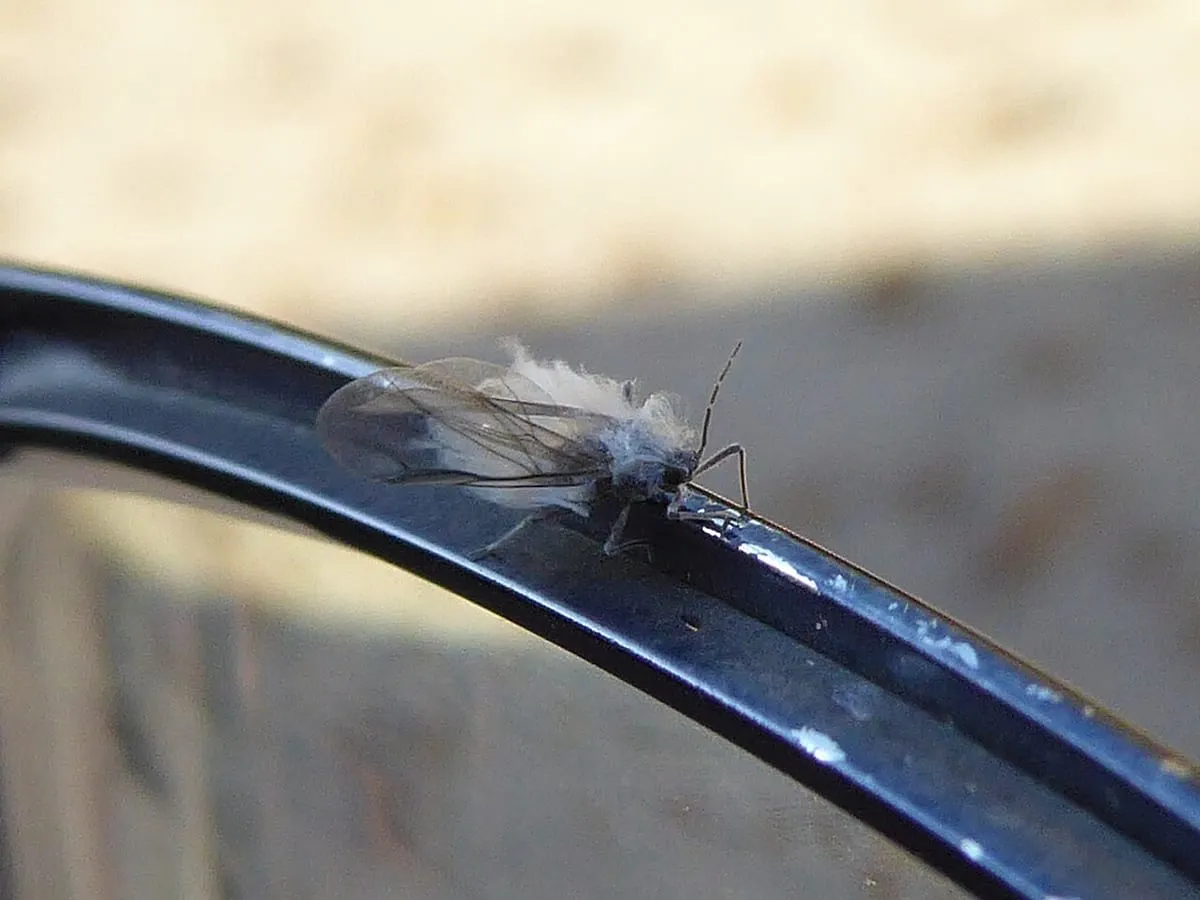
Most likely causes
- Woolly aphids — slow-drifting specks of white fluff in the air, often in late summer and fall
- Whiteflies — a white cloud that erupts when you shake or water a plant
- Hackberry woolly aphid — snowy 'flying lint' anywhere hackberry trees grow
- Planthopper nymphs — fuzzy white tufts that hop when touched, with waxy trails on stems
- Cottony cushion scale crawlers — white cottony masses on twigs in warm climates
Not quite what you're seeing? Answer four quick questions and the clue finder will point you to a closer match.
Compare the possible causes
| Possible cause | Key signs | When it happens | How likely |
|---|---|---|---|
| Woolly aphids | Airborne white fluff about 1/8 inch across that flies slowly and deliberately, unlike drifting seed down; cottony patches on twigs of apple, alder, or beech | Late summer through fall, when winged generations migrate between host plants | Very common |
| Whiteflies | A cloud of tiny white wedge-shaped insects that bursts upward when you disturb a plant, then quickly resettles on the leaf undersides | Mid summer through the first frost; year-round on houseplants and in greenhouses | Very common |
| Hackberry woolly aphid | Abundant floating white fuzz plus sticky mist and shiny honeydew droplets under hackberry trees | Late summer and fall, heaviest in the South and central states where hackberries are common | Common |
| Planthopper nymphs | White cottony tufts on stems and leaf undersides that spring away like fleas when you touch them, leaving fluffy waxy trails behind | Early to mid summer | Common |
| Cottony cushion scale crawlers | Reddish-brown scale insects with white fluted, cottony egg sacs on twigs and leaf midribs; tiny crawlers may drift on the wind | Warm months, mainly in southern and West Coast states | Less common |
Visual clues to check
- Watch the flight: powered, slow, deliberate movement means an insect; pure drifting with the wind is likely cottonwood or dandelion seed fluff
- Shake a suspect plant: an instant white cloud that resettles on leaf undersides is whiteflies
- Touch a fuzzy tuft on a stem: if it leaps away, it's a planthopper nymph, not mold or mealybugs
- Look up: heavy 'snow' in late summer often traces to a hackberry, apple, alder, or maple overhead
- Check surfaces below for stickiness: honeydew spatter on leaves, cars, or patios confirms sap-feeding insects above
- Part the fluff on a twig with a stick: live gray-blue bodies underneath mean woolly aphids; a smooth white crust suggests scale or fungus
- Look for black film on lower leaves: sooty mold grows on honeydew and marks where an infestation has been active for weeks
The causes in detail
Woolly aphids
Woolly aphids coat themselves in waxy white filaments as protection, and when the winged migratory generation takes to the air, the yard fills with what looks like flying lint. They alternate between two host plants — often apple and elm, or alder and maple — so the fliers are commuters, not invaders. Colonies on twigs look like fuzzy white mold but part to reveal gray-blue aphids underneath. Healthy trees shrug off the feeding; the sticky honeydew they drop is usually the biggest annoyance.
Whiteflies
Whiteflies aren't flies at all but sap-sucking relatives of aphids, about 1/16 inch long and dusted with white wax. The tell is the eruption: brush past a tomato, hibiscus, or bean plant and a puff of white rises, then lands right back where it started. Small numbers are trivial; heavy infestations yellow the leaves and coat them in sticky honeydew followed by black sooty mold. A firm spray of water to the leaf undersides every few days knocks populations down fast.
Hackberry woolly aphid
The Asian woolly hackberry aphid turns entire neighborhoods 'snowy' in September and October where hackberry trees line the streets. Beyond the drifting fluff, the giveaway is what's below the tree: sidewalks, cars, and patio furniture speckled with sticky honeydew that later grows dark sooty mold. Established hackberries tolerate the feeding fine, so treatment is rarely justified — hosing off surfaces and waiting for frost is the standard advice.
Planthopper nymphs
If the 'fuzzy bug' hops instead of flying, you've found a planthopper nymph. The young insects trail white waxy filaments from their back ends and leave fluffy deposits along stems that gardeners often mistake for mealybugs or mold. They feed lightly on a wide range of ornamentals and almost never cause real damage — most people can simply ignore them, and the adults they turn into are quiet green or brown wedges.
Cottony cushion scale crawlers
On citrus, pittosporum, and nandina in warmer regions, white cottony ridges glued to the twigs are cottony cushion scale — each ridge is an egg sac holding hundreds of eggs, and the newly hatched crawlers can balloon short distances on silk and breeze. Heavy infestations weaken plants and rain honeydew. This pest has a famous natural enemy, the vedalia lady beetle, which usually controls it if broad-spectrum spraying doesn't wipe the beetles out.
When to worry
- Leaves yellowing, curling, or dropping on a plant that erupts in white clouds — a heavy whitefly load worth treating
- Thick sooty mold blackening leaves and blocking light on garden plants or a small tree
- Cottony masses spreading across citrus or ornamental twigs with dieback behind them — possible scale infestation
- A young or newly planted tree carrying dense woolly aphid colonies on most of its branches
- Fluff accompanied by galled, distorted new growth year after year on the same tree
What to do now
- Identify before acting — most of these insects need no treatment at all, and the drifting fliers are already leaving
- Blast colonies of woolly aphids or whiteflies off plants with a hard jet of water, repeating every few days for a week or two
- Hose honeydew off cars, furniture, and walkways before sooty mold gets established; plain water works if you get it early
- Encourage the cleanup crew: lady beetles, lacewings, and tiny parasitic wasps devour aphids and whiteflies when they aren't sprayed away
- For persistent whiteflies on vegetables, yellow sticky cards placed just above the canopy help monitor and thin the adults
- If a valuable tree is declining or a scale infestation keeps spreading, have a certified arborist or licensed pest professional assess it rather than spraying blind
What not to do
- Don't reach for broad-spectrum insecticide sprays — they rarely reach wax-protected insects but reliably kill the beneficial insects controlling them
- Don't try to treat the air; the flying stage is dispersing and will be gone within days regardless
- Don't confuse woolly aphid fluff with mold and prune out healthy branches unnecessarily
- Don't scrub sooty mold with harsh chemicals on live leaves — stop the honeydew source and the mold weathers away
- Don't spray a tall tree from the ground; you'll wear more pesticide than the canopy receives
Frequently asked questions
What are the little white fuzzy things floating in the air?
If they steer themselves rather than drifting passively, they're most likely winged woolly aphids — tiny sap-feeding insects wrapped in waxy white filaments, migrating between host trees in late summer and fall. Pure wind-drifters are usually cottonwood or other seed fluff. Neither can hurt you.
Are white fuzzy bugs bad for my plants?
Usually not in any lasting way. Woolly aphids, whiteflies, and planthopper nymphs all sip sap, which healthy plants tolerate easily. Trouble is limited to heavy infestations — yellowing leaves, sticky honeydew, and black sooty mold — and those cases respond well to repeated water sprays and natural predators.
Why is everything under my tree sticky?
That's honeydew, the sugary waste that aphids, whiteflies, and scale insects excrete as they feed overhead. It coats cars, decks, and lower leaves, and the black film that follows is sooty mold growing on the sugar. Rinse surfaces with water promptly and the problem ends when the insects do, usually at frost.
Will the white fuzz come back every year?
Often, yes — woolly aphids and hackberry aphids cycle with their host trees, so yards with those trees see some fluff most late summers. Populations swing widely year to year with weather and predator numbers. Since established trees aren't harmed, most homeowners treat it as a seasonal quirk rather than a problem to solve.