Webs on Tree Branches: Tent Caterpillars or Webworms?
Silky webs in your trees are most likely eastern tent caterpillars if it's spring and the web sits in a branch fork, or fall webworms if it's late summer and the web wraps the tips of branches. Both look alarming but rarely do lasting harm to a healthy tree — and whatever you do, never try to burn a nest out of a tree.
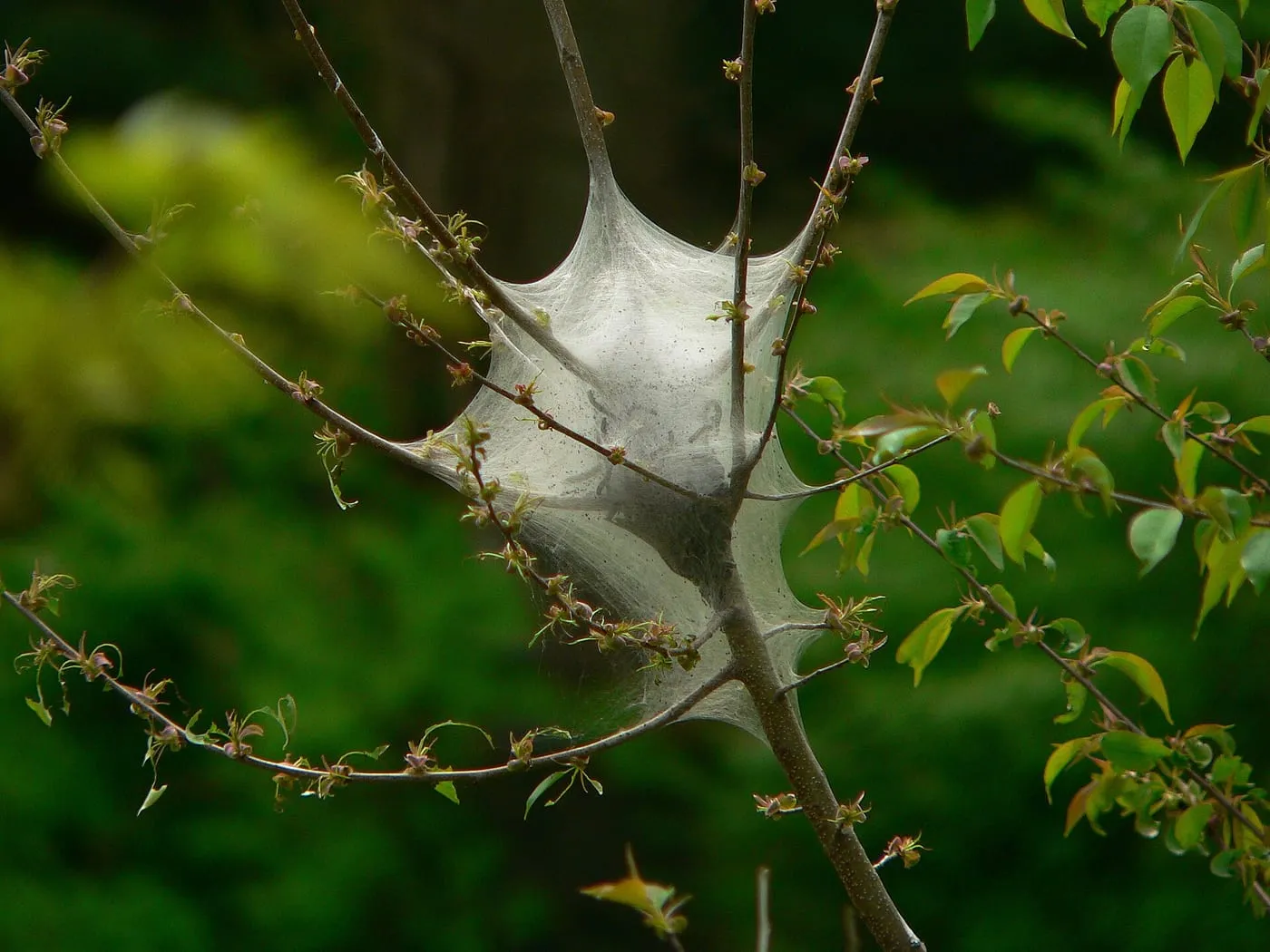
Most likely causes
- Eastern tent caterpillars — dense silk tents in branch crotches in spring
- Fall webworms — loose webbing enclosing leaves at branch tips in late summer
- Ordinary spider webs — no caterpillars inside, harmless and even helpful
- Mite or barklice webbing — fine silk sheets on bark or leaves, mostly cosmetic
Not quite what you're seeing? Answer four quick questions and the clue finder will point you to a closer match.
Compare the possible causes
| Possible cause | Key signs | When it happens | How likely |
|---|---|---|---|
| Eastern tent caterpillars | A compact, layered silk tent wedged into the fork where branches meet, with dark, fuzzy caterpillars visible inside or marching along branches | Early to mid spring, right as leaves emerge; favorites are wild cherry, apple, and crabapple | Very common |
| Fall webworms | Loose, gauzy webbing that encloses whole clusters of leaves at the ends of branches, often with skeletonized leaves inside | Late summer into fall; common on hickory, walnut, sweetgum, mulberry, and many shade trees | Very common |
| Spiders | Classic orb webs, funnel webs, or sheet webs strung between branches with no caterpillars, no enclosed leaves, and no chewing damage | Any time from spring through fall, most noticeable on dewy fall mornings | Common |
| Spider mites or barklice | Very fine silk sheeting over bark or across leaf surfaces without any tent structure, sometimes with tiny insects grazing beneath it | Hot, dry midsummer for mites; late summer for barklice | Less common |
Visual clues to check
- Note where the web sits: a branch crotch means tent caterpillars; branch tips mean fall webworms; strung between branches with no leaves inside means spiders
- Check the calendar: webs in April and May point to tent caterpillars; webs in August and September point to webworms
- Look inside the web: dozens of fuzzy caterpillars confirm one of the two nest-builders; a single spider means a harmless web
- Inspect leaves near the web: chewed or skeletonized leaves inside the silk point to webworms; stripped branches near a crotch tent point to tent caterpillars
- Scan twigs in winter: dark, varnished-looking bands wrapped around pencil-thin twigs are tent caterpillar egg masses you can prune off before spring
- Count the webs across the tree: one or two nests on a mature tree is normal; a small or newly planted tree covered in webs deserves action
The causes in detail
Eastern tent caterpillars
Tent caterpillars hatch in early spring from a dark egg band on a twig and build their tent in a branch crotch, enlarging it as they grow. They leave the tent to feed on nearby foliage and return at night and in bad weather — which is exactly why removal works best early in the morning or on cool, rainy days when the colony is home. A healthy tree can lose a lot of spring leaves to them and releaf by summer.
Fall webworms
Fall webworms do the opposite of tent caterpillars: they wrap the branch tips rather than the crotches, and they feed inside the web, expanding it over the leaves as they eat. The timing is the other giveaway — big webs appearing in August and September are webworms. Because the tree has already banked most of its energy for the year by then, webworm damage is almost entirely cosmetic, and many arborists recommend simply leaving small webs alone.
Spiders
A web with a single spider and no caterpillar colony inside isn't a pest problem at all. Spiders don't eat leaves — they eat the insects that do, including moths whose caterpillars damage trees. Large numbers of webs glinting in the grass and shrubs on cool fall mornings are simply the year's spider population becoming visible, not an infestation.
Spider mites or barklice
Not all tree webbing comes with caterpillars. Spider mites can silk over stressed foliage during hot, dry spells, and barklice — harmless insects that graze on fungi and algae — sometimes spin remarkably neat silk wraps around trunks and limbs. Barklice webbing needs no treatment at all; it typically disappears within weeks, and the insects are actually cleaning the bark.
When to worry
- A young or newly planted tree losing most of its leaves — small trees have fewer reserves and benefit from prompt web removal
- Complete defoliation of the same tree two or more years in a row, which can weaken even a mature tree
- Webs high in a large tree that can't be reached safely from the ground — a job for an arborist, not a ladder
- Caterpillars migrating in large numbers across driveways, patios, or siding when they leave the tree to pupate
What to do now
- For reachable tent caterpillar nests, wait for early morning or a cool, rainy day when the colony is inside, then pull the tent out with a gloved hand or twist it out on a stick and drop it into soapy water
- Prune out webworm webs at branch tips by clipping the webbed twigs into a trash bag — or tear the web open with a stick so birds and wasps can reach the caterpillars
- Leave spider webs alone; the spider is eating pest insects for you
- In winter, check cherry, apple, and crabapple twigs for the dark egg bands of tent caterpillars and prune them off before they hatch
- Keep defoliated trees watered through the season so they can releaf without added drought stress
- For big webs high in a valuable tree, or a small tree being overwhelmed, call a certified arborist rather than climbing with tools
What not to do
- Never burn a web or nest out of a tree — the classic torch-on-a-pole trick kills the branch, scars the trunk, and starts house and brush fires every year; the fire damage is always worse than the caterpillars
- Don't spray insecticide into the web — the silk shields the caterpillars, so the spray mostly misses them and hits everything else
- Don't prune out large limbs just to remove a web; losing the branch hurts the tree more than the caterpillars would
- Don't climb ladders with pruning tools to reach high webs — leave high work to professionals
- Don't panic-treat a mature tree over cosmetic late-season webbing; fall webworms rarely affect the tree's health
Frequently asked questions
Will web caterpillars kill my tree?
Almost never on their own. A healthy, established tree can be heavily defoliated by tent caterpillars in spring and grow a new set of leaves within weeks, and fall webworm feeding happens so late in the season that the tree has already stored most of its energy. The real risk cases are small young trees and trees stripped several years running.
What's the difference between tent caterpillars and fall webworms?
Location and season. Eastern tent caterpillars build a dense tent in the fork of branches in spring and leave it to feed; fall webworms wrap loose webbing around the tips of branches in late summer and feed inside it. If the leaves are enclosed within the silk, you're looking at webworms.
Can I just leave the webs alone?
Often, yes. On a mature tree, both pests are largely cosmetic, and birds, predatory wasps, and parasitic flies take a heavy toll on the caterpillars naturally. Remove nests when the tree is young, when defoliation is severe, or when the webs are simply where you can't stand looking at them — by hand or by pruning, not by fire or spray.
When is the best time to remove a tent caterpillar nest?
Early morning, late evening, or during cool rainy weather — that's when the whole colony is inside the tent rather than out feeding. Pull or twist the tent out with gloves or a stick and drown it in a bucket of soapy water. Removing a tent at midday on a warm day misses most of the caterpillars.