Green Caterpillars on Plants: Which One Is Eating Yours?
The green caterpillar on your plants is most likely a cabbage worm if it's on broccoli or kale, a tomato hornworm if it's large and has a tail spike, or a sawfly larva if it's on roses. Which plant is being eaten narrows it down fast, and handpicking plus row covers handle most of them — no spraying required. Keep in mind that some green caterpillars grow up to be butterflies worth keeping around.
Most likely causes
- Imported cabbage worms — velvety green, on broccoli, cabbage, and kale
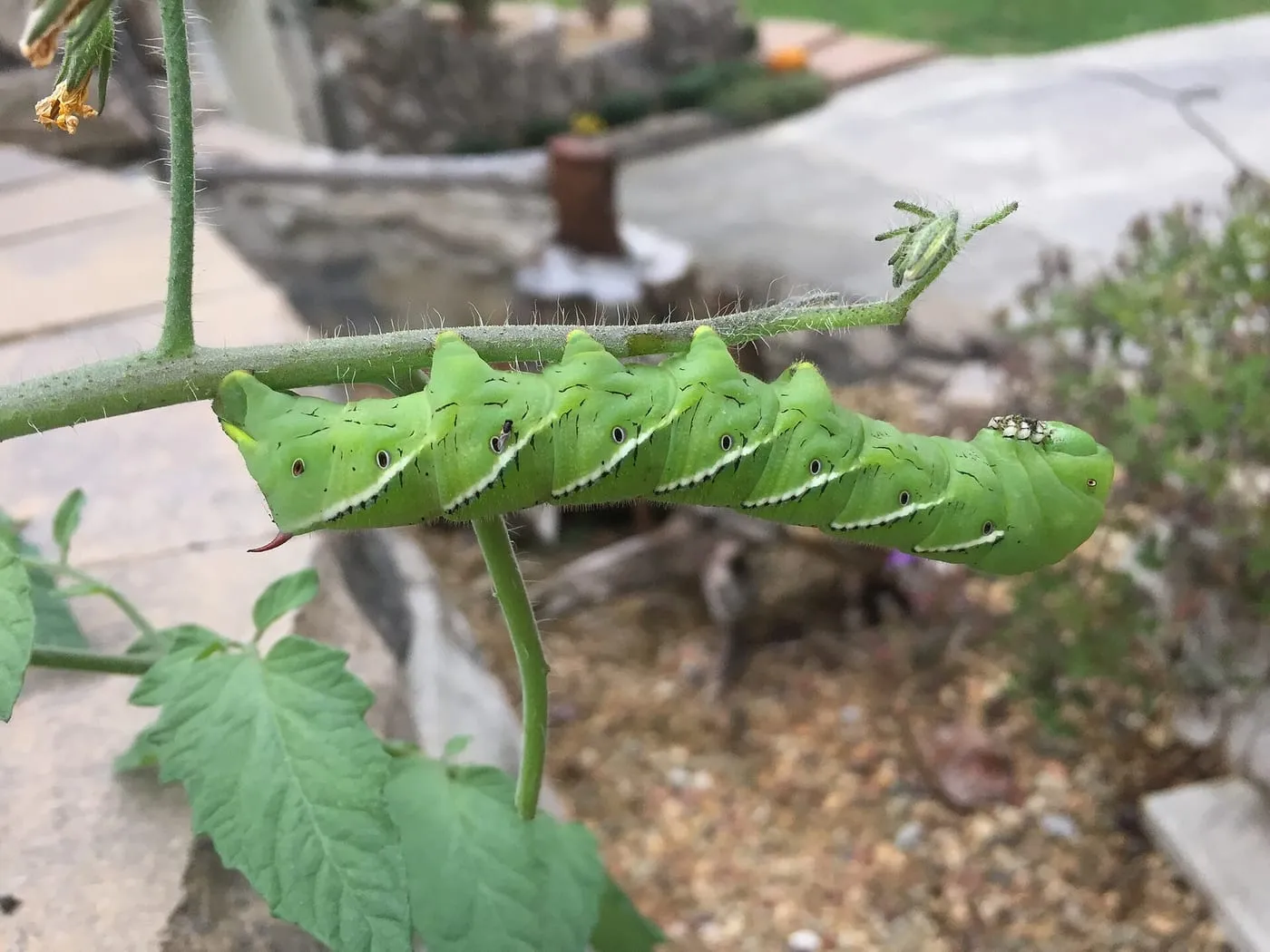
- Tomato hornworms — big green caterpillars with a horn on the tail end, on tomatoes
- Sawfly larvae — small green 'caterpillars' on roses; count the legs to confirm
- Inchworms — thin green loopers that arch their bodies as they move
- Future butterflies — some green caterpillars, like black swallowtails on parsley and dill, may be worth leaving
Not quite what you're seeing? Answer four quick questions and the clue finder will point you to a closer match.
Compare the possible causes
| Possible cause | Key signs | When it happens | How likely |
|---|---|---|---|
| Imported cabbage worms | Velvety, slightly fuzzy green caterpillars up to about an inch long, chewing ragged holes in brassica leaves and leaving green pellet droppings | Spring through fall, wherever small white butterflies are active | Very common |
| Tomato hornworms | A large green caterpillar — up to 4 inches — with white diagonal stripes and a flexible horn on the rear, stripping tomato leaves and leaving barrel-shaped droppings | Mid to late summer, on tomatoes, peppers, and eggplant | Common |
| Sawfly larvae (rose slugs and relatives) | Small green larvae on the undersides of rose leaves, skeletonizing them into windowpane patches; they have six or more pairs of stubby prolegs | Late spring and early summer, with some species active again in fall | Common |
| Inchworms (cankerworms and other loopers) | Slim green caterpillars that move by arching their body into a loop, often dangling from trees on silk threads in spring | Spring for tree-feeding cankerworms; summer for cabbage loopers in the garden | Common |
| Butterfly caterpillars worth keeping | Green caterpillars with bold black bands and yellow dots on parsley, dill, fennel, or carrot tops | Summer, often in small numbers on herbs | Less common |
Visual clues to check
- Start with the host plant: brassicas point to cabbage worms or loopers, tomatoes to hornworms, roses to sawfly larvae, parsley and dill to swallowtails
- Check the rear end: a single flexible horn means a hornworm
- Count the prolegs: five pairs or fewer is a true caterpillar; six or more pairs means sawfly larva, which changes your control options
- Watch how it moves: arching into a loop with each step identifies an inchworm or looper
- Follow the droppings: dark green-to-black pellets on leaves below the damage lead you straight up to the feeding caterpillar
- Inspect at dusk or with a UV flashlight at night — hornworms fluoresce and are far easier to find than in daylight
- Look for white rice-like cocoons on any hornworm before removing it; a parasitized one should stay on the plant
The causes in detail
Imported cabbage worms
If the plant being eaten is broccoli, cabbage, kale, cauliflower, or Brussels sprouts, this is the prime suspect. The adult is the white butterfly with black wing spots that flutters over gardens all season, laying single yellowish eggs that hatch into perfectly camouflaged larvae along the leaf midribs. They ruin the look of leafy greens quickly, but handpicking and lightweight row covers installed at planting time defeat them reliably.
Tomato hornworms
Hornworms are shockingly hard to spot for their size because they match tomato foliage exactly; most people find the bare stems and large dark droppings first. Follow the droppings upward and check stems at dusk, or scan with a UV flashlight at night — hornworms glow under blacklight. The horn looks menacing but is harmless. If you find one covered in white rice-like cocoons, leave it: parasitic wasps have already done your work for you.
Sawfly larvae (rose slugs and relatives)
The classic 'green caterpillar on my roses' usually isn't a caterpillar at all — it's the larva of a sawfly, a stingless wasp relative. Count the fleshy prolegs behind the true legs: butterfly and moth caterpillars have five pairs or fewer, sawfly larvae have six or more. The distinction matters because Bt, the go-to organic caterpillar control, does nothing to sawflies — but a hose spray and handpicking work fine, since dislodged larvae rarely climb back.
Inchworms (cankerworms and other loopers)
Inchworms have legs only at the front and rear, which creates the signature looping walk. Spring inchworms feeding on shade trees are mostly a nuisance — healthy trees releaf easily — while their garden cousin the cabbage looper chews big irregular holes in brassicas and lettuce alongside the cabbage worms. Treat garden loopers like cabbage worms: inspect, handpick, and cover young plantings.
Butterfly caterpillars worth keeping
That striped green caterpillar on your parsley is likely a black swallowtail in the making, and a handful of them won't destroy an established herb patch. Many gardeners plant extra dill and parsley specifically to share. Before killing any distinctive-looking green caterpillar, take a photo and check what it becomes — the difference between a pest moth and a swallowtail butterfly is worth thirty seconds of your time.
When to worry
- Seedlings or young transplants losing leaves fast — small plants can be killed in days, while mature ones usually shrug off the same feeding
- Broccoli or cabbage heads with caterpillars and droppings worked deep inside, not just outer-leaf holes
- Tomato plants losing entire stems of foliage overnight along with the fruit being gouged — multiple large hornworms at work
- Defoliation of a young tree by spring inchworms severe enough to leave it mostly bare
What to do now
- Handpick caterpillars into a bucket of soapy water in the morning or evening — for most home gardens this is genuinely the most effective control
- Check leaf undersides and stem interiors twice a week during the growing season; catching caterpillars small halves the damage
- Install floating row covers over brassicas at planting time so the white butterflies never reach the leaves to lay eggs
- Rinse sawfly larvae off rose leaves with a firm hose spray; they seldom make it back onto the plant
- Relocate swallowtail caterpillars to a spare parsley or dill plant instead of killing them
- Leave parasitized hornworms (the ones carrying white cocoons) in place to breed more beneficial wasps
- If caterpillars are overwhelming a large vegetable planting despite handpicking and covers, contact your county extension office for organic options suited to your region
What not to do
- Don't blanket-spray insecticide over the whole garden for a few caterpillars — you'll kill the wasps, ladybugs, and butterflies along with the pests
- Don't assume every green caterpillar is a pest; some are future swallowtails, and a parasitized hornworm is free pest control in progress
- Don't use Bt-based products on rose slugs expecting results — sawfly larvae aren't caterpillars, and it won't touch them
- Don't handle unfamiliar spiny or hairy caterpillars with bare hands — a few species have stinging spines
- Don't toss picked caterpillars over the fence; they'll walk back or someone else inherits them — soapy water settles it
Frequently asked questions
How do I find the caterpillar that's eating my plant when I can't see it?
Look down before you look up: caterpillar droppings — small dark pellets on lower leaves or the soil — sit directly below the feeding spot, so scan the stems above them. Check at dusk when many caterpillars feed openly, and for hornworms, sweep the plant with a UV flashlight after dark; they glow bright green under blacklight.
Why does it matter whether it's a caterpillar or a sawfly larva?
Because the most popular organic caterpillar treatment, Bt, only works on true moth and butterfly larvae — it does nothing to sawflies. Count the stubby prolegs along the body: five pairs or fewer means caterpillar, six or more means sawfly. For sawflies on roses, stick with hose sprays and handpicking.
Are green caterpillars dangerous to touch?
The common garden species — cabbage worms, hornworms, loopers, rose slugs — are harmless, though it's still smart to wash your hands afterward. The caution applies to unfamiliar caterpillars with spines, tufts, or hair: a handful of species sting on contact, so use gloves or a leaf when you're not sure what you're holding.
Should I kill every caterpillar I find?
No. Kill the confirmed crop-eaters — cabbage worms in your broccoli, healthy hornworms on your tomatoes — and spare the rest. Caterpillars on parsley and dill with black-and-yellow markings become swallowtail butterflies, and a hornworm covered in white cocoons is hosting beneficial wasps that will hunt other hornworms for you.
Do row covers really work against cabbage worms?
Very well, with one condition: they have to go on at planting time, before the white butterflies lay eggs on the leaves. Lightweight floating row cover lets in light, air, and rain while physically blocking egg-laying. Since brassicas don't need pollination to form heads, the cover can stay on for the whole crop.