Tiny Yellow Eggs Under Leaves: Pest or Friend?
Tiny yellow eggs on the underside of leaves usually belong to squash bugs, ladybugs, Colorado potato beetles, or whiteflies. Identify them before you do anything — ladybug eggs look almost identical to pest eggs, and crushing them destroys one of the best aphid killers in your garden.
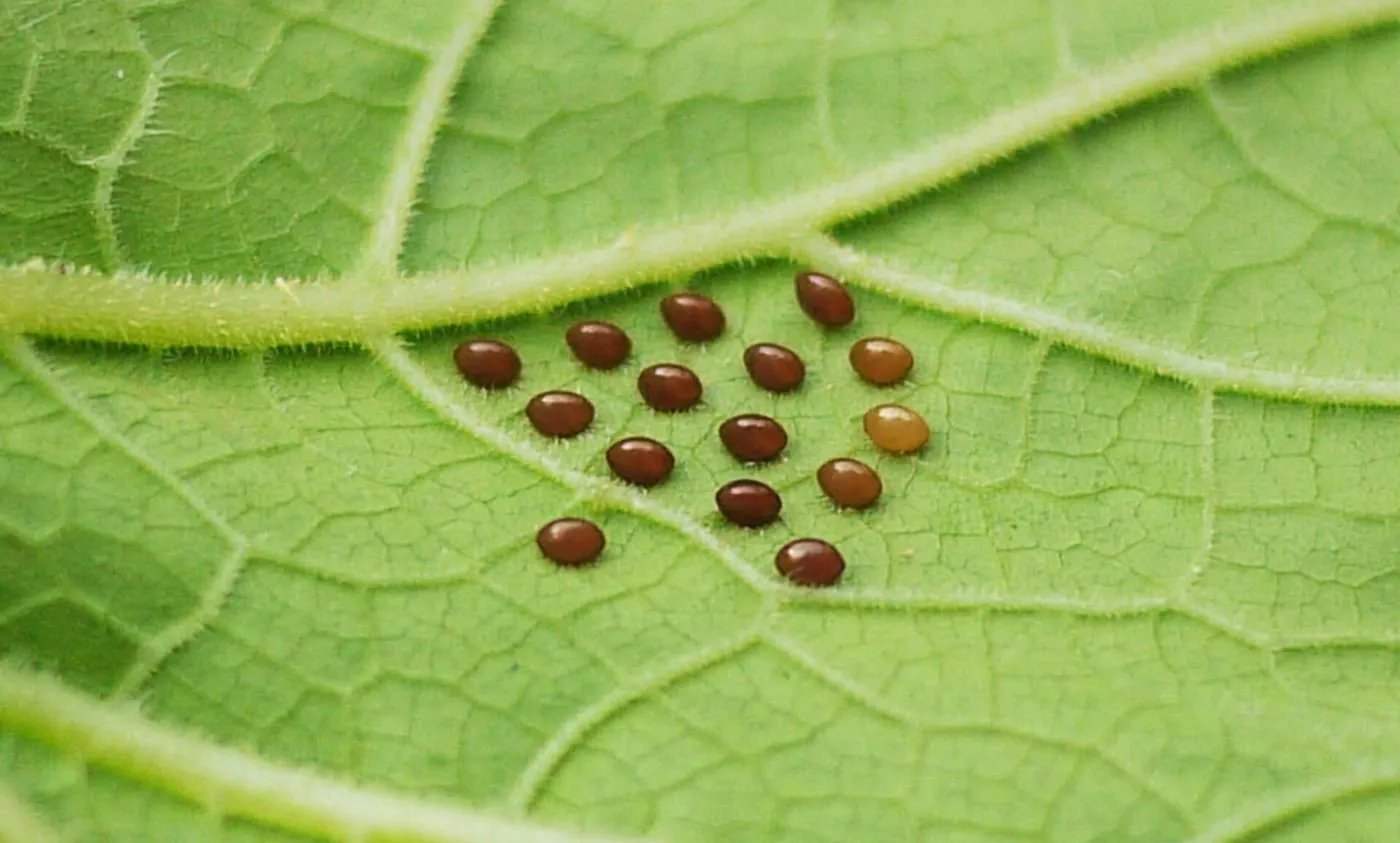
Most likely causes
- Squash bug eggs — shiny bronze-gold clusters in neat rows on squash and cucumber leaves
- Ladybug eggs — bright yellow ovals standing on end in tight clusters (beneficial — leave them)
- Colorado potato beetle eggs — orange-yellow clusters on potato, tomato, and eggplant leaves
- Whitefly eggs — tiny pale yellow specks scattered or laid in partial circles
Not quite what you're seeing? Answer four quick questions and the clue finder will point you to a closer match.
Compare the possible causes
| Possible cause | Key signs | When it happens | How likely |
|---|---|---|---|
| Squash bugs | Oval eggs with a metallic bronze-to-gold sheen, laid in orderly clusters of 10–20, often tucked into the V where leaf veins meet | Late spring through midsummer, on squash, zucchini, pumpkins, and cucumbers | Very common |
| Ladybug eggs (beneficial — do not destroy) | Bright yellow to yellow-orange, spindle-shaped eggs standing on end in tight clusters of 5–30, often near an aphid colony | Spring through summer, wherever aphids are feeding | Common |
| Colorado potato beetles | Orange-yellow oval eggs in clumps of 20–30 on the undersides of potato, tomato, eggplant, or pepper leaves | Late spring through summer, starting when potato plants are a few inches tall | Common |
| Whiteflies | Very small pale yellow specks scattered across the leaf underside, sometimes arranged in arcs or partial circles | Summer outdoors; year-round on houseplants and in greenhouses | Common |
| Cabbage white butterflies | Pale yellow, bullet-shaped eggs laid singly rather than in clusters, mostly on broccoli, cabbage, and kale | Spring through fall, whenever white butterflies are fluttering over the garden | Less common |
Visual clues to check
- Check the color closely: metallic bronze-gold points to squash bugs; bright glossy yellow standing on end points to ladybugs; deeper orange-yellow points to potato beetles
- Identify the host plant: squash and cucumbers suggest squash bugs; potatoes, tomatoes, and eggplant suggest Colorado potato beetles; brassicas suggest cabbage whites
- Look at the arrangement: neat evenly spaced rows are squash bugs; tight upright clusters are ladybugs; loose flat clumps are potato beetles; scattered specks or arcs are whiteflies
- Scan nearby leaves for aphids: eggs laid right beside an aphid colony are very likely ladybug eggs
- Give the plant a gentle shake: a puff of tiny white insects confirms whiteflies
- Photograph the cluster with something for scale — a coin or your fingertip — before deciding whether to remove it
The causes in detail
Squash bugs
Squash bug eggs start out yellowish and darken to a distinctive coppery bronze within a day or two — that metallic color is the giveaway. Females lay them in tidy, evenly spaced groups on leaf undersides, usually in the angle between two veins. They hatch in about 10 days into gray, spider-legged nymphs that swarm and weaken vine crops fast, so this is one egg cluster worth removing on sight.
Ladybug eggs (beneficial — do not destroy)
Ladybugs deliberately lay their eggs next to aphid infestations so the larvae hatch straight into a meal — a single larva can eat several hundred aphids before it pupates. The eggs are glossier and more upright than most pest eggs, like tiny yellow footballs balanced on their tips. If you find these near curled leaves or sticky residue, your garden's cleanup crew has already arrived; leave the cluster alone and skip spraying that plant.
Colorado potato beetles
Colorado potato beetle eggs are a deeper orange than ladybug eggs and are laid lying flatter, in looser, messier groups — and almost always on a nightshade-family plant. The humpbacked reddish larvae that hatch can strip potato foliage in days. The plant they're on is your best clue: eggs on squash point to squash bugs, eggs on potatoes point to this beetle.
Whiteflies
Whitefly eggs are much smaller than squash bug or beetle eggs — closer to dust than to distinct ovals — and females often lay them in a curved pattern as they pivot in place. The confirming test is easy: brush the plant, and if a cloud of tiny white insects flutters up, whiteflies are your culprit. They weaken plants by sucking sap and leaving sticky honeydew behind.
Cabbage white butterflies
If the yellow eggs are scattered one at a time instead of grouped, and they're on a brassica, they're likely from the small white butterflies you see bobbing over the garden. Each egg hatches into a velvety green cabbage worm that chews ragged holes in the leaves. Because the eggs are laid singly, checking leaf undersides once or twice a week and wiping them off keeps the damage manageable.
When to worry
- Multiple egg clusters on most of your squash or potato plants — hatch is days away and young plants can be overwhelmed
- Wilting squash vines alongside bronze egg clusters — adult squash bugs are already feeding
- Sticky leaves, sooty black film, and clouds of whiteflies — a large infestation that spreads to neighboring plants
- Skeletonized or stripped potato foliage near orange eggs — Colorado potato beetle larvae are active
What to do now
- Identify before acting: compare color, arrangement, and host plant, and confirm with a photo search if unsure
- Leave ladybug eggs completely alone and avoid spraying anything — including soaps and oils — on that plant
- Scrape confirmed squash bug or potato beetle eggs into a container of soapy water, or press a strip of duct tape over the cluster and peel it off
- Check leaf undersides every few days during late spring and summer; egg patrol twice a week prevents most infestations
- For whiteflies, start with a firm spray of water to the leaf undersides, then insecticidal soap if they persist
- If vine crops are collapsing or beetles keep returning in large numbers, ask your county extension office for region-specific guidance
What not to do
- Don't crush every yellow egg cluster on sight — you may be killing ladybugs that would control your aphids for free
- Don't blanket the garden with broad-spectrum insecticide over a few egg clusters; it kills the beneficials along with the pests
- Don't ignore bronze eggs on squash plants — squash bugs are far easier to stop at the egg stage than after they hatch
- Don't spray anything on a plant where ladybug eggs or larvae are present
Frequently asked questions
How do I tell ladybug eggs from pest eggs?
Ladybug eggs are bright glossy yellow, spindle-shaped, and stand upright on their ends in tight clusters, usually near aphids. Squash bug eggs turn metallic bronze and sit in neat rows on vine crops, while Colorado potato beetle eggs are a deeper orange and lie flatter on nightshade plants. Location is the fastest clue: eggs beside an aphid colony are almost certainly ladybugs.
Should I remove yellow eggs from my plant leaves?
Only after you've identified them. Squash bug, potato beetle, whitefly, and cabbage white eggs are worth removing; ladybug eggs should be left alone because the larvae eat huge numbers of aphids. When in doubt, wait a day and take a clear photo — pest eggs won't hatch overnight, and a correct ID beats a fast one.
How long until the eggs hatch?
Most of these hatch quickly in warm weather: squash bug eggs in roughly 7–10 days, Colorado potato beetle eggs in 4–10 days, and ladybug eggs in about 3–5 days. That gives you a few days to identify a cluster, but not weeks — check the garden again within the week.
Why are the eggs always on the underside of the leaf?
The underside shelters eggs from rain, direct sun, and most predators, so nearly all garden insects lay there. That's also why infestations sneak up on people — the tops of the leaves look fine until hatching is done. Flipping leaves over once or twice a week is the single best early-warning habit in a vegetable garden.