Brown Egg Sacs on Branches: Mantis, Lanternfly, or Moth?
A brown egg case on a branch is either very good news or very bad news: praying mantis egg cases (oothecae) are beneficial and should be left alone, while spotted lanternfly and spongy moth egg masses are invasive pests you should destroy — and in many states, report. Texture and shape tell them apart, so identify before you scrape.
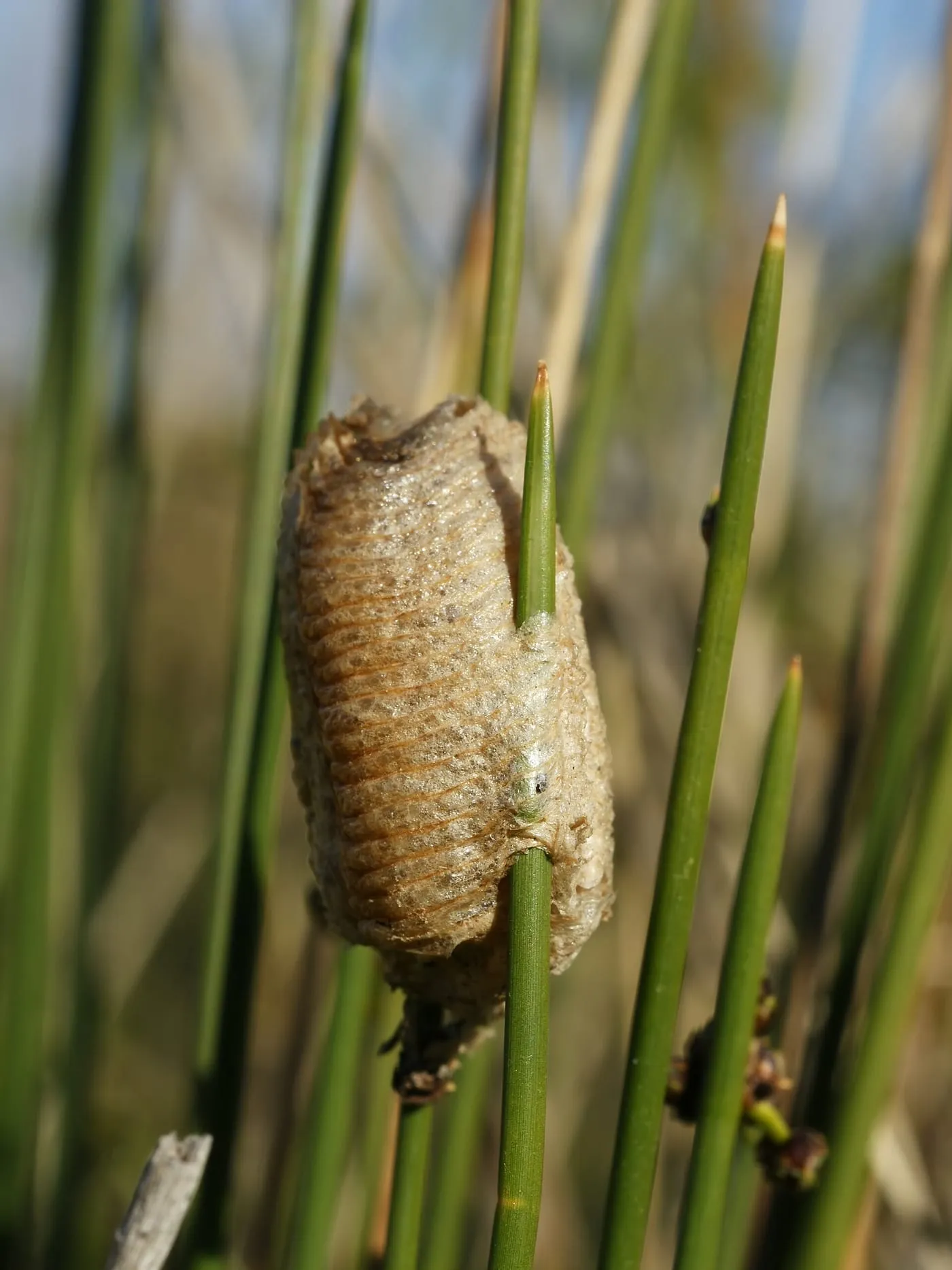
Most likely causes
- Praying mantis ootheca — a hard, ridged, foam-like tan case wrapped around a twig (beneficial — leave it)
- Spotted lanternfly egg mass — a flat, gray-brown mud-like smear on smooth bark (invasive — destroy and report)
- Spongy moth (formerly gypsy moth) egg mass — a fuzzy tan patch the size of a quarter to a half-dollar (invasive — destroy)
- Spider egg sac — a small silk ball or teardrop tucked under bark or in branch angles (harmless)
Not quite what you're seeing? Answer four quick questions and the clue finder will point you to a closer match.
Compare the possible causes
| Possible cause | Key signs | When it happens | How likely |
|---|---|---|---|
| Praying mantis ootheca (beneficial — leave alone) | A tan-to-brown case about 1–2 inches long with a hardened foam texture and visible ridges, molded around a twig, stem, or fence wire | Laid in fall, visible all winter on bare branches; nymphs emerge in late spring | Common |
| Spotted lanternfly egg mass (invasive — destroy and report) | A flat, 1–1.5 inch patch that looks like smeared gray-brown mud or putty on bark, stone, patio furniture, or vehicles; older masses crack into rows of seed-like eggs | Laid September through December; present all winter until hatch in late spring | Common |
| Spongy moth egg mass (invasive — destroy) | A fuzzy, felt-like tan-to-buff patch, roughly quarter- to half-dollar-sized, on trunks, branch undersides, firewood, or outdoor gear | Laid mid to late summer; visible through winter until spring hatch | Less common |
| Spider egg sacs | A small ball, disc, or teardrop of white-to-brown silk, often tucked under loose bark, in branch angles, or under eaves | Late summer and fall; many overwinter and hatch in spring | Common |
Visual clues to check
- Feel the texture (with a glove): rigid ridged foam is a mantis; smooth dried mud or putty is a lanternfly; soft felt or suede is a spongy moth; fibrous silk is a spider
- Check how it attaches: wrapped around a twig like set foam points to mantis; lying flat against smooth bark or hard surfaces points to lanternfly
- Measure it: mantis cases run 1–2 inches long and chunky; lanternfly masses are about an inch and flat; spongy moth masses are a fuzzy quarter-to-half-dollar patch
- Look beyond the tree: egg masses on patio furniture, grills, stone, and vehicles are far more likely to be lanternfly than anything else
- Check an old, weathered mass: lanternfly coatings crack to reveal neat vertical rows of seed-like eggs
- Note your state: spotted lanternfly and spongy moth have known ranges — a quick search of your state agriculture site tells you whether they're established near you
The causes in detail
Praying mantis ootheca (beneficial — leave alone)
A mantis ootheca looks like a blob of expanding spray foam that set around the twig — rigid, ridged, and papery-crisp. Inside are dozens to a couple hundred mantis eggs that hatch into pinhead predators come late spring, and mantises eat a broad menu of garden insects. This is the one brown egg case on this list you should protect. If a branch bearing one must be pruned, clip the section and tie it into a shrub elsewhere in the yard, a few feet off the ground.
Spotted lanternfly egg mass (invasive — destroy and report)
Spotted lanternfly is an invasive planthopper spreading through the eastern and midwestern US, and each mud-like mass hides 30–50 eggs under its putty coating. Unlike a mantis case, it lies flat against the surface rather than wrapping a twig, and it turns up on far more than trees — check grills, planters, firewood, and car wheel wells. If you're in or near a known infestation state, scrape the mass into a bag or jar of rubbing alcohol or hand sanitizer, and report the find to your state agriculture department.
Spongy moth egg mass (invasive — destroy)
Spongy moth egg masses are covered in tan hairs from the female's body, giving them a suede or felt texture that neither mantis cases nor lanternfly masses have. Each mass can hold several hundred eggs, and the caterpillars that hatch are among the worst defoliators of oaks and other hardwoods in the eastern US. Scrape masses into soapy water or alcohol — never just onto the ground, where the eggs can still hatch — and check firewood and camping gear before moving them, which is how this pest spreads.
Spider egg sacs
Spider egg sacs are wrapped in silk rather than foam, mud, or felt — look closely and you'll see the fibrous, cottony wrapping. The spiderlings that emerge disperse quickly and get to work eating small insects, so sacs on trees and fences are best ignored. There's no need to identify the spider species to make this call; on an outdoor branch, a silk sac is simply next year's pest control.
When to worry
- Mud-like masses on multiple trees, vehicles, or outdoor gear in or near a spotted lanternfly quarantine state — report it before hatch
- Numerous fuzzy tan masses on oaks — a heavy spongy moth year can defoliate whole trees, and the count of masses in winter predicts it
- Egg masses on firewood or an RV you're about to move — transporting them starts new infestations and violates quarantine rules in some states
- Sticky sap flow, wasp activity, and black sooty mold on a tree that had lanternfly masses — signs adults fed heavily there last season
What to do now
- Identify first — texture and attachment separate the beneficial mantis case from the invasive masses in seconds
- Leave mantis oothecae and spider sacs alone; if a mantis case is somewhere inconvenient, move the whole twig to a shrub instead of scraping the case off
- Scrape confirmed lanternfly masses off with a plastic card or putty knife, catching them in a bag or jar of rubbing alcohol or hand sanitizer — smashing alone can miss protected eggs
- Scrape spongy moth masses into soapy water or alcohol wearing gloves, and check trunks, branch undersides, firewood, and outdoor equipment for more
- Report suspected spotted lanternfly finds to your state department of agriculture, especially outside known infestation counties — photos with location help
- Do a winter walk-through of your trees, fence lines, and stored gear; egg masses are easiest to spot and destroy on bare branches
- For a large tree covered in invasive masses, or any infestation you can't reach, contact a certified arborist or your state extension service
What not to do
- Don't scrape or destroy an egg case before identifying it — the ridged foam one wrapped around a twig is a praying mantis, the good guy on this list
- Don't scrape invasive masses onto the ground and walk away; unprotected eggs can still hatch — get them into alcohol or soapy water
- Don't handle spongy moth masses bare-handed; the hairs on the mass can irritate skin
- Don't move firewood, grills, or outdoor furniture out of a lanternfly or spongy moth area without checking them for egg masses first
- Don't burn egg masses off branches — fire wounds the tree and creates a fire hazard for nothing a plastic scraper can't do
Frequently asked questions
How can I tell a praying mantis egg case from a spotted lanternfly egg mass?
A mantis ootheca is three-dimensional — a ridged, hardened foam blob 1–2 inches long that wraps around a twig or stem. A lanternfly mass is flat, smooth, and mud-colored, smeared against bark or a hard surface like dried putty. If it looks like set spray foam gripping a twig, protect it; if it looks like a mud smear on a flat surface, destroy it.
What do I do if I find spotted lanternfly eggs in my yard?
Scrape the mass off with a plastic card or putty knife directly into a bag or container of rubbing alcohol or hand sanitizer, which kills the eggs. Then check nearby trees, stone, furniture, grills, and vehicles, since females lay on almost any surface. Report the find to your state department of agriculture — many affected states have simple online reporting forms.
Should I buy or relocate praying mantis egg cases for pest control?
If you find an ootheca on your own property, protecting it costs nothing and adds a generalist predator to the yard. Store-bought cases are usually a non-native mantis species, and mantises eat beneficial insects along with pests — so most experts suggest protecting the wild cases you find rather than importing more.
When do these egg cases hatch?
All three of the big ones overwinter and hatch in spring: mantis nymphs emerge in late spring once temperatures warm, spotted lanternfly eggs hatch from roughly late April into June depending on region, and spongy moth caterpillars appear as oaks leaf out. That's why winter and early spring are the ideal window to scout branches and destroy invasive masses.