Shelf Fungus on a Tree Trunk: A Sign of Decay Inside the Tree
A shelf or bracket fungus growing from a living tree's trunk is a red flag: it means the fungus has been decaying wood inside the tree, often for years, before producing that visible 'conk.' The tree may still look healthy, but internal decay weakens its structure — so the right move is an assessment by an ISA-certified arborist, not knocking the fungus off.
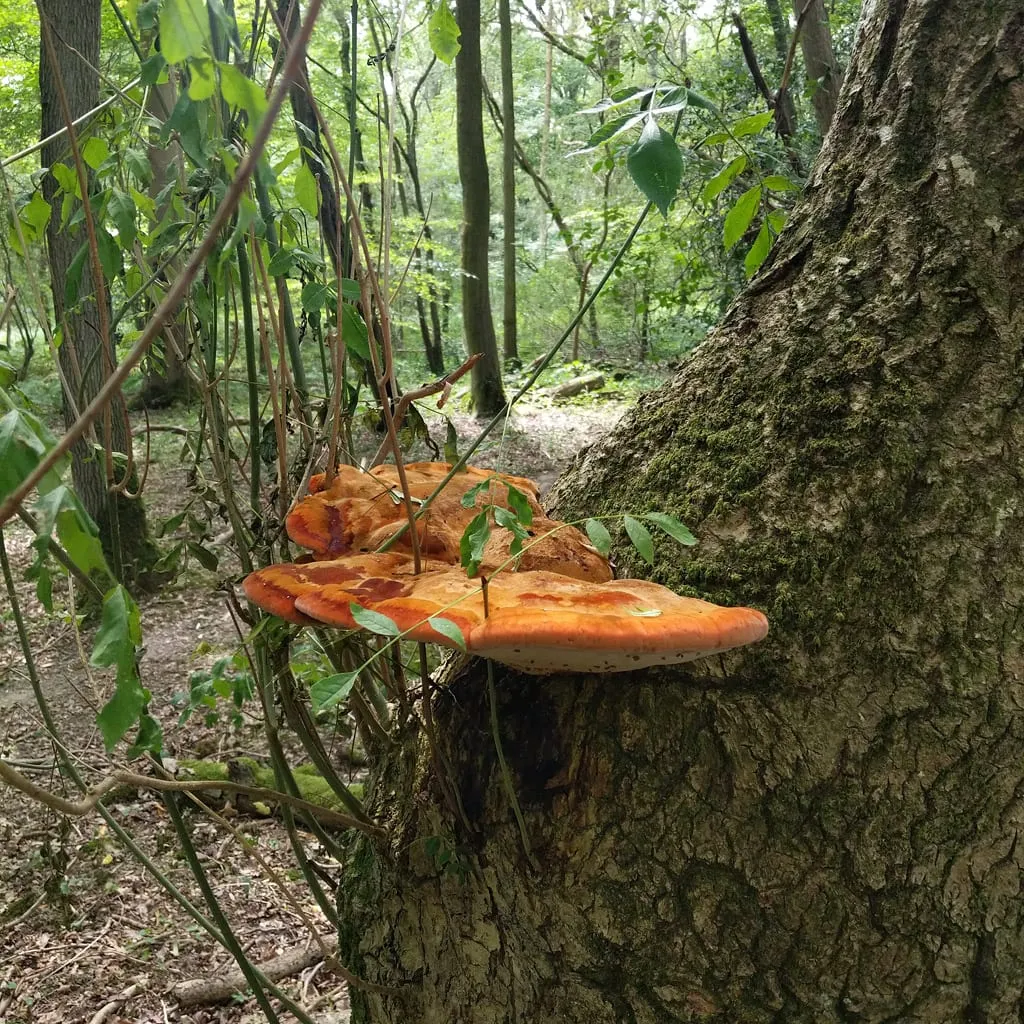
Most likely causes
- Bracket fungus on a living trunk — internal heartwood or sapwood decay already underway
- Conks at the base or on root flares — root or butt rot, the most serious structural concern
- Shelves on a dead stub, old wound, or pruning cut — decay localized around the injury
- Fungus on a stump or long-dead tree — normal decomposition, not a hazard sign
Not quite what you're seeing? Answer four quick questions and the clue finder will point you to a closer match.
Compare the possible causes
| Possible cause | Key signs | When it happens | How likely |
|---|---|---|---|
| Bracket fungus on the trunk of a living tree | One or more hard, hoof- or shelf-shaped growths jutting from the bark — woody brown, gray, or varnished reddish on top, often pale underneath | Conks persist year-round and add growth layers each season; new ones often appear in late summer and fall | Common |
| Conks at the base of the tree or on root flares | Shelves or large fleshy brackets emerging at the soil line, between root flares, or from the lower few feet of trunk | Most conspicuous late summer through fall; some rot the roots for years before fruiting | Common |
| Shelves on wounds, pruning cuts, and dead limbs | Brackets clustered on an old lightning scar, storm-torn stub, flush-cut pruning wound, or a single dead branch, while the rest of the tree looks vigorous | Years after the original injury, whenever moisture allows fruiting | Common |
| Fungus on stumps and long-dead wood | Ranks of thin, colorful shelves — like the banded 'turkey tail' — covering a stump, downed log, or a tree that's clearly been dead a while | Year-round, flushing after wet weather | Very common |
Visual clues to check
- Note the position: conks at the base or on roots are the most serious; mid-trunk is serious; a single dead stub is more contained; a stump is no concern
- Check whether the host is alive: leaves and intact bark mean an active decay problem; long-dead wood means normal decomposition
- Count and track the conks: photograph them with a tape measure and compare over months — more or bigger conks means advancing decay
- Look for companion clues: cavities, oozing seams, carpenter ants, woodpecker work, or a hollow sound when the trunk is tapped
- Scan the canopy: thinning top growth, dead limbs, and undersized leaves on the same side as the conks suggest the decay is winning
- Map the fall zone: note what the tree could hit — house, cars, sidewalk, play set — because that drives how urgent an assessment is
The causes in detail
Bracket fungus on the trunk of a living tree
A conk is the fruiting body of a wood-decay fungus, and it only forms after the fungus has built up substantial mass inside the tree — meaning decay is established, not beginning, by the time you see it. Depending on the species, the fungus may be hollowing the heartwood or degrading the living sapwood. Trees compartmentalize decay and can coexist with it for years, but a trunk that's part cavity holds up worse in wind and ice. The number, size, and vertical spread of conks give an arborist real information about how far the column of decay runs.
Conks at the base of the tree or on root flares
Location matters enormously with bracket fungi, and the base of the tree is the worst place to find one. Fungi fruiting at the root collar or on surface roots often indicate root or butt rot — decay in exactly the wood that anchors the tree and carries its entire load. Trees with advanced root rot can fail whole, at the ground, sometimes with little warning and a full green canopy. Any conk within a few feet of the soil line on a tree that could reach a house, driveway, play area, or street deserves a professional evaluation promptly.
Shelves on wounds, pruning cuts, and dead limbs
Decay fungi usually enter through wounds — storm breaks, bad pruning cuts, mower and string-trimmer damage at the base. When shelves grow only on one dead stub or scar, the decay may still be reasonably contained to that area, which is a better situation than conks emerging from intact bark. It still warrants a look: a decayed limb over a patio is its own falling hazard, and an arborist can judge whether the compartmentalization is holding or the rot is advancing into the main stem.
Fungus on stumps and long-dead wood
On already-dead wood, shelf fungi are simply the cleanup crew doing what forests need done, and there's no tree health question left to ask. A stump wearing turkey tail is decomposing on schedule. The only caution is the standing one: however recognizable a species may seem, edibility calls on wild fungi belong to experts, and nothing from the yard should be eaten. If the dead tree itself is still standing, its increasing brittleness — not the fungus — is the hazard to plan around.
When to worry
- Any conk growing at the base, on root flares, or from intact bark of a living tree that could strike a structure, driveway, or play area
- Multiple conks spread vertically along the trunk — evidence of a long internal column of decay
- The tree also shows lean, heaving soil at the base, cracked bark seams, or major deadwood in the crown
- A large limb with shelves on it hangs over a spot where people sit, park, or walk
- Mushrooms or conks appear at the base of several mature trees after construction, grading, or trenching disturbed their roots
What to do now
- Photograph the conks, their height on the trunk, and the whole tree, and note when each growth appeared
- Book an assessment with an ISA-certified arborist — find one through the Trees Are Good directory — and mention conk location, since base-of-trunk fungi deserve priority
- Keep people, cars, and play equipment out of the likely fall zone until the tree has been evaluated, especially before storms
- Ask the arborist about resistance drilling or sonic tomography if the extent of internal decay is unclear — these tools measure how much sound wood remains
- Follow through on the recommendation, whether it's monitoring on a schedule, cabling, pruning weight out of the crown, or removal
- Protect your remaining trees from the next infection: avoid wounding trunks with mowers and trimmers, prune correctly outside the branch collar, and don't pile mulch against bark
What not to do
- Don't knock, cut, or pry the conks off — the fungus inside the tree is unaffected, you lose the evidence an arborist reads, and the decay continues invisibly
- Don't drill, inject, or spray a decayed tree with fungicides; no product cures established internal wood decay
- Don't seal cavities or wounds with paint, tar, or cement — modern arboriculture abandoned this decades ago because it traps moisture and can worsen decay
- Don't harvest shelf fungi for the table or for tea because an app or forum picture matched — lookalikes and contamination make this an experts-only call
- Don't climb the tree or hang swings, hammocks, or ladders on a trunk or limb showing conks
- Don't assume a full green canopy means the tree is sound — trees with hollow trunks and rotted roots can look lush right up to failure
Frequently asked questions
Does shelf fungus mean my tree is dying?
It means part of the wood inside is decaying — which is not the same as dying, but is never meaningless on a living tree. Trees wall off decay and can live with internal rot for many years; the real question is structural: how much sound wood remains, and what would the tree hit if it failed. That's exactly what an arborist's assessment answers, sometimes with instruments that measure the decay from outside.
Should I remove the fungus from the tree trunk?
No. The shelf is only the fruiting body — the actual fungus is a network threaded through the wood inside, and removing the conk doesn't slow it at all. Worse, you'd be destroying the most useful diagnostic evidence: the species, size, location, and growth rate of conks tell an arborist a great deal about what's happening internally. Leave them, photograph them, and get the tree assessed.
How long can a tree live with bracket fungus on it?
Anywhere from a few years to several decades, depending on the fungus species, the tree species, where the decay sits, and how vigorous the tree is. Decay confined to heartwood in a healthy, low-target tree may be monitored for a long time; root and butt rots at the base of a large tree near a house are a much shorter conversation. This variability is why the answer comes from an on-site professional, not a rule of thumb.
Who do I call about a tree with fungus on it — and what does an assessment cost?
Look for an ISA-certified arborist (the International Society of Arboriculture runs a searchable directory at treesaregood.org) rather than a general landscaper or the cheapest tree-cutting crew. Many arborists do a basic risk assessment for a modest fee or free with an estimate; advanced testing like resistance drilling costs more. For a tree standing over your house, it's some of the best money in homeownership.