Mushroom Rings in Grass: What a Fairy Ring Is Telling You
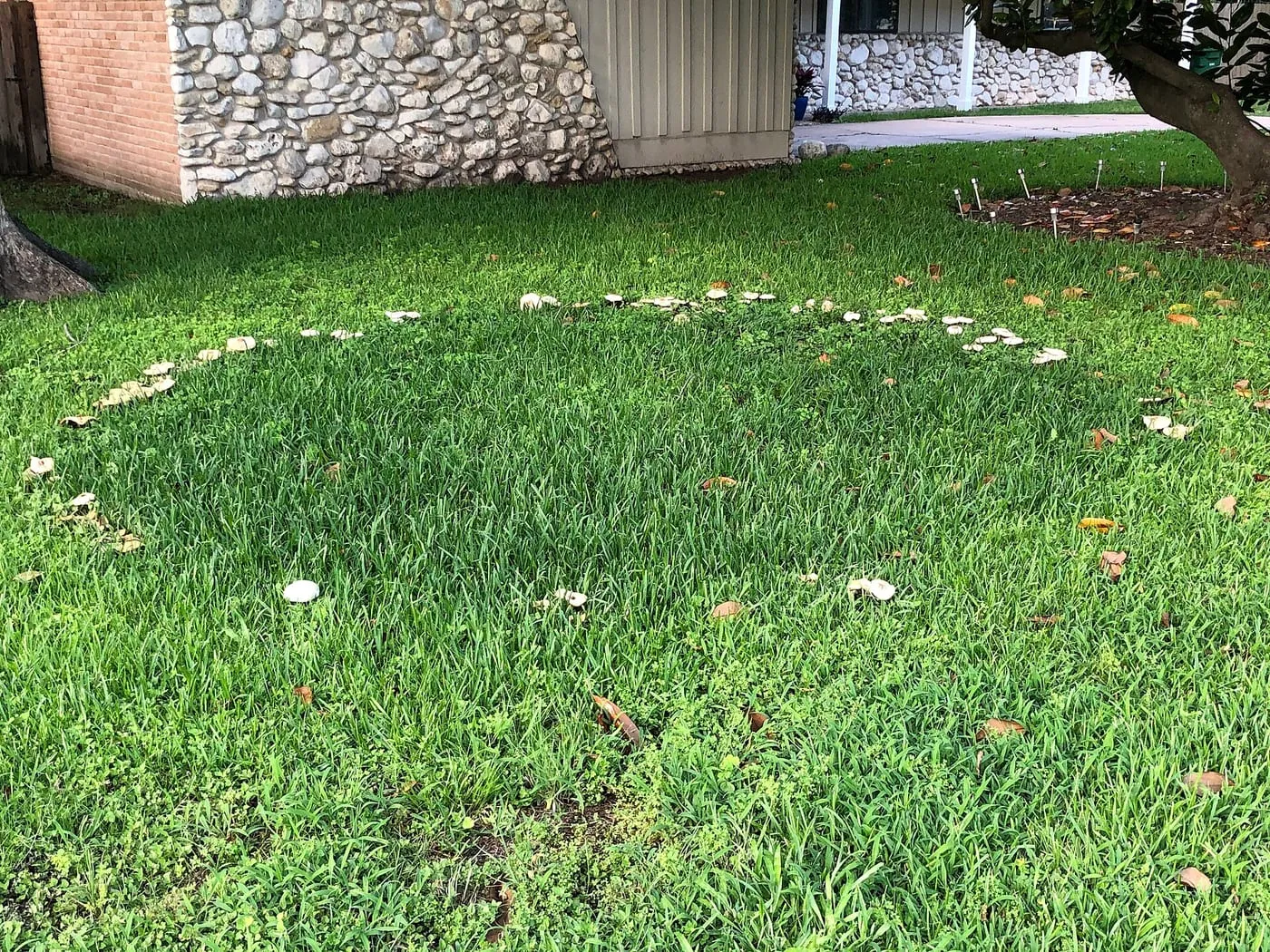
A circle or arc of mushrooms in your grass is a fairy ring: a single underground fungus colony that started at one point and has been expanding outward ever since, fruiting mushrooms at its edge after rain. Fairy rings are mostly cosmetic and notoriously hard to eliminate — for the vast majority of lawns, the right plan is managing the look and removing the mushrooms, not fighting the fungus.
Most likely causes
- Type with mushrooms only — a curved line of mushrooms after rain, grass otherwise normal
- Type with a lush ring — dark green arc of faster-growing grass, with or without mushrooms
- Type with a dead zone — a brown band of dry, water-repellent turf along the ring
- Buried organic matter — an old stump or roots that gave the fungus its starting point
Not quite what you're seeing? Answer four quick questions and the clue finder will point you to a closer match.
Compare the possible causes
| Possible cause | Key signs | When it happens | How likely |
|---|---|---|---|
| Mushroom-only fairy ring (Type 3) | Mushrooms or puffballs appear in a clean arc or circle after wet weather, while the grass along the ring looks the same as the rest of the lawn | After soaking rains, most often late summer through fall | Common |
| Lush green fairy ring (Type 2) | A band of noticeably darker, faster-growing grass in an arc or circle, often with mushrooms popping along the same line after rain | Visible spring through fall, widening slightly every year | Common |
| Dead-zone fairy ring (Type 1) | A band of brown, dying, or bare turf along the ring, with soil beneath it so dry that water beads and runs off instead of soaking in | Worst in summer heat and drought; the dry band persists until broken up | Less common |
| The buried food source that started it | The ring is centered on the site of a removed tree, old stump, or construction debris — sometimes decades after the fact | The ring persists and expands for years, sometimes 10 or more | Common |
Visual clues to check
- Connect the mushrooms: if they trace a curve or circle rather than random scatter, you're looking at a fairy ring
- Measure it year over year: fairy rings expand a few inches to a couple of feet per season — a circle that grows is fungal
- Check the grass along the ring: normal grass means Type 3, extra-green means Type 2, a brown dry band means Type 1
- Water a dead band and watch: if water beads and runs off, the soil below has gone hydrophobic — the Type 1 signature
- Dig a small plug at the ring's edge: white cottony threads and a mushroomy smell in the soil confirm the fungal mat
- Think back on the site: a tree removed years ago near the ring's center is the classic origin
The causes in detail
Mushroom-only fairy ring (Type 3)
The mildest version: the fungal colony is present underground, but its only visible sign is a curved crop of mushrooms when moisture triggers fruiting. Turf specialists call this a Type 3 ring. The circle can be a couple of feet across on a young colony or dozens of feet on one that's been expanding for decades. Between fruitings, you'd never know it was there. The only management most households need is removing the mushrooms when kids or pets use the lawn.
Lush green fairy ring (Type 2)
As the fungal mat digests organic matter at its expanding edge, it releases nitrogen — effectively fertilizing a ring of your lawn from below. That's the Type 2 ring: a green stripe that mows faster and stands out most when the surrounding lawn is underfed or drought-stressed. It's harmless, and the usual camouflage is feeding the whole lawn evenly so the ring stops being the greenest grass in view. This is the same phenomenon covered in our dark green circles guide.
Dead-zone fairy ring (Type 1)
The troublemaker of the three. In a Type 1 ring, the fungal mycelium grows so dense in the soil that it becomes hydrophobic — a waxy, water-repelling layer that starves the grass above it of moisture no matter how much you irrigate. Dig a small plug in the brown band and you'll often find white, mold-like threads and a musty smell in bone-dry soil. Management means physically breaking that layer: repeated core aeration or deep forking along the band, then slow, repeated soakings so water finally penetrates.
The buried food source that started it
Fairy ring fungi usually get their start on a big underground meal: stump grindings, dead roots, or buried lumber. From that point, the colony eats outward in every direction, abandoning the exhausted center — which is why you get a ring rather than a patch, and why the middle of the circle often looks perfectly normal. Knowing the origin story explains the ring's location, but digging out the starting material rarely stops an established colony, since the active fungus is now out at the edge.
When to worry
- A brown, dying band is widening — Type 1 rings gradually kill more turf each season until the water-repellent layer is broken up
- Mushrooms keep appearing where small children or pets play unsupervised — remove each flush promptly
- Anyone may have eaten a mushroom from the ring — call Poison Control or your vet immediately, whatever the mushroom looked like
- Multiple rings are merging across the lawn, which can produce large irregular bands of stressed turf that are easier to manage early
What to do now
- Identify which type you have — mushroom-only and green rings need almost nothing, while dead-zone rings need real work
- Remove mushrooms with gloved hands or a mower whenever they flush, especially before letting pets and kids out after rain
- Fertilize the entire lawn lightly and evenly so a green ring blends in instead of standing out
- For a dead-zone ring, core-aerate or deep-fork the brown band repeatedly and water it slowly and often until moisture penetrates again
- Overseed the recovered band in early fall to close the turf back up
- Accept the ring as a long-term tenant: most fairy rings outlast every cheap attempt to kill them, and many fade away on their own after some years
- If a ring is destroying high-value turf and you want to escalate, get a turf professional or extension office involved — the aggressive options (deep fumigation or full excavation and soil replacement) are not DIY projects
What not to do
- Never eat mushrooms from a fairy ring — 'growing in a neat circle' says nothing about safety, and dangerous species form rings too
- Don't drench the ring with lawn fungicide; homeowner products don't penetrate deep enough to kill the colony and the label doesn't cover wishful thinking
- Don't just dig out the visible mushrooms expecting the ring to die — they're the fruit, and the organism is a huge underground network
- Don't over-fertilize only the pale grass around a green ring; you'll create patchwork instead of camouflage
- Don't ignore a spreading dead band because the rest of the ring is 'just cosmetic' — Type 1 damage compounds every dry summer
Frequently asked questions
Why do mushrooms grow in a perfect circle?
Because the fungus started at a single point — often a buried stump or root — and has grown outward evenly in all directions ever since, like a ripple in a pond. The old center runs out of food, so the living, fruiting part of the colony is always the expanding outer edge. Mushrooms pop up along that edge, drawing the circle you see.
How do I get rid of a fairy ring in my lawn?
Mostly, you don't — you manage it. The colony can extend several feet deep and wide, beyond the reach of homeowner fungicides, and truly killing it means fumigation or excavating and replacing the soil, which is rarely worth it for a lawn. The practical playbook: remove mushrooms as they appear, fertilize evenly to hide green rings, and aerate and soak dead bands. Many rings eventually decline on their own.
Are fairy rings harmful to the lawn, or to kids and pets?
The ring itself harms nothing but appearances in most cases — only the dead-zone type actually kills turf, by making the soil water-repellent. The safety issue is the mushrooms: some ring-forming species are toxic, so children and pets shouldn't have access to them. Clear each flush and the ring is just a quirk of the lawn.
How big and how old can a fairy ring get?
Rings grow from a foot or two across to dozens of feet over time, expanding up to a couple of feet per year in good conditions. A large ring can be decades old — some documented rings in old pastures are centuries old and hundreds of feet across. In a typical yard, expect yours to have started around the time a tree or its roots died there.