Slime Mold in Mulch: The Gross-Looking Blob That's Harmless
A foamy yellow, tan, or orange blob spreading across your mulch is almost certainly a slime mold — most often the species nicknamed 'dog vomit slime mold.' Despite the revolting look, it's completely harmless to plants, pets, and people, it usually rides in on fresh hardwood mulch, and it needs no treatment: rake it out, hose it apart, or just let it dry up on its own.
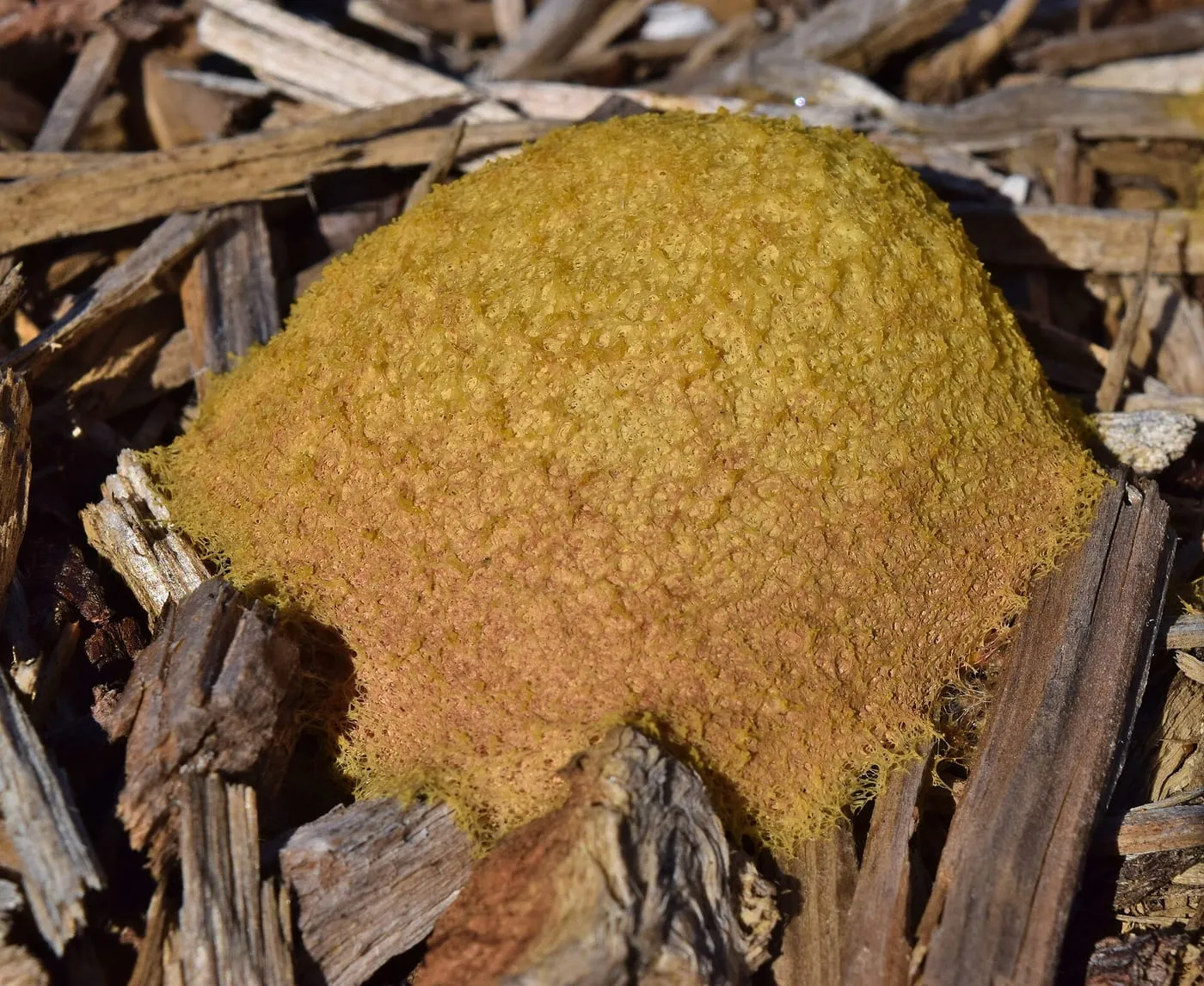
Most likely causes
- Dog vomit slime mold — bright yellow foamy patch that fades to tan, then dusty brown
- Other slime mold species — gray, white, or purplish crusts and blobs on damp mulch
- Fresh hardwood mulch plus warm rain — the standard recipe that triggers a bloom
Not quite what you're seeing? Answer four quick questions and the clue finder will point you to a closer match.
Compare the possible causes
| Possible cause | Key signs | When it happens | How likely |
|---|---|---|---|
| Dog vomit slime mold (Fuligo septica) | A frothy, scrambled-egg-like patch from a few inches to over a foot across — vivid yellow when fresh, dulling to tan and finally a crusty brown powder | Late spring through summer, typically two or three days after warm rain on mulch under a year old | Very common |
| Other slime mold species | Grayish, white, pinkish, or purple-brown blobs, crusts, or tiny clustered balls creeping over mulch, and occasionally up the base of a plant stem | Any warm, humid stretch from spring through fall | Common |
| Fresh hardwood mulch in warm, wet weather | Blooms appear in the first season after new mulch goes down, especially in beds that stay damp or get overhead watering | The first spring and summer after mulching, after rain or heavy irrigation | Very common |
Visual clues to check
- Check the texture: fresh dog vomit slime mold looks like foamy scrambled eggs and feels moist; old material is a dry, dusty brown crust
- Mark its position with a pebble and look the next morning — a blob that moved or changed shape is a slime mold, full stop
- Poke the dried crust with a stick: a puff of brown, smoke-like spore dust confirms the identification
- Look at what it's sitting on: slime molds sit on top of mulch, stems, or even garden hoses — they don't grow out of plants the way fungus grows out of wood
- Consider the calendar: mulch laid this year plus a warm rain two or three days ago is the classic setup
- Scan the rest of the bed: several small blooms at once after one rain event is typical and still harmless
The causes in detail
Dog vomit slime mold (Fuligo septica)
This is the yard's most alarming-looking harmless organism. Fuligo septica isn't a fungus at all but a plasmodial slime mold — essentially a giant amoeba that oozes slowly across the mulch surface engulfing bacteria and yeasts. In its fresh yellow stage it can genuinely move, relocating several inches overnight, which unnerves people more than the color does. Within a few days it settles, dries into a brown, spore-filled crust that puffs dust when poked, and the show is over. It damages nothing along the way.
Other slime mold species
Dog vomit gets the fame, but dozens of slime mold species live in landscape beds, and they come in a surprising range of colors and textures. One even climbs a few inches up plant stems or grass blades to release spores from higher ground — it looks like the plant is infected, but the slime mold is only using it as a ladder and feeds on bacteria, not plant tissue. Wipe or hose it off and the plant is untouched underneath.
Fresh hardwood mulch in warm, wet weather
Slime molds don't invade your yard so much as arrive with the groceries: their spores are already in most loads of shredded hardwood mulch, waiting for moisture. Fresh mulch holds water, breeds the bacteria slime molds eat, and sits in the sun — a perfect incubator. That's why the blob shows up weeks after a landscaping refresh and why it becomes rare once the mulch ages. It's a sign the mulch is decomposing normally, not a sign anything is wrong.
When to worry
- Honestly, almost never — slime molds don't infect plants, lawns, pets, or people
- A dog has eaten a quantity of the material — it's not a known toxin, but any strange snack in volume warrants a call to your veterinarian
- What you're seeing has a stalk, cap, gills, or grows out of wood — then it's a mushroom or fungus, and different rules apply
- Blooms recur constantly all season, which is less a slime mold problem than a sign the bed stays too wet and could use drainage or watering changes
What to do now
- Nothing is a legitimate option: the blob dries into a crust and disappears on its own within a week or so
- If it bothers you, scoop the blob and an inch of mulch under it into a bag with a shovel and toss it in the trash
- Hose it apart with a hard jet of water if you just want it gone from view — it won't 'spread' into an infestation
- Rake and turn the mulch afterward so the surface dries; dry mulch is poor slime mold habitat
- Water beds at the base of plants in the morning rather than sprinkling the whole surface in the evening
- Expect an encore or two after the next rains in fresh mulch, and less each year as the mulch ages — no professional needed for this one
What not to do
- Don't spray fungicide — slime molds aren't fungi, the products don't affect them, and you'd be treating something harmless anyway
- Don't let kids or pets handle, taste, or stomp the dried crust for fun — the spore dust is harmless to plants but not something anyone should inhale on purpose
- Don't rip out plants a slime mold has climbed; it's using the stem as a perch, not attacking it, and wipes right off
- Don't replace all your mulch in a panic — the spores are in virtually every batch of hardwood mulch, and blooms fade as the mulch ages
Frequently asked questions
What is the yellow foamy stuff in my mulch that looks like vomit?
That's dog vomit slime mold (Fuligo septica), the most common and most alarming-looking slime mold in American landscapes. It blooms on fresh hardwood mulch after warm rain, spends a few days as a bright yellow foam, may creep a few inches, then dries into a brown dusty crust and disappears. It's harmless to plants, pets, and people.
Did the slime mold really move overnight?
Yes — in its active stage, a plasmodial slime mold is one giant crawling cell that flows slowly across the mulch hunting bacteria, and it can cover several inches in a night. That's normal behavior, not a sign of anything spreading dangerously. Once it dries into its crusty spore stage, it stops moving for good.
How do I get rid of slime mold in my mulch bed?
Scoop it into a trash bag with the top inch of mulch, hose it apart, or simply wait — it collapses into a dry crust and vanishes within about a week either way. There is no spray for it and none needed. To see less of it, keep the mulch surface drier: water at the plant bases in the morning and rake the mulch occasionally so it fluffs and dries.
Is dog vomit slime mold dangerous to dogs?
It isn't known to be toxic, and most dogs ignore it after one sniff. If your dog actually eats some, a precautionary call to your veterinarian is reasonable, as with any odd thing a dog swallows in quantity. The bigger point of caution is making sure the yellow blob really is slime mold and not a mushroom, which is why keeping pets away from all yard growths is the safest habit.