Dark Green Circles in Your Lawn: Fairy Rings and Other Causes
A dark green circle or ring in your lawn is most often a fairy ring — an underground fungus releasing nitrogen as it grows outward — or grass feeding on something buried: a decomposing stump, old roots, spilled fertilizer, or a septic drain field line. Nearly all of these are cosmetic rather than a threat to the lawn.
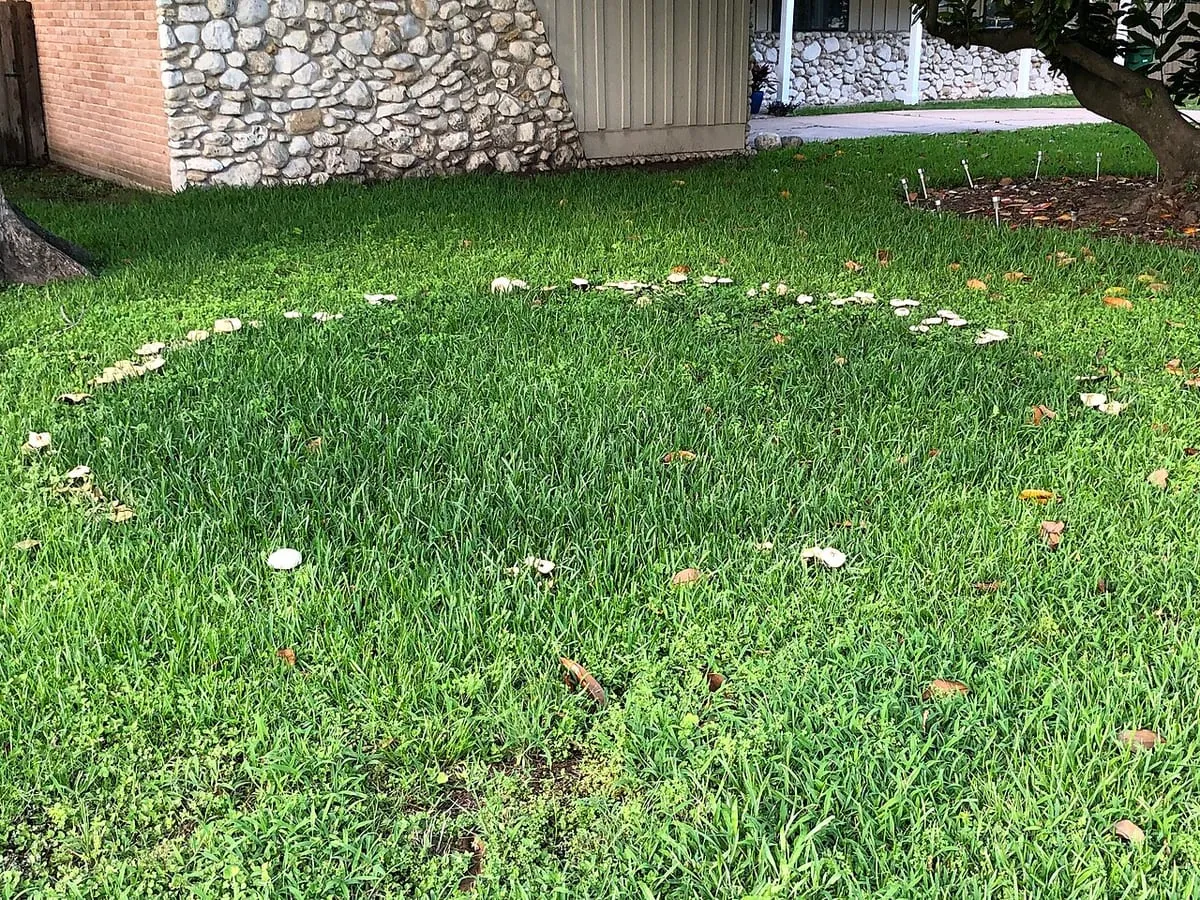
Most likely causes
- Fairy ring — a lush green arc or full circle that grows wider each year, sometimes sprouting mushrooms
- Buried stump or old roots — one fixed green patch or ring over decomposing wood
- Fertilizer spill — a sharply greener spot exactly where the spreader sat or a bag leaked
- Septic drain field — parallel green stripes rather than circles, over the leach lines
- Dog urine halo — small green rings around brown centers, scattered where the dog goes
Not quite what you're seeing? Answer four quick questions and the clue finder will point you to a closer match.
Compare the possible causes
| Possible cause | Key signs | When it happens | How likely |
|---|---|---|---|
| Fairy ring fungus | A dark green arc or complete circle from one foot to over ten feet across that reappears in the same area and expands a little every year, sometimes with a ring of mushrooms after rain | Most visible spring through fall; mushrooms typically pop after wet spells in late summer and fall | Very common |
| Buried stump, roots, or construction debris | A single green circle or irregular patch that stays the same size and place year after year, often where a tree once stood | Year-round, most obvious when the rest of the lawn is stressed in summer | Common |
| Fertilizer spill or overlap | An intensely green spot or stripe with fairly sharp edges that appeared within a week or two of feeding the lawn | Days after fertilizing, fading over the following month or two | Common |
| Septic drain field lines | Long, straight, evenly spaced green stripes — not circles — over the leach field, greenest during dry weather | Year-round, most visible in summer drought when surrounding grass browns | Less common |
| Dog urine green halos | Small rings of darker green grass, usually around a yellow or brown center, scattered in the dog's territory | Any season, appearing spot by spot over weeks | Common |
Visual clues to check
- Track it across seasons: a ring that expands outward year over year is a fairy ring; a circle that stays put is buried organic matter
- Check for mushrooms after rain: a curved line of mushrooms tracing the green edge confirms a fairy ring
- Look at the geometry: straight parallel stripes point to the septic field; equipment-shaped spots point to fertilizer; small scattered rings point to the dog
- Think about site history: a green circle where a tree was removed a few years ago is almost certainly the old stump and roots decomposing
- Probe the soil in a brown-edged ring: if the soil under the dead zone is bone-dry and sheds water, the fairy ring's fungal mat has turned it water-repellent
- Match dates: greening that appeared within two weeks of fertilizing is your spreader, not your soil
The causes in detail
Fairy ring fungus
Fairy rings are caused by soil fungi that start at a central point and grow outward in all directions, like a ripple. As the fungal mat digests organic matter underground, it releases nitrogen at its leading edge — free fertilizer that paints a green ring in the turf. Rings expand a few inches to a couple of feet per season and can persist for decades. Some produce mushrooms along the ring after rain, some green the grass, and some develop a dead brown zone where the dense fungal mat repels water. The green-ring type is harmless and mostly just interesting.
Buried stump, roots, or construction debris
When a stump is ground out or a tree removed, a large mass of wood stays behind underground. As fungi and bacteria break it down, they release nutrients that feed the grass directly above — so the lawn writes a green map of the old root system. Unlike a fairy ring, this circle doesn't march outward each year; it sits still and slowly fades over five to ten years as the wood finishes decomposing. Buried organic construction debris does the same thing in newer subdivisions.
Fertilizer spill or overlap
Set a full spreader down on the grass, let it drip while you answer the phone, or double-pass a strip, and the lawn will tell on you: that area gets a nitrogen surplus and turns conspicuously darker. The tell is the timeline and geometry — it showed up right after you fertilized, in a shape that matches equipment rather than biology, and it fades as the extra nitrogen is used up. A heavy enough spill burns instead of greening, so the same accident can go either way.
Septic drain field lines
A septic system's drain field disperses nutrient-rich moisture through parallel underground lines, and the grass above them often grows greener and faster than the rest of the lawn — especially in a dry spell. Mild striping is normal and no cause for concern. What's not normal is soggy ground, standing water, or sewage odor over the lines: that suggests the field is failing and effluent is surfacing, which is a health hazard and a call-the-septic-professional situation, not a lawn quirk.
Dog urine green halos
Where a dog urinates, the concentrated center often burns while the diluted outer zone gets a nitrogen boost — producing a miniature green ring a few inches to a foot across. If your dark green circles are small, numerous, and concentrated near the door or along the fence, you're looking at pet chemistry rather than fungus. Sometimes light urine doses skip the burn entirely and leave only green spots.
When to worry
- The ring develops a widening band of dead brown grass — the water-repellent type of fairy ring, which needs aeration and persistent watering to limit
- Green stripes over the septic field come with soggy ground, surfacing water, or sewage smell — call a septic professional promptly
- Mushrooms along the ring keep appearing where children or pets play unsupervised
- A depression forms inside the circle — a large buried stump can settle as it rots, leaving a sinkhole-like dip that needs filling
What to do now
- Identify the pattern first — expanding ring, fixed circle, stripes, or scattered spots — since it distinguishes the causes better than any single test
- For cosmetic fairy rings, simply fertilize the whole lawn lightly so the ring blends in, and mow as usual
- Pick and dispose of mushrooms (gloves on) if kids or pets use the lawn; the mushrooms are the fungus's fruit and removing them doesn't harm anything
- For a dry, dead-edged ring, core-aerate the band and water it deeply and repeatedly, ideally with a drop of dish-soap-free wetting agent guidance from your extension office
- For circles over old stumps, either live with the temporary green badge or dig out what wood you reasonably can and topdress with soil
- If you suspect the septic field is surfacing effluent, stop guessing and have the system inspected by a licensed septic contractor
What not to do
- Don't try to dig out or fungicide-drench a fairy ring — the fungal body can extend several feet deep and wide, and turf fungicides rarely reach or kill it
- Don't over-fertilize just the pale area around a green circle; you'll chase your tail creating new dark patches
- Don't let anyone eat mushrooms growing along a ring, no matter how familiar they look
- Don't ignore sewage odor over a green-striped drain field because the grass 'looks healthy' — surfacing effluent is a health hazard
Frequently asked questions
What causes a perfect circle of dark green grass in a lawn?
A perfect circle is almost always biological: a fairy ring fungus expanding evenly outward from a central starting point, releasing nitrogen that greens the grass at its edge. Grass over a decomposing stump can also form a rough circle, but it stays the same size, while a fairy ring widens each year.
Are fairy rings bad for my lawn?
Usually not. The green-ring and mushroom-only types are cosmetic — some homeowners never even notice them. The one troublesome type creates a band of dead grass where the dense fungal mat makes soil water-repellent; that version takes aeration and heavy watering to manage. None of the types harm people, pets, or trees by their presence.
How do I get rid of a fairy ring permanently?
Honestly, you mostly don't. The fungus can occupy a huge volume of soil, and excavating or fumigating it is drastic and rarely worth it for a green ring. The practical play is camouflage: fertilize the whole lawn evenly so the ring stops standing out, water well, and remove mushrooms when they appear. Many rings eventually die out or merge and disappear on their own.
Why is the grass greener over my septic tank and drain field?
The drain field releases moisture and nutrients into the soil, and grass above the lines takes advantage — especially during dry spells when the rest of the lawn is thirsty. Mild green striping is normal. Constant sogginess, standing water, or odor is not; that pattern suggests the field is failing and deserves a professional inspection.