Shiny Green Beetles on Plants: Japanese Beetles or Friends?
Shiny metallic-green beetles clustered on your plants are most often Japanese beetles, especially if they're piled on roses, grapes, or linden leaves in early summer and the foliage is turning to lace. Green June beetles, iridescent dogbane beetles, and quick-running tiger beetles are the usual look-alikes — and two of those are actually good news. Which beetle you have decides whether you act or leave it be.
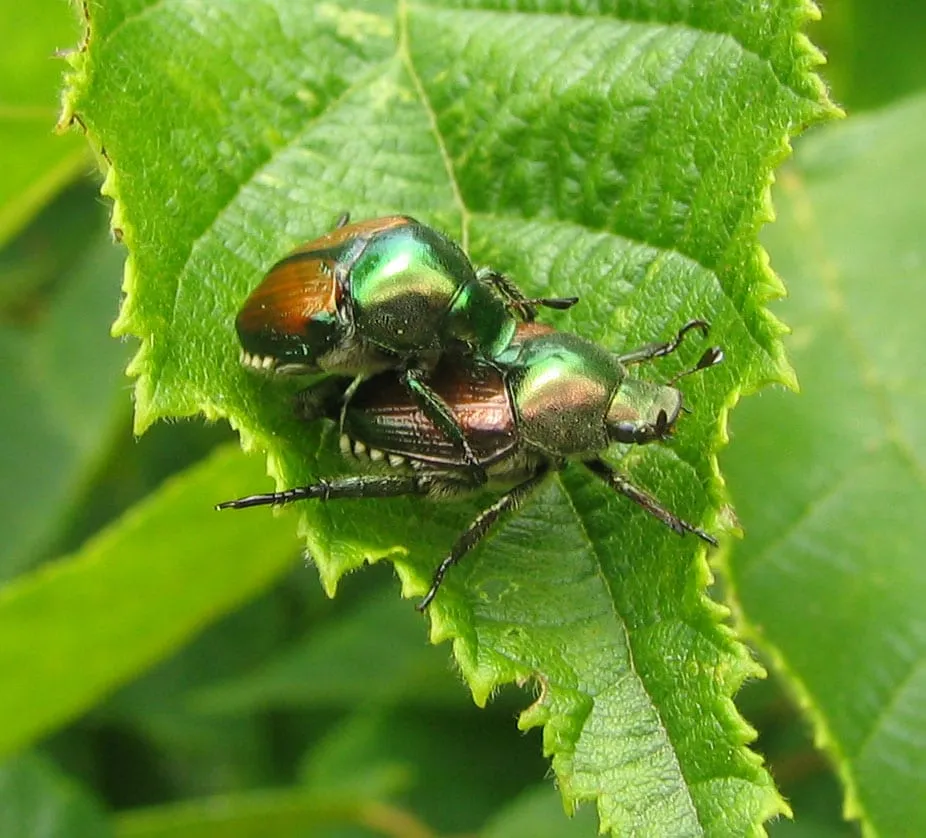
Most likely causes
- Japanese beetles — copper wing covers over a green head, feeding in clusters and skeletonizing leaves
- Green June beetles — bigger, velvety green, buzzing loudly at lights and ripe fruit
- Dogbane beetles — jewel-like rainbow iridescence, only on dogbane plants, harmless
- Six-spotted tiger beetles — brilliant green sprinters on sunny paths, a beneficial predator
Not quite what you're seeing? Answer four quick questions and the clue finder will point you to a closer match.
Compare the possible causes
| Possible cause | Key signs | When it happens | How likely |
|---|---|---|---|
| Japanese beetles | Beetles about 3/8 inch long with metallic green heads, coppery wing covers, and five white tufts along each side, feeding in groups on leaf tops | Roughly mid June through August, peaking over four to six weeks | Very common |
| Green June beetles | Chunky beetles close to an inch long, velvety dull green above with metallic edges, flying with a loud buzz in daytime and blundering into lights and people | Late June through August, especially hot afternoons and evenings | Common |
| Dogbane beetles | Oval beetles under 1/2 inch that shimmer green, gold, copper, and blue all at once, found only on dogbane (and occasionally milkweed) | Summer | Less common |
| Six-spotted tiger beetles | Slender, long-legged, brilliant emerald beetles that sprint and make short flights ahead of you on sunny paths and bare soil | Spring through mid summer, in sunny openings near woods | Less common |
| Emerald ash borer (on ash trees only) | Narrow, bullet-shaped metallic green beetle about 1/2 inch long, seen on or near ash trees with thinning crowns and D-shaped exit holes in the bark | Adults fly May through July | Rare |
Visual clues to check
- Look for the white tufts: five small white hair patches along each side of the abdomen confirm Japanese beetle
- Check the feeding pattern: leaves eaten to a lacy skeleton of veins is Japanese beetle work; ragged gouges in ripe fruit point to green June beetles
- Size them up: Japanese beetles are about 3/8 inch; green June beetles are nearly double that
- Watch the behavior: clustered and munching means a pest; sprinting on bare ground means a tiger beetle; parked on a roadside weed means a dogbane beetle
- Note the time of day: Japanese beetles feed openly in full midday sun, unlike most leaf pests
- Scan the lawn in fall: brown patches that peel back like carpet reveal white C-shaped grubs — the next generation of beetles
The causes in detail
Japanese beetles
Japanese beetles are the classic culprit east of the Rockies and are spreading westward. They feed gregariously in full sun, starting at the top of a plant and working down, chewing the tissue between leaf veins until leaves look like brown lace. Roses, grapes, lindens, raspberries, and crabapples top their menu of 300-plus plants. The white tufts along the abdomen edge separate them from every look-alike, and damaged, beetle-occupied leaves release scents that attract even more beetles — which is why early removal pays off.
Green June beetles
Green June beetles are twice the size of Japanese beetles and far clumsier — their low, noisy flight over the lawn is often mistaken for a wasp attack. Adults mostly gouge soft, overripe fruit like figs, peaches, and tomatoes rather than chewing leaves. Their large grubs tunnel in lawns rich in organic matter and have the odd habit of crawling on their backs across pavement after heavy rain. Damage from adults is usually minor and brief.
Dogbane beetles
Often called the most beautiful beetle in North America, the dogbane beetle's shifting rainbow iridescence outshines any Japanese beetle. It feeds exclusively on dogbane, a weedy roadside plant, and won't touch your roses, vegetables, or lawn. If the shimmering beetle you found is on a milky-sapped weed at the yard's edge and lacks white side tufts, admire it and move on — no action needed.
Six-spotted tiger beetles
Tiger beetles never sit on plants chewing leaves — they're fast-running predators that hunt ants, caterpillars, and other small insects on the ground. The giveaway is behavior: they stay ahead of you on a trail or patio in quick bursts, all legs and speed. These are firmly beneficial insects, and their presence signals a yard with healthy insect life. Leave them to their work.
Emerald ash borer (on ash trees only)
You'll rarely spot this one on garden plants, but it's worth knowing: a slim, torpedo-shaped emerald beetle on an ash tree — especially one with a thinning top, woodpecker damage, or small D-shaped holes in the bark — may be emerald ash borer, a tree-killing invasive. Unlike the leaf-feeders above, the damage is done by larvae under the bark. Suspected finds on ash are worth photographing and reporting to your state agriculture department or extension office.
When to worry
- Skeletonized leaves spreading across roses, grapes, raspberries, or a young tree during the summer flight
- Repeated heavy defoliation of the same young or newly planted tree — mature plants shrug it off, small ones may not
- Lawn areas turning brown and lifting easily in late summer or fall, with more than a handful of grubs per square foot underneath
- Skunks, raccoons, or flocks of birds tearing up the turf — they're mining the grubs below
- A slim metallic green beetle on a declining ash tree, which should be reported rather than ignored
What to do now
- Identify first — of the shiny green beetles you'll meet, only the Japanese beetle regularly earns a response
- Hand-pick in the early morning while beetles are sluggish: hold a bucket of soapy water under the leaf and tap them in, repeating every day or two
- Start picking as soon as the first beetles arrive; fewer feeding beetles means fewer scent signals recruiting reinforcements
- Cover high-value plants like roses or a young grapevine with fine netting during the peak weeks, removing it from anything that needs bee pollination while in bloom
- Rake out and reseed small grub-damaged lawn patches in fall, and keep the lawn watered deeply but infrequently — moist turf in July invites egg-laying
- If grub counts are high across the lawn or a specimen tree is being hammered every year, get advice from your county extension office or a licensed lawn care professional on properly timed treatment
What not to do
- Don't hang a pheromone beetle trap in the middle of the yard — traps lure in far more beetles than they catch, and studies consistently find more damage on plants near traps
- Don't crush beetles on the plant; unlike some pests, dead Japanese beetles don't repel others, and the disturbed survivors just resettle nearby
- Don't spray blooming plants with insecticide — you'll kill the bees working the same flowers
- Don't kill the rainbow-iridescent beetles on roadside weeds or the green sprinters on your walkway; dogbane and tiger beetles are harmless or actively helpful
- Don't blanket the lawn with grub killer on suspicion alone — confirm grub numbers by checking a square foot of turf first
Frequently asked questions
Why are Japanese beetles all over my roses but not my neighbor's plants?
Japanese beetles are drawn to their favorite hosts — roses, grapes, lindens, raspberries — and to the scent of leaves other beetles are already feeding on, so damage snowballs on a few preferred plants while others go untouched. Sun matters too: they strongly favor plants in full sun.
Does soapy water really kill Japanese beetles?
Yes. A squirt of dish soap in a bucket of water breaks the surface tension so beetles sink and can't escape. Tap the leaf and they drop straight down — their default escape move — right into the bucket. Morning picking while they're cool and slow is most effective, and daily picking during the peak weeks genuinely reduces damage.
Are the beetles on my plants connected to the grubs in my lawn?
Directly — Japanese beetle and June beetle adults lay eggs in turf in mid to late summer, and the white C-shaped grubs that hatch feed on grass roots into fall. Heavy grub damage shows up as brown patches that lift like loose carpet, often excavated further by skunks and raccoons. Managing one life stage helps with the other.
Will Japanese beetles kill my trees and shrubs?
Rarely. Established plants can lose a surprising amount of leaf area to skeletonizing and recover fully the next season. The plants worth protecting are young trees, new transplants, and anything defoliated several years running, since repeated stress adds up. For those, netting during the six-week flight is the most reliable safeguard.
How long does Japanese beetle season last?
Adults emerge around mid June in most of the country and feed heavily for four to six weeks, with stragglers into August. Each beetle lives about a month to six weeks. If you can defend your favorite plants through that window with picking or netting, the pressure drops off on its own.