Wasp Nest Under the Eaves: Which Wasp, and How Careful to Be
A nest under your eaves is most likely paper wasps if you can see open honeycomb cells on an umbrella-shaped comb, bald-faced hornets if it's a fully enclosed gray papery ball, or mud daubers if it's made of dried mud tubes. Paper wasps and hornets will defend their nest, while mud daubers almost never sting. Identify the builder from a distance first — the right response ranges from leaving it alone to calling a licensed pest control professional.
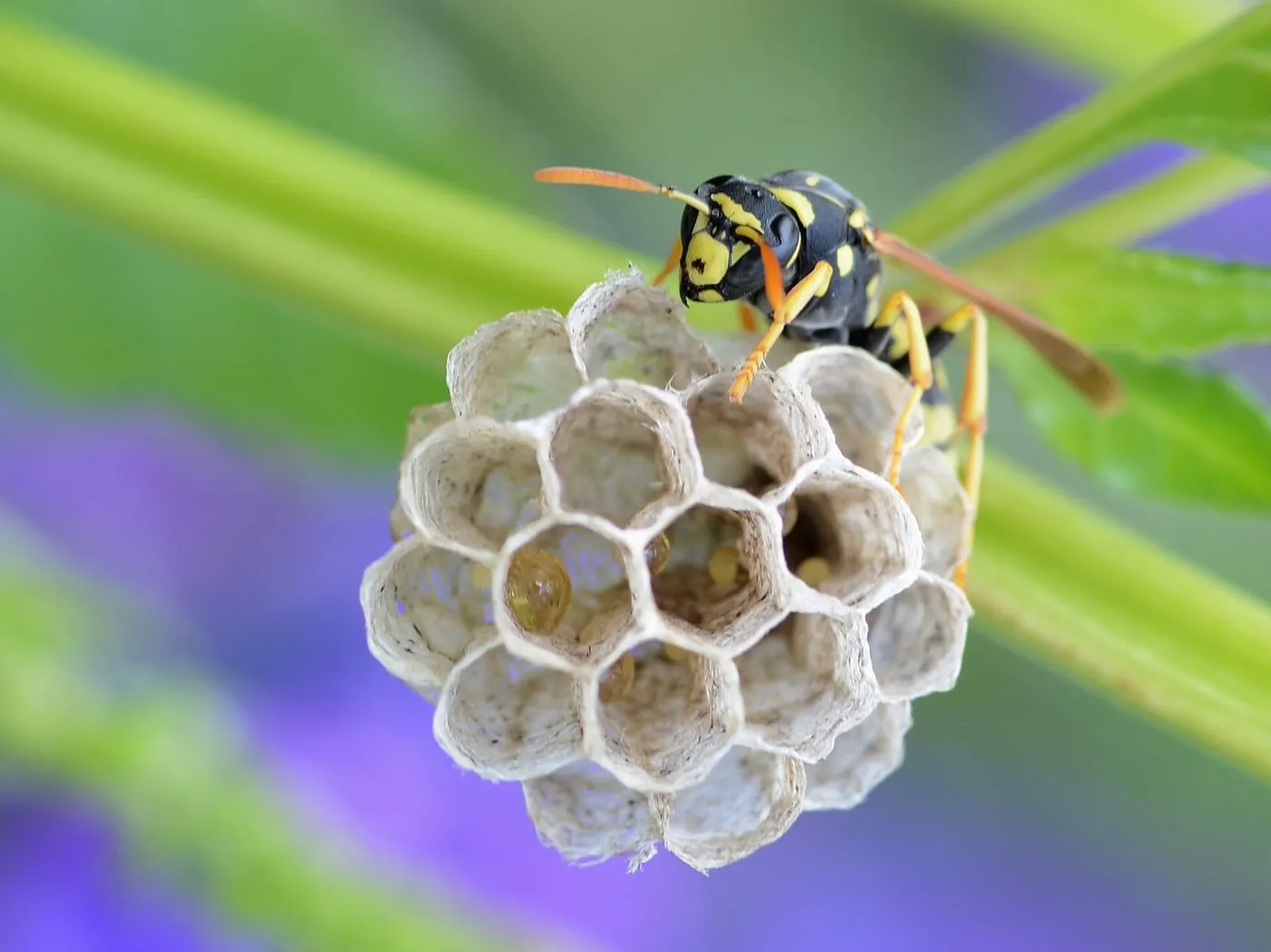
Most likely causes
- Paper wasps — open, umbrella-shaped comb with visible hexagon cells, hanging from a single stalk
- Bald-faced hornets — enclosed gray football-shaped ball with one entrance hole near the bottom
- Mud daubers — smooth mud tubes or lumps, no paper, no colony, almost no sting risk
- Yellowjackets — steady traffic into a gap in the eave itself rather than a visible hanging nest
Not quite what you're seeing? Answer four quick questions and the clue finder will point you to a closer match.
Compare the possible causes
| Possible cause | Key signs | When it happens | How likely |
|---|---|---|---|
| Paper wasps | An open, upside-down umbrella of gray paper cells on a short stalk, with slender brown-and-yellow wasps resting on the comb, legs dangling in flight | A queen starts a golf-ball-size comb in spring; the colony peaks at a few dozen wasps by late summer | Very common |
| Bald-faced hornets | A fully enclosed, gray, papery ball or football shape — sometimes larger than a basketball by fall — with a single entrance hole and black-and-white wasps coming and going | Starts small in late spring, grows dramatically through summer, peaks at several hundred insects by early fall | Common |
| Mud daubers | Smooth or ridged tubes of dried mud — often side-by-side 'organ pipe' rows — or golf-ball lumps stuck flat against the wall or eave, with at most a single slender wasp coming and going | Built in summer; old nests persist for years after the wasps are gone | Common |
| Yellowjackets nesting in the eave void | No visible nest at all — just steady, purposeful traffic of compact yellow-and-black wasps in and out of a gap where the soffit meets the wall or roof | Traffic builds through summer and peaks in late summer and early fall | Less common |
Visual clues to check
- Look at the architecture from a safe distance: open visible cells mean paper wasps; a closed gray shell means bald-faced hornets; dried mud means daubers
- Count the traffic: one occasional slender wasp is a mud dauber; dozens of insects streaming to one point is a social colony
- Note the flight style: paper wasps cruise slowly with long legs dangling; yellowjackets and hornets fly fast and direct
- Check the season against the size: a golf-ball nest in April is a startup with one queen; any large nest in August holds a full defensive workforce
- Look for an entrance hole near the bottom of an enclosed ball — that's the hornet doorway, and the direction their guards face
- Watch whether wasps enter a crack in the structure itself rather than a hanging nest — hidden-void nests change the difficulty level entirely
- Use binoculars or a zoomed phone photo instead of stepping closer; every one of these IDs can be made from 15 feet away or more
The causes in detail
Paper wasps
Paper wasps build the classic eave nest: no outer shell, so you can see straight into the hexagonal cells. Colonies stay relatively small — typically 20 to 75 wasps — and the wasps are not aggressive away from the nest; they're actually useful predators of caterpillars and garden pests. Near the nest is another matter, since they will defend it, and a comb directly over a doorway, deck, or play area is a legitimate conflict. A fresh spring nest the size of a golf ball with one queen is the easiest and safest stage to deal with; an August comb bristling with workers is not.
Bald-faced hornets
Despite the name, bald-faced hornets are large aerial yellowjackets, and they are the most defensive insect on this list. Colonies of 100 to 400 or more will pursue a perceived threat farther than paper wasps, sting repeatedly, and react to vibration — a bumped ladder or a thrown rock is enough. The enclosed shell means you can't judge colony size from outside. An enclosed gray ball of any real size under an eave, in a shrub, or in a tree is a job for a licensed pest control professional, full stop.
Mud daubers
Mud daubers are solitary — there is no colony, no guards, and effectively no defense of the nest. The female packs each mud tube with paralyzed spiders for her larvae and moves on. Stings are extremely rare, essentially requiring you to handle the wasp itself. Round exit holes in an old mud tube mean the young have already emerged and the nest is empty. This is the one eave nest you can safely scrape off yourself with a putty knife once it's inactive — or simply ignore.
Yellowjackets nesting in the eave void
When the nest is inside the soffit or wall cavity, the entrance gap is all you see, and colony size is anyone's guess — mature yellowjacket nests can hold thousands of workers by September. Hidden structural nests are more dangerous than exposed combs because the colony is bigger than it looks and the wasps can chew through drywall into living space if the void is treated wrong. Never plug the entrance hole; blocked yellowjackets search for another exit, and that exit is sometimes indoors.
When to worry
- Any enclosed gray ball nest bigger than a softball — bald-faced hornet colonies defend aggressively and in numbers
- A nest directly above a door, deck, mailbox, or anywhere people pass within a few feet daily
- Wasp traffic disappearing into the soffit, siding, or attic vents — the hidden colony is larger than the entrance suggests
- Anyone in the household with a known or suspected sting allergy — the stakes of a mistake go up sharply
- Wasps appearing inside the house, which can mean a void nest has broken through or found an interior gap
- Late-summer nests of any social species; colonies are at maximum size and maximum defensiveness from August through the first hard frost
What to do now
- Identify the nest type from a distance with binoculars or a zoomed photo before deciding anything
- Leave nests that aren't in conflict with people alone — paper wasps in a back corner of the eaves are eating your garden's caterpillars, and the whole colony dies at first frost anyway
- Mark the area mentally and reroute kids, pets, and yard work away from the nest's approach path in the meantime
- For a brand-new spring paper wasp comb the size of a golf ball in a spot you can't tolerate, act early — that's the smallest and safest the colony will ever be
- Scrape off old, inactive mud dauber tubes with a putty knife whenever convenient; check for exit holes confirming they're empty
- Wait for the season's end where possible: after a hard frost or two, paper wasp and hornet nests are dead and can be removed safely; they are not reused next year
- For bald-faced hornet balls, hidden void nests, large colonies, anything high off the ground, or any household allergy, call a licensed pest control professional — this is exactly what they're equipped for
What not to do
- Don't knock a nest down with a broom, stick, or water jet — vibration and impact are precisely what triggers a mass defensive response
- Don't climb a ladder to spray a nest overhead; a sting 10 feet up turns into a fall injury, and hornets target the source of the threat
- Don't plug the entrance hole of a void nest — trapped yellowjackets chew toward light and can emerge inside the house
- Don't burn a nest or spray it with gasoline, which is a fire hazard against your own eaves and doesn't reliably kill the colony
- Don't assume a quiet nest is empty in warm weather — social wasps are simply out foraging at midday and return by evening
- Don't swat at wasps near the nest; crushing a wasp releases alarm pheromone that recruits its nestmates
Frequently asked questions
How do I tell paper wasps from hornets under my eaves?
Look at whether you can see the cells. Paper wasps build an open umbrella-shaped comb — hexagon cells visible from below — with a few dozen slender wasps at most. Bald-faced hornets wrap their comb in a smooth gray paper shell, so you see only a ball or football shape with one entrance hole. Open comb, smaller and calmer colony; closed ball, larger and far more defensive one.
Will wasps reuse the same nest next year?
No. Paper wasp and hornet colonies die at the first hard frosts, leaving only new queens that overwinter elsewhere in bark and leaf litter. The old nest is never recolonized — you can remove it safely in winter. Queens do favor the same kinds of sheltered spots, though, so an eave that hosted a nest once may attract a new queen next spring; a coat of paint and sealed gaps help.
Are mud dauber nests dangerous?
About the least dangerous thing that will ever attach itself to your house. Mud daubers are solitary, don't defend their nests, and sting only if handled directly. They also hunt spiders, including some you'd rather not have around. If the tubes bother you cosmetically, wait until you see round exit holes (meaning the young have left) and scrape them off.
When is the best time to deal with a wasp nest?
Either very early or very late. In early spring a starter nest holds one queen and a few cells — the lowest-risk moment to have it removed. From late fall onward, after hard frosts, social nests are dead and can be taken down freely. The worst time is late summer, when colonies are at peak population and peak defensiveness; that's when professional treatment earns its fee.
Should I just leave the nest alone until winter?
Often, yes. A paper wasp comb tucked in an eave corner away from doors and decks poses little day-to-day risk, the wasps control garden pests all season, and the colony is dead by winter anyway. The leave-it-alone calculus changes for enclosed hornet balls, nests over walkways, hidden void nests, or any allergy in the household — those justify professional removal now rather than patience.