Mud Nests Under Your Eaves: Swallows, Wasps, or Daubers?
Mud structures under your eaves were built either by swallows — barn or cliff swallows, which are federally protected birds — or by mud dauber wasps, which are docile solitary insects. A gray papery umbrella-shaped comb is neither: that's a paper wasp nest, and it's the only one of the three that stings defensively. Identify the builder before you reach for a scraper, because the right response is different for each.
Most likely causes
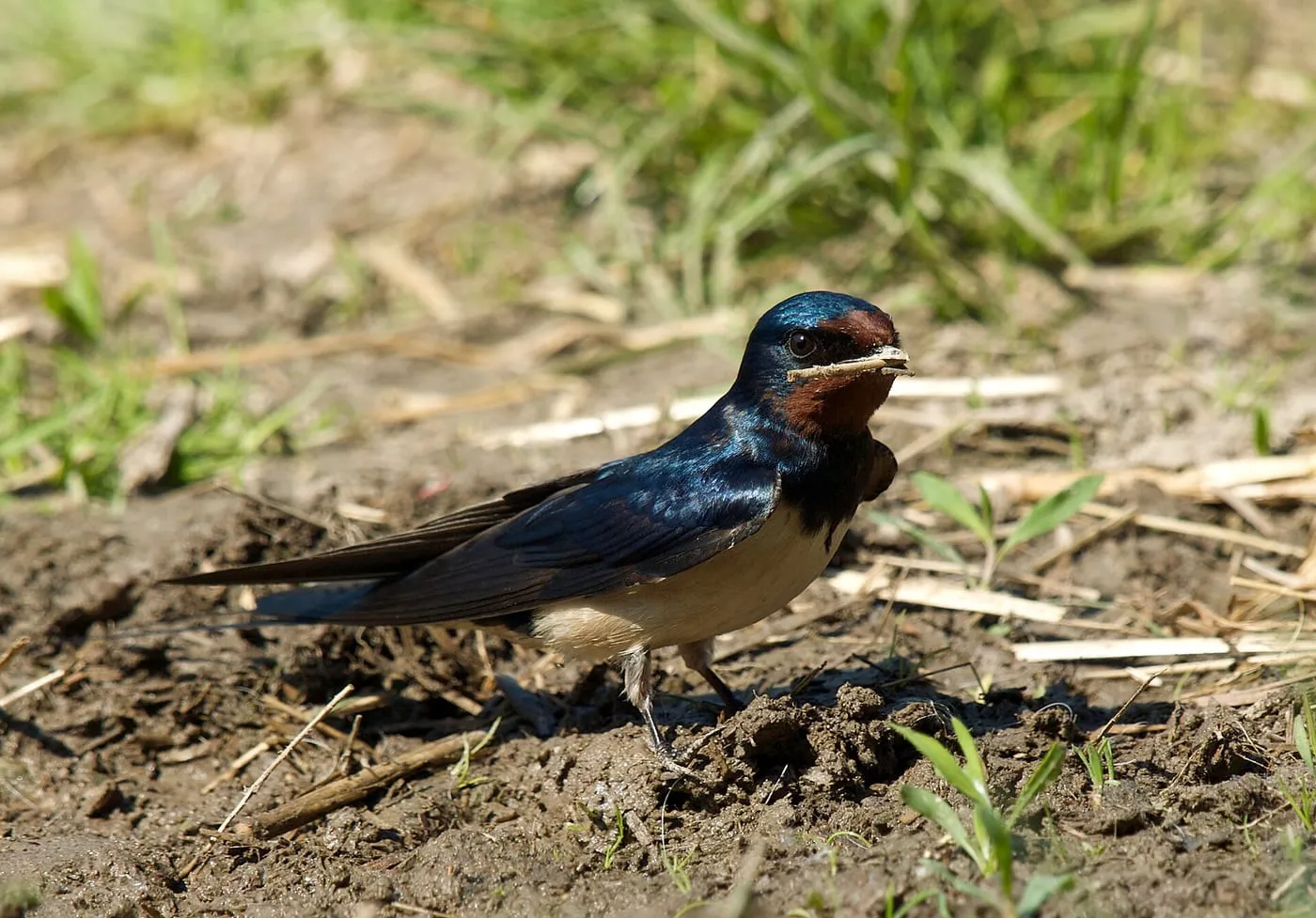
- Barn swallows — open mud cup on a ledge or beam, with birds swooping in and out
- Cliff swallows — enclosed mud gourds with a neck-like entrance, often in tight rows
- Mud dauber wasps — smooth mud tubes like organ pipes, or a plastered lump the size of a fist
- Paper wasps — not mud at all: a gray papery umbrella of open cells hanging from a stalk
Not quite what you're seeing? Answer four quick questions and the clue finder will point you to a closer match.
Compare the possible causes
| Possible cause | Key signs | When it happens | How likely |
|---|---|---|---|
| Barn swallows | An open half-cup of mud pellets mixed with grass, plastered to a vertical wall or beam under a porch roof or eave, with fork-tailed birds making fast feeding runs | Arrive in spring, nest April through August, gone by early fall | Common |
| Cliff swallows | Fully enclosed mud gourds with a downward-angled entrance neck, often built shoulder to shoulder in colonies under an eave or gable overhang | Spring arrival; colonies active April through July | Less common |
| Mud dauber wasps | Smooth, finished mud tubes side by side like organ pipes, or a plastered fist-size lump with no visible entrance traffic — often in a garage, under an eave, or behind shutters | Built and provisioned in summer; old tubes persist for years | Common |
| Paper wasps (the look-alike that isn't mud) | A gray, papery, umbrella-shaped comb of open hexagonal cells hanging from a short stalk, with wasps sitting on the face of the comb | Started by a lone queen in spring; colony grows through summer, peaks in late summer | Common |
Visual clues to check
- Check the material first: genuine mud (gritty, earth-colored pellets) means swallows or daubers; gray papery fiber with visible hexagonal cells means paper wasps
- Look at the shape: open cup = barn swallow, sealed gourd with an entrance neck = cliff swallow, smooth pipes or a plastered lump = mud dauber, hanging umbrella = paper wasp
- Watch the traffic for a few minutes from a distance: swooping birds versus a lone unhurried wasp versus multiple wasps standing guard on a comb
- Count the structures: a tight row of identical mud jugs is a cliff swallow colony; daubers scatter their tubes in sheltered corners
- Look below the nest: a stripe of bird droppings means active swallows; nothing below is typical of wasp work
- Check old mud tubes for round holes — drilled openings mean last year's daubers already emerged and the tubes are empty
The causes in detail
Barn swallows
Barn swallows build an open-topped cup, one nest per pair, usually on a ledge, light fixture, or beam under cover. They're superb neighbors in one respect — a pair sweeps up hundreds of flying insects a day, including mosquitoes — but droppings accumulate directly below the nest. They're protected under the Migratory Bird Treaty Act, so an active nest with eggs or chicks stays put until the young fledge, roughly five to six weeks after building starts.
Cliff swallows
Cliff swallows are the colonial cousins — where barn swallows build one open cup, cliff swallows may cement a dozen or more sealed jugs in a row under a single overhang. Each nest is roughly a thousand individual mud pellets carried in beak by beak. Colonies can return and grow year over year, which is why prevention after the season ends matters if you don't want a larger colony next spring. Same federal protection applies: active nests are off-limits.
Mud dauber wasps
Mud daubers are solitary wasps, and that changes everything about the risk: there is no colony to defend, so they almost never sting — you can stand beside a female building her tube and she'll ignore you. Each tube is packed with paralyzed spiders (black widows are a favorite prey) as food for a single larva. Round exit holes mean the tubes are old and empty. Most entomologists consider daubers beneficial and not worth removing while active.
Paper wasps (the look-alike that isn't mud)
Homeowners routinely lump paper wasp nests in with mud nests, but the material is chewed wood fiber, not mud, and the occupants are social wasps that will defend the nest if you disturb it. A golf-ball comb with one queen in April becomes a colony of dozens by August. This is the one eave nest that justifies real caution: small early-season nests in low-traffic spots can often be left alone, but a large active comb near a doorway is a job for a pest control professional.
When to worry
- A papery comb with multiple wasps within reach of a doorway, deck, or window you use daily — stings become likely by mid-summer
- Anyone in the household with a known wasp or bee sting allergy and any active wasp nest on the structure
- Swallow droppings piling up over an entryway, grill, or outdoor seating — a health and cleanup issue you can manage with a board or tarp below the nest
- Mud nests reappearing inside attic vents, dryer vents, or gaps that lead into the structure rather than on the outside of it
- Swarming, aggressive insect behavior when you merely walk past — paper wasps escalate as colonies mature in late summer
What to do now
- Identify the builder from a distance before touching anything — a photo with your phone's zoom is safer and more accurate than a close look
- For active swallow nests, wait them out: nesting wraps up within about six weeks, and a piece of cardboard or a drop board mounted beneath the nest catches the droppings meanwhile
- For mud daubers, the simple option is to do nothing while they're active; scrape old, hole-punctured tubes off with a putty knife any time
- After swallows depart in fall, remove old mud and wash the surface, then hang bird netting or install a slick barrier under favored overhangs before they return in spring
- Seal or screen any vents and gaps where nests are being built into the structure rather than on it
- For a large paper wasp comb, or any wasp nest near an entrance or above a ladder-unfriendly spot, hire a licensed pest control professional rather than treating it yourself
What not to do
- Don't knock down an active swallow nest with eggs or chicks — barn and cliff swallows are federally protected under the Migratory Bird Treaty Act, and violations carry real fines
- Don't spray a papery comb from a ladder or in daylight; paper wasps defend the nest, and a defensive swarm plus a ladder is how eave jobs turn into ER visits
- Don't assume every eave nest stings — mud daubers are nearly harmless, and treating them like hornets wastes pesticide on a beneficial insect
- Don't power-wash nests off blindly; confirm the nest is inactive first, whichever species built it
- Don't seal vents or gaps until you're certain nothing is nesting inside them
Frequently asked questions
How can I tell a swallow nest from a wasp nest at a glance?
Material and openness. Swallow nests are built of visible dried mud pellets and either sit open like a cup (barn swallow) or form a sealed jug with an entrance hole (cliff swallow), with birds flying in and out. Mud dauber work is smooth mud in tubes or lumps with almost no visible activity. Anything gray and papery with open hexagonal cells is a paper wasp comb, not mud at all.
Is it really illegal to remove a swallow nest?
If it's active — containing eggs or young — yes. Barn and cliff swallows are covered by the Migratory Bird Treaty Act, and destroying an active nest is a federal violation. Once the young have fledged and the nest is empty, typically by late summer, you may remove old nests and install deterrents before the next season.
Will mud daubers sting my kids?
It's very unlikely. Mud daubers are solitary wasps with no colony to defend, and they show almost no defensive behavior — stings are rare even for people who handle the nests, which you still shouldn't do. They also hunt spiders, including black widows. The eave insects that do sting defensively are social species like paper wasps and yellowjackets.
The mud tubes have little round holes in them. What does that mean?
The nursery has emptied. Mud dauber larvae develop inside the sealed tubes, pupate, and chew perfectly round exit holes when they emerge as adults. Holed tubes are abandoned and safe to scrape off with a putty knife whenever you like — though a new female may recycle the mud or build beside them next summer.
How do I keep swallows from rebuilding next year?
Act in the off-season. After the birds leave in fall, remove old mud completely, wash the wall, and make the site unusable: bird netting angled across the overhang, a slick panel of plexiglass over the favored corner, or commercial swallow deterrent strips all work. Once a pair starts laying in spring, you're legally committed for the season, so timing is everything.