June Bugs vs Japanese Beetles: How to Tell Them Apart
June bugs and Japanese beetles are different insects that get mixed up because both are summer scarab beetles whose larvae are white lawn grubs. Telling them apart is easy once you know the tells: June bugs are reddish-brown, fly clumsily at night around porch lights in May and June, and do little visible damage as adults, while Japanese beetles are smaller, metallic green with copper wing covers, feed in broad daylight from June into August, and skeletonize the leaves of roses, grapes, and dozens of other plants.
Most likely causes
- Metallic green-and-copper beetles eating leaves in daylight — Japanese beetles
- Chunky brown beetles thudding into porch lights and window screens at night — June bugs (May/June beetles)
- Leaves turned to lace with only veins left — the signature of Japanese beetle feeding
- White C-shaped grubs under brown lawn patches — larvae of either beetle eating grass roots
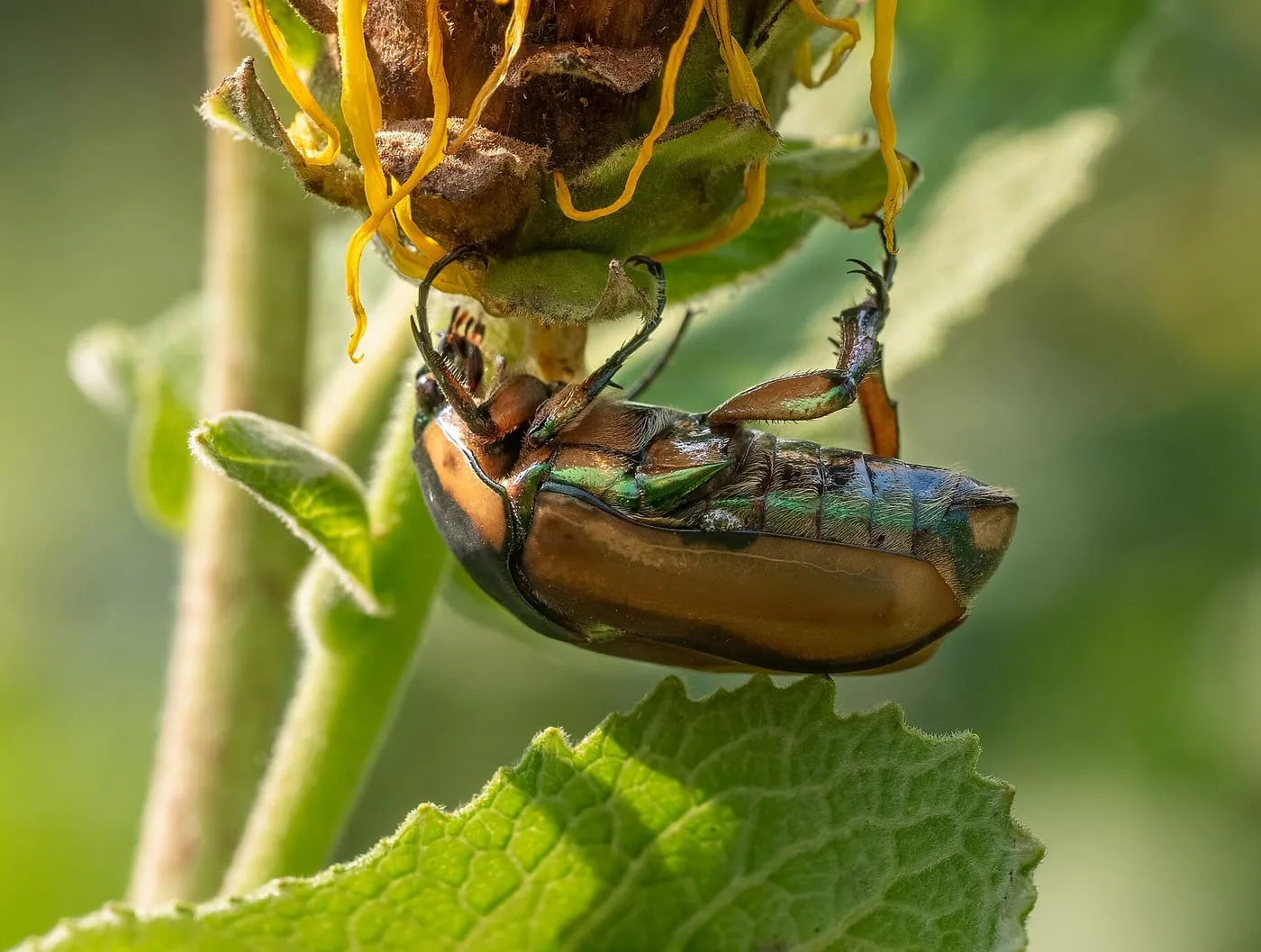
- A big velvety-green beetle buzzing low over the lawn in daytime — a green June beetle, a third species
Not quite what you're seeing? Answer four quick questions and the clue finder will point you to a closer match.
Compare the possible causes
| Possible cause | Key signs | When it happens | How likely |
|---|---|---|---|
| Japanese beetle adults | Beetles about 3/8 inch long with a shiny metallic-green head, coppery wing covers, and five tufts of white hair along each side of the abdomen, feeding in clusters during the day | Late June through August, most active on warm sunny afternoons | Very common |
| June bug adults (May/June beetles) | Reddish-brown to chestnut beetles 1/2 to 1 inch long that fly clumsily at night, bang into lit windows, and cling to screens | May and June, at night; by mid-July they're mostly done | Very common |
| Japanese beetle grubs | White C-shaped grubs up to about 1 inch long in the top few inches of soil under browning turf, mainly in late summer and fall | Eggs are laid in turf in July; grubs feed heavily August through October, then again briefly in spring | Common |
| June bug grubs | Larger white C-shaped grubs, up to 1.5 inches, found deeper in the soil and present across multiple seasons | Feed spring through fall over a 2–3 year life cycle, overwintering deep in the soil | Common |
| Green June beetles (the bonus look-alike) | Big velvety dull-green beetles, 3/4 to 1 inch, buzzing loudly in low daytime flights over lawns like tiny drones | July and August, daytime | Less common |
Visual clues to check
- Check the clock: daytime leaf-feeding points to Japanese beetles (or green June beetles); night flights around lights point to June bugs
- Check the color: metallic green with copper wing covers means Japanese beetle; solid reddish-brown means June bug; big and velvety green means green June beetle
- Look for the white tufts: five little white hair spots along each side of the abdomen confirm a Japanese beetle
- Compare sizes: Japanese beetles are about 3/8 inch, June bugs 1/2 to 1 inch, green June beetles up to an inch
- Read the leaf damage: lace-like skeletonized leaves are Japanese beetle work; June bug adults rarely leave damage you'd notice
- Do a grub check in late summer: cut a square foot of turf 2–3 inches deep and count white C-shaped grubs — under five per square foot rarely matters
- Watch the calendar: June bug season winds down about when Japanese beetle season ramps up, so a July-August leaf-eater is almost never a June bug
The causes in detail
Japanese beetle adults
Japanese beetles are the ones actually wrecking your plants in daylight. They feed gregariously — a few beetles release scents that draw a crowd — and chew the tissue between leaf veins, leaving a lacy skeleton. They hit over 300 plant species, with roses, grapes, lindens, crabapples, cherries, and raspberries among the favorites. The white tufts along the abdomen are the giveaway detail that separates them from every look-alike.
June bug adults (May/June beetles)
The classic 'June bug' is any of several native Phyllophaga species. Adults hide in the soil by day and emerge at dusk, and while some species nibble tree leaves at night, most homeowners never see meaningful adult damage — just the nightly bumbling around porch lights. If a brown beetle is annoying you at night but your garden looks fine, this is your insect, and the adults themselves are harmless to people, pets, and (mostly) plants.
Japanese beetle grubs
Japanese beetles complete their whole life cycle in one year: adults lay eggs in moist lawns in midsummer, and the grubs chew grass roots hard in late summer and early fall. That's when lawn damage shows — brown patches that peel back like carpet, plus skunks and raccoons tearing up turf to eat the grubs. A common rule of thumb is that healthy lawns tolerate several grubs per square foot; damage usually takes ten or more.
June bug grubs
May/June beetle grubs look nearly identical to Japanese beetle grubs but live underground for two to three years before emerging as adults, so a bad infestation can damage turf across several seasons. Because they grow bigger than annual grubs, a heavy population can do serious root damage, and they also attract the same grub-hunting skunks, raccoons, and moles. To the naked eye the two grubs are twins — species-level ID comes down to the raster pattern, a tiny arrangement of hairs on the grub's rear end read under magnification.
Green June beetles (the bonus look-alike)
A third beetle muddies the picture in the southern and eastern U.S.: the green June beetle is much larger than a Japanese beetle, matte velvet green rather than metallic, and cruises noisily a few inches over turf in daylight. Adults mostly go after ripe and overripe fruit rather than leaves. Its grubs are oddballs too — they crawl on their backs, and they tunnel enough to leave small mounds in lawns.
When to worry
- Leaves on roses, grapes, cherries, or lindens turning to lace across large parts of the plant — heavy Japanese beetle pressure
- Brown lawn patches in late summer that pull up like loose carpet, exposing grubs at the roots
- Skunks or raccoons tearing up turf overnight, or flocks of birds working one patch — they're mining a grub hotspot
- Ten or more grubs per square foot in a soil check, or grub damage recurring in the same lawn areas year after year
- Young or newly planted trees being defoliated — mature plants shrug off beetle feeding, but small ones may need protection
What to do now
- Identify which beetle you actually have before treating anything — the adults, timing, and life cycles differ, and June bug adults usually need no action at all
- Hand-pick Japanese beetles in the morning while they're sluggish and drop them into a bucket of soapy water; on small plantings this works better than it sounds
- Cover prized roses, grapes, or young trees with fine netting during the 6–8 week Japanese beetle peak
- Turn off unneeded outdoor lights in May and June, or switch to warm/yellow bulbs, to cut down nightly June bug traffic
- Keep the lawn deep-watered and mowed high — vigorous roots tolerate light grub feeding, and drier July turf is less attractive for egg-laying
- Confirm grub numbers with the square-foot test before considering any lawn treatment, and if counts are high or damage recurs, have a licensed lawn care or pest professional identify the grub species and time the treatment correctly
What not to do
- Don't hang a Japanese beetle bag trap in the middle of the yard — the lure draws in far more beetles than the bag catches, often increasing damage nearby
- Don't crush Japanese beetles on the plant; dead beetles don't repel others, and hand-picking into soapy water is tidier and just as effective
- Don't blanket the lawn with grub insecticide 'just in case' — treating without a confirmed count and correct timing wastes money and harms beneficial soil insects
- Don't assume the brown beetles at your porch light are the ones eating your roses — night-flying June bugs and daytime-feeding Japanese beetles are different problems
- Don't panic over every grub you unearth while digging; a few grubs in garden soil are normal and no threat to a healthy lawn
Frequently asked questions
Do grubs turn into Japanese beetles?
Some do. The white C-shaped grubs in your lawn are the larvae of several scarab beetles — Japanese beetles, June bugs (May/June beetles), green June beetles, and chafers all start as white grubs that eat grass roots. Japanese beetle grubs become adults in one year, while June bug grubs stay underground for two to three years before emerging.
How can I tell Japanese beetle grubs from June bug grubs?
By eye, you basically can't — both are white, C-shaped, brown-headed root feeders. Specialists separate them by the raster pattern, the arrangement of tiny hairs on the underside of the grub's rear segment, which requires a hand lens and a reference key. If species ID matters for treatment timing, have a lawn care or extension professional look at a sample.
Are June bugs harmful to my yard?
The adults, barely — they're clumsy, harmless night-fliers that don't bite or sting, and most cause little noticeable leaf damage. Their grubs are the real concern: over their multi-year life underground they eat grass roots, and a dense population can brown out turf and attract digging skunks and raccoons.
Why are Japanese beetles all over my roses but not my neighbor's?
Japanese beetles aggregate: feeding beetles release compounds that attract more beetles to the same plant, so damage snowballs on a few favorites while nearby plants go untouched. Preferred hosts like roses, grapes, and lindens get hit hardest. Morning hand-picking breaks up the crowd and genuinely reduces how many new beetles arrive.
Does killing the adult beetles stop grubs in my lawn?
Not reliably. Adult Japanese beetles fly in from up to a mile away, so the beetles on your plants didn't necessarily hatch in your lawn — and your lawn can grow grubs from eggs laid by visitors you never noticed. Treat the two stages as separate decisions: protect plants from adults if damage is bad, and treat the lawn only if a grub count justifies it.