Bald-Faced Hornet Nest: How to Identify It and Stay Safe
A gray, papery nest the size of a football or basketball hanging in a tree, in a shrub, or under an eave — fully enclosed except for one hole near the bottom — is the work of bald-faced hornets, black wasps with distinctive white face markings. They defend the nest aggressively and can sting repeatedly, so an active nest near doors, decks, or play areas is a job for a licensed pest professional, not a DIY project.
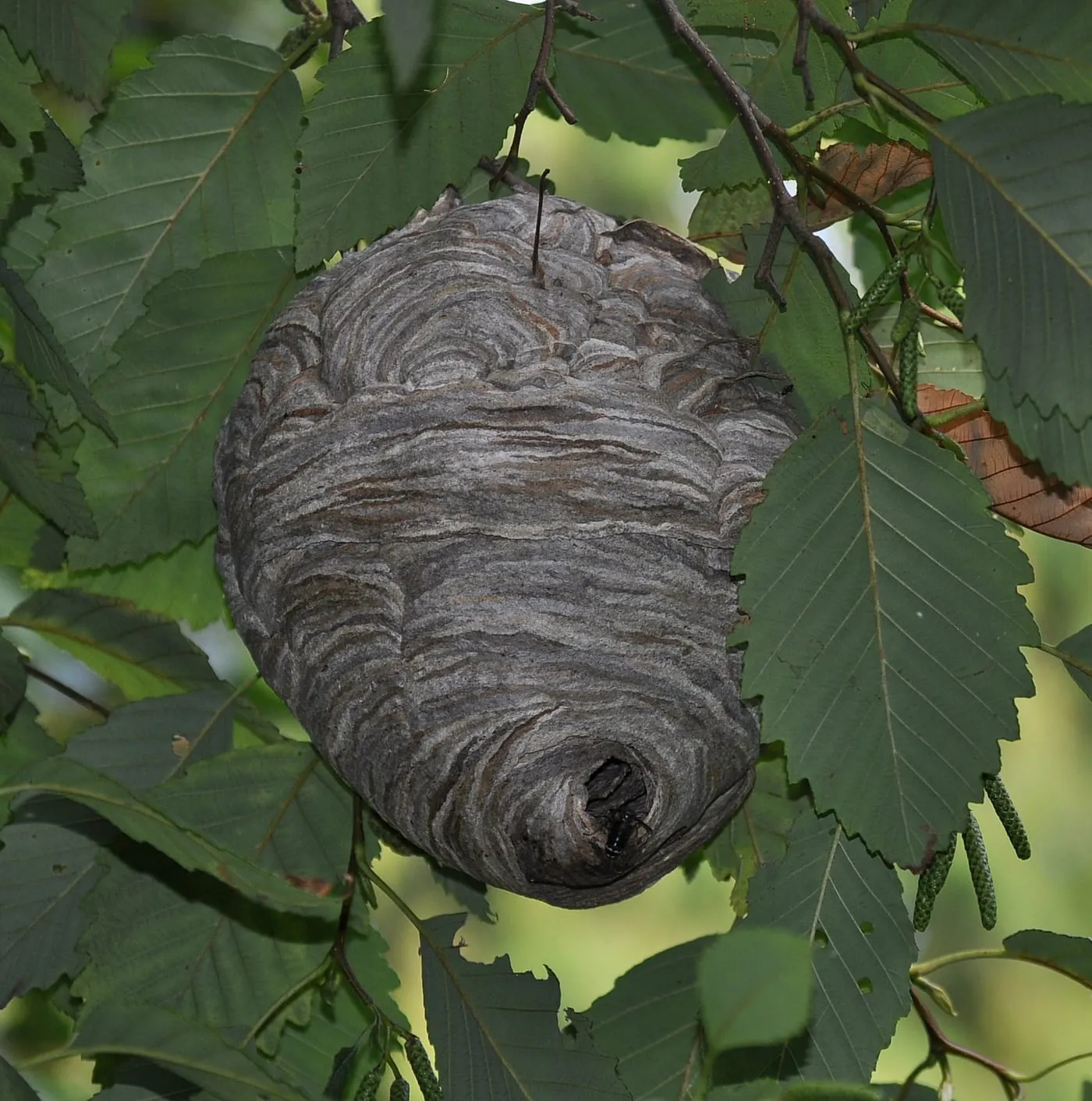
Most likely causes
- Gray football- or basketball-shaped paper nest with a single bottom entrance — bald-faced hornet colony
- Black wasps with white faces flying steady routes to and from the nest — workers foraging
- Golf-ball-size gray nest appearing in spring — a lone founding queen, easiest stage to deal with
- Open umbrella-shaped comb with visible cells — paper wasps, not hornets
- Intact gray nest with zero activity in winter — dead colony; nests are never reused
Not quite what you're seeing? Answer four quick questions and the clue finder will point you to a closer match.
Compare the possible causes
| Possible cause | Key signs | When it happens | How likely |
|---|---|---|---|
| An active bald-faced hornet colony | Enclosed gray nest with a swirled, papier-mâché texture and one entrance hole near the bottom, with black-and-white wasps coming and going | Nests grow from June onward and peak in late summer, when colonies reach 100–400 workers | Common |
| A founding queen's starter nest | A gray nest the size of a golf ball to a tennis ball in spring, with only a single wasp tending it | April through early June, depending on region | Common |
| Paper wasps (the open-comb look-alike) | An umbrella-shaped comb with visible hexagonal cells and no paper envelope, usually under an eave, railing, or grill lid | Spring through fall | Very common |
| European hornets in a cavity | Large brown-and-yellow hornets entering a hollow tree, wall void, or attic vent rather than a hanging ball nest | Summer through fall; uniquely, they also fly at night and bang into lit windows | Less common |
| An abandoned nest after frost | A weathered gray nest with no insect traffic at all, often becoming visible when leaves drop in late fall | Late fall through winter | Common |
Visual clues to check
- Check the shape: fully enclosed gray ball or teardrop with one bottom hole means bald-faced hornets; open comb with visible cells means paper wasps
- Look at the insects: bald-faced hornets are about 5/8 to 3/4 inch, jet black with white markings on the face and tail end
- Watch the traffic from well back — 20 feet or more: steady arrivals and departures at a single bottom entrance confirm an active colony
- Note the season and size: golf-ball nest in spring means one queen; basketball-size nest in August means hundreds of defenders
- Scan likely spots each spring: tree branches, dense shrubs, eaves, deck undersides, and utility poles, before nests get large
- In winter, confirm the colony is dead: no flights on a mild afternoon means the nest is empty and inert
The causes in detail
An active bald-faced hornet colony
Despite the name, bald-faced hornets are actually a native aerial yellowjacket. Workers chew weathered wood into pulp and build layered paper walls around stacked combs, so the nest is completely enclosed — you can't see the cells the way you can with paper wasps. Nests hang in trees and shrubs 3 to 60 feet up, and also show up under eaves, on utility poles, and along fence lines. Many go unnoticed until fall leaf drop reveals them.
A founding queen's starter nest
Each spring an overwintered queen starts a nest alone, raising the first small batch of workers herself. At this stage the colony is one insect and the defensive response is minimal — this is the window when a nest in a bad location is simplest and safest to have removed. By July the same nest can hold hundreds of workers, and the risk calculation changes completely.
Paper wasps (the open-comb look-alike)
If you can see open cells from below, you're looking at paper wasps, not bald-faced hornets. Paper wasp colonies are much smaller — usually a few dozen wasps — and notably less defensive, though they will still sting if the nest is disturbed. The fully enclosed gray envelope is the bald-faced hornet's signature.
European hornets in a cavity
The other true hornet-size wasp in the eastern U.S. nests in enclosed cavities, so you typically see traffic into a hole instead of a visible gray ball. They're brown and yellow rather than black and white. A wall-void nest is another situation for a professional, since treating an entrance wrong can drive the colony indoors.
An abandoned nest after frost
Bald-faced hornet colonies are annual: workers and the old queen die at the first hard frosts, and only new mated queens survive — hibernating in leaf litter, stumps, or under bark, never in the nest. Nests are not reused the following year. Watch an exposed winter nest on a couple of days above 50°F to confirm zero activity, and it can be knocked down and bagged safely, or simply left for weather and birds to shred.
When to worry
- An active nest within about 15–20 feet of a door, deck, patio, driveway, playset, or mowing route — defenders attack when the nest zone is disturbed
- A nest under an eave, in a wall void, or over an entryway where daily vibration and foot traffic can trigger defense
- Anyone in the household with a bee or wasp sting allergy — multiple stings are likely in a defensive attack, and this is an emergency-level risk
- Hornets bumping or striking people who are just walking nearby — a sign the colony is large and already on alert
- Late-summer nests near fruit trees or trash areas where wasp activity concentrates as colonies peak
What to do now
- Identify from a distance — binoculars or a zoomed phone photo — and never tap, shake, or prod the nest to 'check' it
- Mark off the area and reroute kids, pets, and mowing at least 20 feet around the nest until it's handled
- If the nest is high in a tree away from activity areas, consider leaving it alone: the colony kills flies, caterpillars, and other pests all season and dies on its own at first hard frost
- For a nest near doors, decks, or play areas, call a licensed pest control professional — they have the protective gear and treatments to eliminate the colony safely, usually in one visit
- Deal with badly placed starter nests early: a spring golf-ball nest with one queen is a quick, low-risk professional job compared with an August colony
- Remove confirmed-dead nests in winter if you want them gone, and knock down old ones so you can spot new construction next spring
What not to do
- Don't spray, hit, burn, or hose an active nest yourself — bald-faced hornets pour out in seconds and pursue farther than most wasps
- Don't seal or plug an entrance on a structure; trapped hornets will chew toward light and can emerge inside the house
- Don't approach at night assuming they're dormant — the colony is home and still ready to defend, and a flashlight beam draws them to you
- Don't climb a ladder to deal with a nest; a defensive swarm plus a ladder is how sting incidents become fall injuries
- Don't knock down a 'quiet' nest in fall without watching it first on a warm day — colonies stay active until real frosts arrive
Frequently asked questions
How do I get rid of a bald-faced hornet nest?
If the nest is active and anywhere near human activity, hire a licensed pest control professional — they treat the colony through the entrance with proper protective gear, typically in a single visit. If the nest is far from activity areas, the cheapest option is patience: the entire colony dies at the first hard frost and never returns to that nest. Only a confirmed-dead winter nest is safe to remove yourself.
How bad is a bald-faced hornet sting?
Painful — most people rate it worse than a honey bee or yellowjacket sting, with sharp burning pain and swelling that can last a day or more. Because they sting repeatedly and defend as a group, the real danger is getting many stings at once. Anyone with a wasp allergy should treat any sting as urgent.
Will bald-faced hornets come back to the same nest next year?
No. Colonies are annual: everyone but the new mated queens dies in late fall, the queens overwinter in leaf litter or under bark — not in the nest — and old nests are never reoccupied. A new queen may build in the same general area if it's attractive, but the old nest itself is dead weight.
Are bald-faced hornets actually hornets?
Technically no — they're a native aerial yellowjacket that builds its nest in the open instead of underground. The 'hornet' name stuck because of their size and enclosed paper nest. The only true hornet established across much of the U.S. is the European hornet, which is brown and yellow and nests in cavities.
Is it safe to leave a bald-faced hornet nest alone?
Often, yes. A nest high in a tree away from doors, decks, and play areas poses little risk if nobody disturbs it, and the colony consumes large numbers of flies and caterpillars all season. Mark it, give it a wide berth when mowing or pruning, and let frost end the colony naturally.