What Is Eating My Roses? How to Identify the Culprit
Rose bushes are most often eaten by Japanese beetles, rose slugs (sawfly larvae), aphids, leafcutter bees, deer, or rabbits — and each leaves a different signature. Lacy skeletonized leaves in midsummer point to Japanese beetles, translucent 'windowpane' patches in spring point to rose slugs, and cleanly clipped buds and stems point to deer or rabbits.
Most likely causes
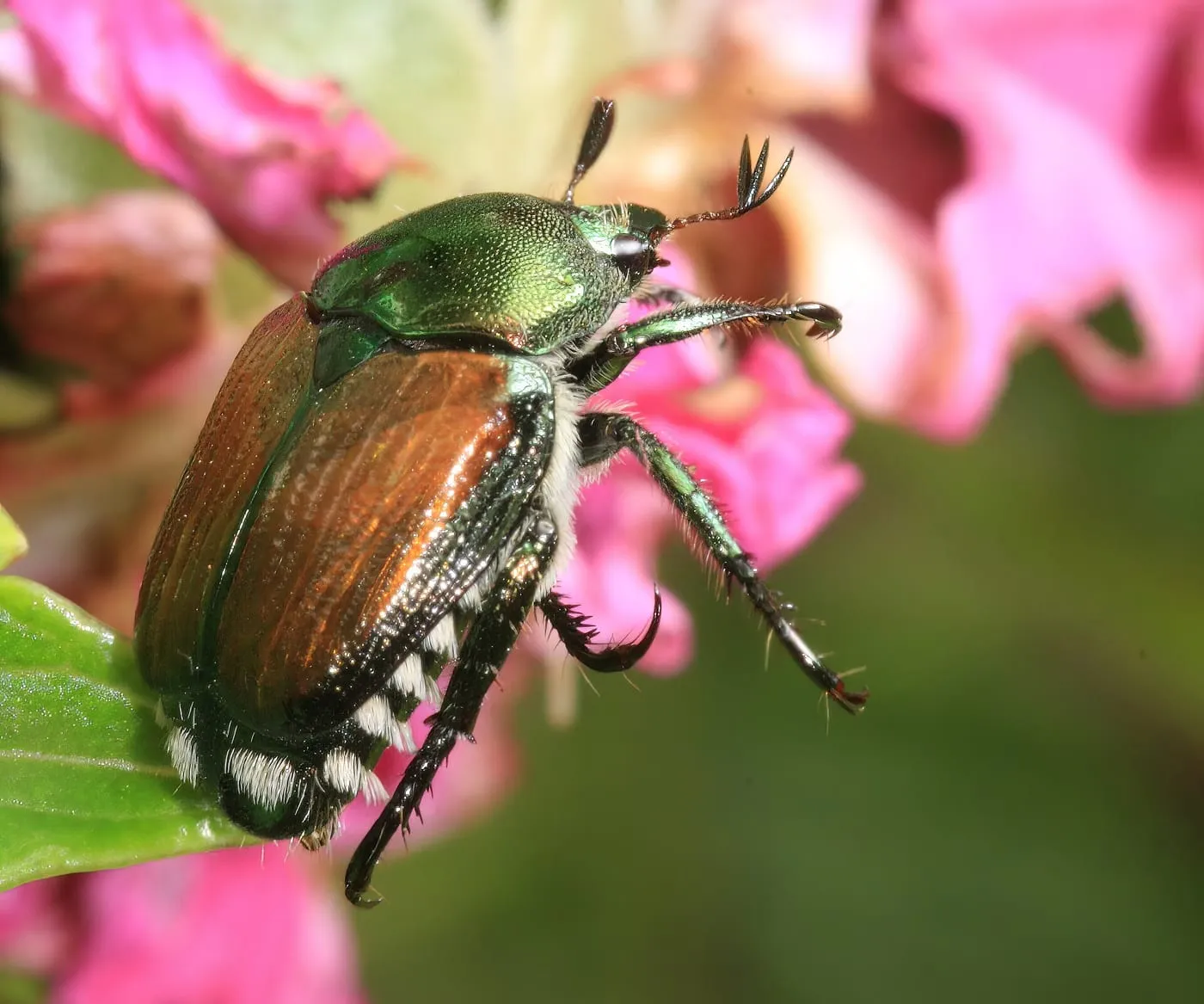
- Japanese beetles — leaves and flowers skeletonized to lace, June through August
- Rose slugs (sawfly larvae) — translucent windowpane patches on spring leaves
- Leafcutter bees — perfect half-circle notches cut from leaf edges
- Aphids — clusters on buds and new shoots, sticky residue, distorted blooms
- Deer — buds and stem tips bitten off with ragged, torn ends
- Rabbits — low canes clipped at a clean 45-degree angle
Not quite what you're seeing? Answer four quick questions and the clue finder will point you to a closer match.
Compare the possible causes
| Possible cause | Key signs | When it happens | How likely |
|---|---|---|---|
| Japanese beetles | Metallic green-and-copper beetles feeding in groups, leaving leaves skeletonized to a lacy web of veins and flowers shredded | Mid-June through August, with feeding heaviest on warm, sunny afternoons | Very common |
| Rose slugs (sawfly larvae) | Pale green, caterpillar-like worms up to half an inch long on leaf undersides, leaving translucent 'windowpane' patches that later turn brown and drop out | Spring through early summer, usually before Japanese beetles show up | Very common |
| Leafcutter bees | Smooth, almost perfectly circular or half-moon notches cut from leaf edges, as if punched with a hole punch | Late spring through summer | Common |
| Aphids | Dense clusters of tiny green or pink insects on buds and new growth, sticky residue on leaves, and buds that open distorted or not at all | Spring flushes of new growth, tapering as summer heats up | Very common |
| Deer | Buds, blooms, and stem tips bitten off entirely, with ragged, torn ends — often to a uniform browse height of 2 to 4 feet | Year-round, worst in late spring bud season and in fall and winter when wild food thins out | Common |
| Rabbits | Low canes and young shoots clipped off at a clean 45-degree angle, typically within 18 inches of the ground | Year-round; worst on new spring growth and on canes in winter when food is scarce | Less common |
Visual clues to check
- Check the damage pattern: lacy skeletonized leaves mean beetles or rose slugs; smooth half-circles mean leafcutter bees; missing buds mean deer or rabbits
- Look at the cut ends: ragged and torn points to deer, clean 45-degree snips low on the plant point to rabbits
- Flip the leaves: pale green sawfly larvae hide on the undersides in spring, right along the veins
- Do a day-versus-night check: Japanese beetles feed openly at midday, while slugs, some caterpillars, and deer do their work after dark
- Inspect at dusk or dawn with a flashlight if daytime inspection shows nothing — nocturnal feeders rarely leave themselves in view
- Note the height: damage above 2 feet rules out rabbits; damage confined to low canes rules out deer
- Look for sticky, shiny residue on leaves below the buds — that's aphid honeydew, and the colony is directly above it
The causes in detail
Japanese beetles
No pest hits roses harder in midsummer. Japanese beetles are about half an inch long, feed in broad daylight in clusters, and prefer blooms and the tender tissue between leaf veins — which is why damaged leaves look like brown lace. They release scents that attract more beetles, so a lightly hit bush can be swarmed within days. Their grubs, meanwhile, may be feeding in your lawn.
Rose slugs (sawfly larvae)
Despite the name, rose slugs aren't slugs — they're the larvae of sawflies, small non-stinging wasp relatives. Young larvae rasp away one leaf surface and leave the other intact, creating see-through windows; older larvae chew clean holes. Because they aren't true caterpillars, some caterpillar-specific treatments do nothing to them, but they're soft-bodied and easy to remove by hand or knock off with a hose.
Leafcutter bees
If the notches look too neat to be chewing, they are — leafcutter bees slice out precise leaf discs to line their nest cells. The bees are gentle, solitary, and among the best pollinators in your yard, and the cosmetic damage does not harm an established rose. This is one rose 'pest' worth celebrating: no control is needed or recommended.
Aphids
Rose aphids don't chew — they pierce and suck sap — but the effect on buds reads as 'something eating my roses': stunted shoots, puckered leaves, and blooms that fail. The sticky honeydew they excrete attracts ants and grows black sooty mold. A hard blast of water every few days knocks them back, and ladybugs and lacewings usually catch up with them by early summer.
Deer
Deer treat rose buds as dessert and, lacking upper front teeth, they tear rather than snip — so damaged stems look shredded, not cut. Damage appears overnight, often with heart-shaped tracks or oval droppings nearby. One deer can strip every bud from a bush in a single visit, thorns and all. See all deer signs →
Rabbits
Rabbit damage is the mirror image of deer damage: low instead of high, and razor-clean instead of ragged, because rabbits have sharp paired incisors. Look for pea-sized round droppings and tufts of fur near the base of the bush. In winter, rabbits will also gnaw bark from lower canes, which can kill the cane above the wound. See all rabbits signs →
When to worry
- Complete defoliation of a young or newly planted rose, which may not have the reserves to recover
- Japanese beetles arriving in growing numbers day after day — infestations snowball fast once feeding scents build up
- Winter bark gnawing that girdles canes near the base, which kills everything above the wound
- Deer browsing that repeats nightly, since deer return to a reliable food source all season
- Sooty black mold coating leaves under heavy aphid clusters, which blocks light and weakens the plant
What to do now
- Identify first: match the damage pattern and check the plant at both midday and dusk before treating anything
- Handpick Japanese beetles in the early morning when they're sluggish, knocking them into a bucket of soapy water — done daily, this genuinely reduces damage
- Hose off aphids and rose slugs with a strong jet of water every few days; both are soft-bodied and rarely climb back
- Prune off badly skeletonized leaves and spent shredded blooms so the bush puts energy into clean new growth
- For deer and rabbits, physical barriers beat repellents: fencing, netting during bud season, or a cylinder of hardware cloth around the base for winter rabbit protection
- Leave leafcutter bee damage alone — it's cosmetic, and the bees are valuable pollinators
- If a prized rose is being destroyed despite your efforts, ask a local extension office or professional to confirm the pest — treatment only works when it targets the right culprit
What not to do
- Don't hang a Japanese beetle bag trap next to your roses — traps lure far more beetles into the yard than they catch, and feeding often gets worse nearby
- Don't spray broad insecticides on blooming roses; you'll kill the bees and the ladybugs that eat your aphids while barely denting the actual pest
- Don't treat leafcutter bee notches as a pest problem — no spray is appropriate for a beneficial pollinator causing cosmetic damage
- Don't assume caterpillar products will handle rose slugs; sawfly larvae aren't caterpillars, and some biological caterpillar treatments won't touch them
- Don't blame insects for clipped-off buds without checking for tracks and droppings first — spraying does nothing when the culprit is a deer
Frequently asked questions
What is eating my rose leaves but I can't see any bugs?
Invisible daytime damage usually means the feeder works at night or hides by day. Check leaf undersides for pale green rose slug larvae, look for slime trails or clipped stems, and inspect the bush with a flashlight an hour after dusk. Deer damage also appears overnight — look for missing buds, torn stem ends, and tracks in soft soil.
Should I kill the bees cutting circles in my rose leaves?
No. Those half-moon notches are made by leafcutter bees, gentle solitary pollinators that use the leaf pieces to line their nests. The damage is purely cosmetic and doesn't weaken an established rose, and these bees rarely sting. They're protected as beneficials in spirit if not in law — enjoy them.
What eats rose buds before they open?
If the whole bud is gone, suspect deer — they bite buds off entirely, leaving ragged stem ends. If buds are present but deformed, sticky, or refusing to open, aphids clustered on the bud are the likely cause. Small ragged holes chewed into the side of a bud usually mean a caterpillar, such as a budworm.
Do Japanese beetles on my roses mean grubs in my lawn?
Quite possibly. Adult Japanese beetles lay eggs in turf in mid-summer, and those eggs hatch into the white grubs that eat grass roots in late summer and fall. A heavy beetle year on your roses is a good prompt to check the lawn for grubs in August or September.