Yellow Mushrooms in Potted Plants: Harmless or a Problem?
Bright yellow mushrooms popping up in a potted plant are almost certainly Leucocoprinus birnbaumii, the flowerpot parasol — a tropical fungus that rides into your home in potting soil and fruits when conditions turn warm and moist. It won't hurt your plant at all; it lives on decaying organic matter in the mix, not on roots. The only real concern is that the mushrooms are toxic if eaten, so households with small children or pets that nibble should remove them.
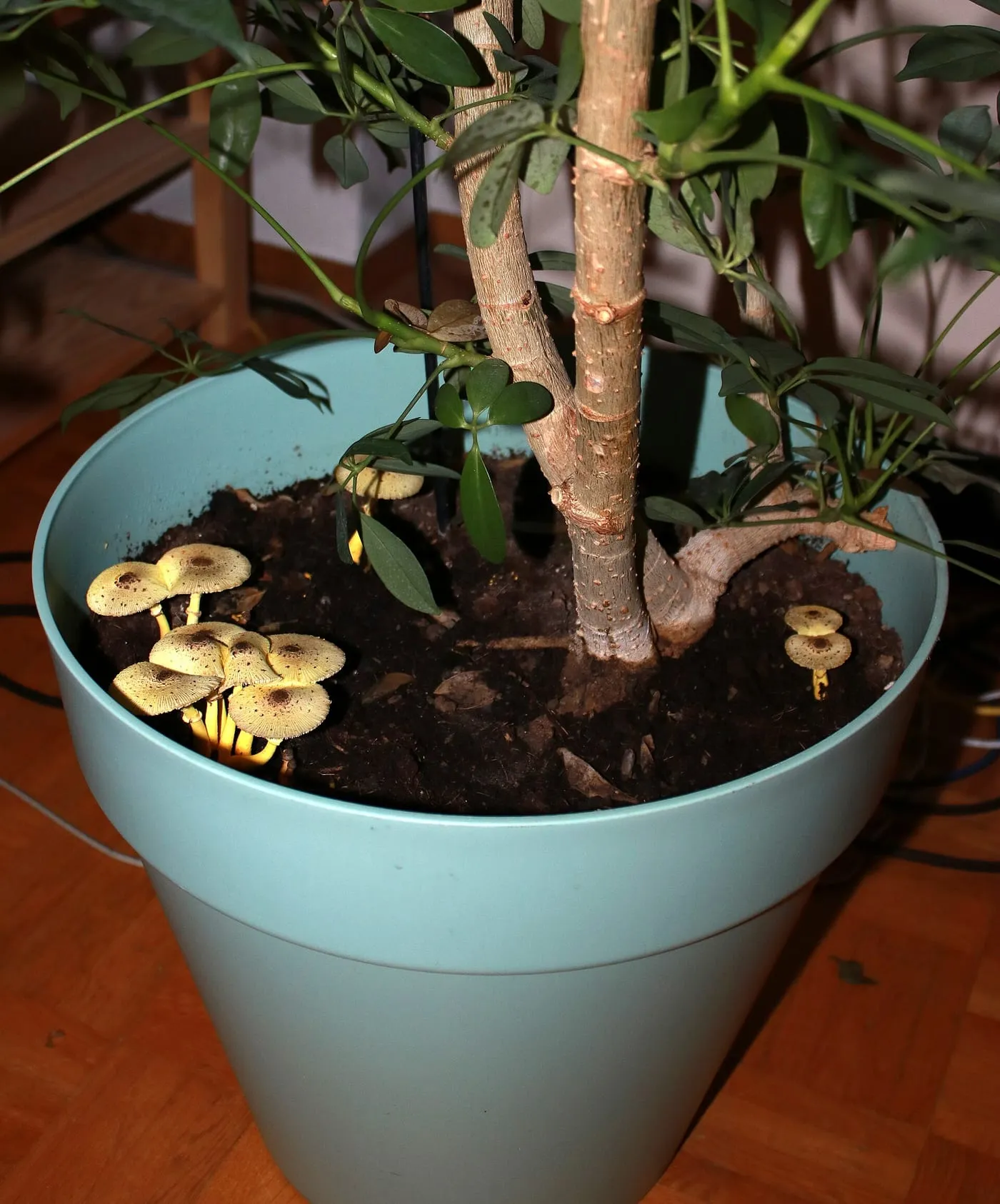
Most likely causes
- Leucocoprinus birnbaumii (flowerpot parasol) — lemon-yellow caps, harmless to the plant
- Other potting-mix fungi — small tan or white mushrooms from the same source
- Yellow slime mold or soil mold — a crusty or fuzzy patch rather than a true mushroom
Not quite what you're seeing? Answer four quick questions and the clue finder will point you to a closer match.
Compare the possible causes
| Possible cause | Key signs | When it happens | How likely |
|---|---|---|---|
| Leucocoprinus birnbaumii (the flowerpot parasol) | Vivid lemon- to sulfur-yellow mushrooms, 1 to 3 inches tall, with oval caps that open into ribbed parasols; often several at once, fading paler as they age | Any time of year indoors, most often in summer or whenever soil stays warm and consistently damp | Very common |
| Other potting-mix mushrooms | Small tan, brown, or white mushrooms — sometimes with a fringed, cone-shaped cap — appearing alone or in clusters and vanishing within a day | Warm, humid stretches, or shortly after repotting with fresh mix | Less common |
| Yellow slime mold or surface mold | A flat, crusty, foamy, or fuzzy yellow patch spreading across the soil surface instead of a stalked mushroom | After a period of overwatering, especially in pots with poor drainage | Rare |
Visual clues to check
- Check the color and shape: pale to bright lemon-yellow with an oval cap opening to a ribbed parasol is the flowerpot parasol's signature look
- Watch the timeline: these mushrooms appear almost overnight and wilt within a day or two — a fast cycle is typical, not alarming
- Inspect the soil surface for yellow threads or small yellow bumps: that's the fungus's mycelium and baby mushrooms getting started
- Feel the soil: if it's damp an inch down days after watering, you've found why the fungus is fruiting
- Check the plant itself: healthy leaves and normal growth alongside mushrooms confirm the fungus is eating the potting mix, not the plant
- Note when it started: mushrooms soon after repotting or buying a new plant point to spores that arrived with the mix
The causes in detail
Leucocoprinus birnbaumii (the flowerpot parasol)
This tropical species is the classic houseplant mushroom worldwide — it can't survive winters outdoors in most of the US, but heated homes and greenhouses suit it perfectly. Its spores or threadlike mycelium arrive already in the bagged potting mix or in a nursery plant's root ball, then sit invisibly until warmth and moisture trigger fruiting. It's a decomposer, feeding only on the dead organic matter in the mix (peat, bark, compost), so your plant isn't being attacked; some growers even consider it a sign of biologically active soil. Each mushroom lasts only a day or two before collapsing.
Other potting-mix mushrooms
The flowerpot parasol has relatives and neighbors: various small decomposer fungi come bundled in compost-rich potting soils and fruit under the same warm, damp conditions. Like their yellow cousin, they feed on the mix rather than the plant, appear fast, and collapse fast. Identification to species is genuinely difficult even for experts, which is exactly why the household rule is simple — no mushroom from a pot goes anywhere near a mouth.
Yellow slime mold or surface mold
If the yellow growth has no stem and cap — more of a scrambled-egg blob or a fuzzy film — you're looking at a slime mold or a saprophytic surface mold rather than a mushroom. These also feed on organic matter and won't harm the plant, but they're a louder signal that the soil is staying too wet. Scrape the patch off, let the top inch or two of soil dry out, and improve airflow around the pot.
When to worry
- A toddler or a pet that chews plants has access to the pot — the mushrooms are toxic if eaten, so remove them and move the pot out of reach
- You suspect a child or pet has already eaten any part of a mushroom — treat it as a poisoning call, not a wait-and-see
- The plant itself is declining — yellowing leaves, mushy stems, or a swampy smell mean chronic overwatering or root rot, a separate problem the mushrooms merely hint at
- Fungus gnats are swarming the pot along with the mushrooms, another sign the soil is staying too wet
What to do now
- If kids or pets are around, pluck mushrooms as soon as they appear — wear gloves or use a plastic bag as a mitt, and put them in the trash, not the compost
- Scrape off and replace the top 2 inches of potting mix to remove the surface mycelium and unopened buttons
- Let the soil dry out more between waterings and empty saucers promptly — drier cycles make fruiting far less frequent
- For a persistent crop, repot: knock off as much old mix as the plant tolerates, rinse the roots gently, wash the pot with hot soapy water, and refill with fresh mix
- Or simply coexist: if no one in the house will eat them, the mushrooms are harmless to plant and people alike, and many owners just enjoy the surprise
- If a child or pet eats one, don't wait for symptoms — call Poison Control at 1-800-222-1222 (for pets, your veterinarian or a pet poison hotline) and save a sample or photo of the mushroom
What not to do
- Never eat the mushrooms or let anyone taste-test them — Leucocoprinus birnbaumii causes significant stomach upset, and lookalikes can be worse
- Don't rely on a photo app to declare a pot mushroom edible; small yellow species are easy to misidentify
- Don't drench the pot with fungicide — it's poorly effective against fungi living throughout the mix and harsher on your plant than the mushrooms are
- Don't toss contaminated soil into your compost or houseplant watering can rotation if you're trying to eliminate the fungus; bag it for the trash
- Don't panic-repot a thriving plant in the middle of winter over a few mushrooms — they're cosmetic, and repotting stress is real
Frequently asked questions
Will yellow mushrooms hurt my houseplant?
No. The flowerpot parasol is a decomposer that feeds on dead organic matter in the potting mix — peat, bark, and compost — not on living roots. Your plant and the fungus are neighbors, not enemies. If the plant looks unhealthy, look to watering habits and drainage rather than the mushrooms.
Where did the mushrooms come from? I never had them before.
They almost certainly arrived in the potting soil or in the root ball of a nursery plant, as spores or dormant fungal threads. The fungus can sit unnoticed for months until warmth and steady moisture trigger fruiting — which is why mushrooms often first appear in summer or after you settle into a generous watering routine.
How do I get rid of them permanently?
Honestly, it's hard — the fungal network runs all through the mix, so picking mushrooms only removes the fruit. Your best odds come from a full repot with fresh mix, a washed pot, and gently rinsed roots, plus letting the soil dry more between waterings. Even then it can return. If no children or pets are at risk, coexistence is the low-effort answer.
Are the mushrooms dangerous to touch?
Touching them briefly isn't the hazard — ingestion is. That said, use gloves or a bag when removing them, wash your hands afterward, and teach kids that houseplant mushrooms are look-only. The gloves habit matters mostly because it keeps any mushroom handling consistent and safe.
Do the mushrooms mean I'm overwatering?
Often, yes — fruiting is triggered by warm, consistently damp soil, so a steady crop of mushrooms is a nudge to check your watering. Let the top inch or two dry out between waterings and make sure the pot drains freely. Less moisture won't kill the fungus, but it usually stops the mushrooms.