Signs of Rats in Your Yard (and What to Do)
Classic rat signs are smooth, worn burrow openings 2–3 inches across near foundations, decks, and sheds; dark greasy rub marks along walls and pipes; fresh gnaw marks on wood and plastic; and capsule-shaped droppings 1/2–3/4 inch long. Rats work at night — daytime digging and sightings point to chipmunks or squirrels instead.
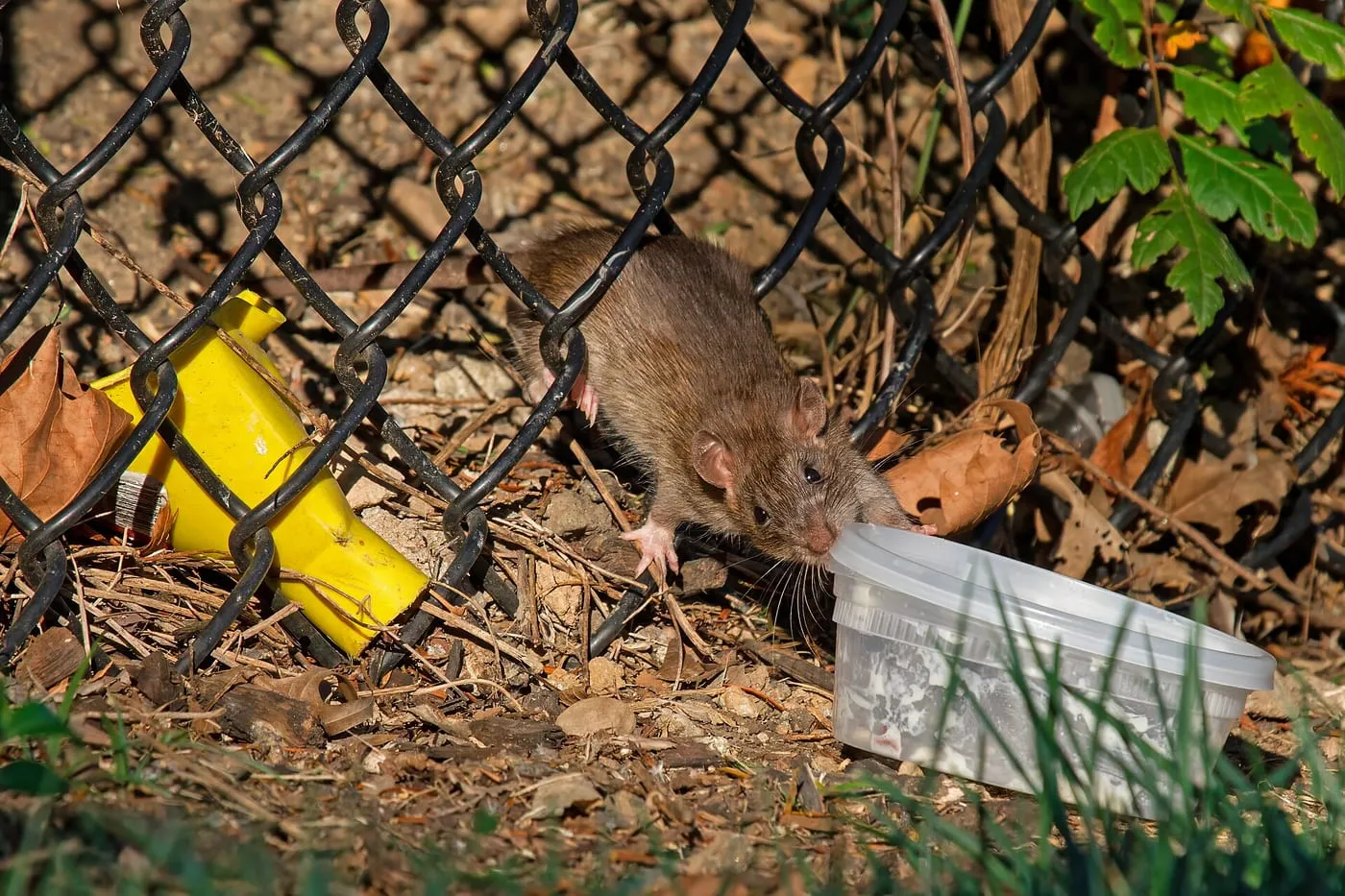
Key signs of rats
- Burrow entrances 2–3 inches in diameter with smooth, hard-packed, worn edges and a fan of excavated soil, usually against a foundation, slab, shed, or compost bin
- Dark, greasy rub marks (sebum smears) along wall bases, pipes, beams, and hole edges on habitual travel routes
- Capsule-shaped droppings 1/2–3/4 inch long with blunt ends, concentrated along runways and near food
- Fresh gnaw marks — paired tooth grooves about 1/8 inch wide — on wood, plastic bins, garbage lids, and wiring
- Worn runways: smooth, packed paths 2–3 inches wide hugging walls and fence lines, free of grass and debris
- Scratching, scurrying, or squeaking at night in walls, crawl spaces, or under decks — rats are nocturnal
- Pets fixating on one spot along a wall, under a deck, or at a shed base
Compare rats with other visitors in our animal tracks chart and yard hole size chart.
What the evidence looks like
| Sign | What it looks like | Where you'll find it |
|---|---|---|
| Foundation burrow | A smooth, worn hole 2–3 inches across, edges polished by traffic, with kicked-out dirt fanned to one side | Against foundations and slabs, under decks and sheds, beside compost bins and woodpiles |
| Greasy rub marks | Dark, oily smudges at rodent height that smear when rubbed — body oil and dirt deposited over many trips | Along wall bases, on pipes and joists, and around the edges of entry holes |
| Capsule droppings | Dark, blunt-ended pellets 1/2–3/4 inch long, the size of a raisin — much bigger than 1/4-inch pointed mouse droppings | Along runways, in the garage or shed, under decks, near garbage and pet food |
| Gnaw marks | Fresh pale wood or shaved plastic with parallel tooth grooves; holes chewed through door corners and bin lids | Garage door bottoms, shed corners, garbage and feed bins, wiring, and irrigation lines |
| Packed runways | Narrow, smooth dirt paths worn free of vegetation, sometimes with tail drag marks in dust or mud | Tight along walls, fences, and foundation lines between the burrow and food |
Habits worth knowing
The yard-burrowing rat across most of the US is the Norway rat (brown rat), a ground-dweller that digs shallow burrow systems under slabs, decks, sheds, and dense vegetation. In warm coastal and southern regions, roof rats are also common — they nest above ground in trees, vines, and attics rather than in burrows, but leave the same rub marks and droppings (theirs are slightly smaller with pointed ends).
Rats are almost entirely nocturnal and deeply cautious about new objects, which is why you can have a substantial population without ever seeing one. Seeing rats in daylight usually means the population is large enough that competition is pushing animals out at off-hours.
Rats live in colonies and breed fast — a female can produce several litters a year, each of 6–12 pups that mature in about three months. They need food, water, and harborage within a range of roughly 100–150 feet, so the source of a yard problem (garbage, pet food, chicken feed, fallen fruit, birdseed, compost with food scraps) is almost always close by.
Often confused with
- Mice — Everything mouse-scale is smaller: droppings about 1/4 inch with pointed ends (rat droppings are 1/2–3/4 inch and blunt), pencil-width gnaw holes, and entry gaps as small as a dime. Mice rarely dig yard burrows; a 2–3 inch worn burrow means rats.
- Chipmunks — Chipmunk holes are about the same size but clean, with no dirt fan, no greasy edges, and daytime traffic by a small striped animal. Rat burrows look used — worn smooth and grimy — with excavated soil at the entrance and activity after dark.
What to do now
- Confirm activity: lightly rake soil flat at a suspected burrow or dust a runway with flour, then check for fresh tracks, reopened holes, and new droppings within a couple of nights
- Cut off food first — nothing else works until this is done: garbage in tight-lidded cans, pet food and chicken feed brought in overnight, birdseed spills cleaned up, fallen fruit picked up, and no meat or cooked scraps in open compost
- Remove harborage: clear dense ivy and shrubs from the foundation line, elevate woodpiles and lumber 18 inches off the ground, and haul away junk piles
- Harden the house: seal gaps larger than 1/2 inch with hardware cloth, sheet metal, or mortar (not foam alone — rats chew through it), fit door sweeps, and screen crawl-space vents
- If you trap, use full-size rat snap traps secured inside tamper-resistant boxes placed along walls and runways, unset but baited for several days first to beat rats' wariness of new objects
- For an established colony, active burrows, or rats inside the house, call a licensed pest control professional — colony-scale rat work needs sustained baiting or trapping programs plus exclusion, and it's what the pros do every day
What not to do
- Don't scatter rat poison in the yard or use it outside tamper-resistant bait stations — it's illegal off-label and a leading cause of poisoning in dogs, cats, hawks, and owls; poisoned rats also die in walls and under decks
- Don't handle rats, dead or alive, with bare hands, and don't sweep or vacuum dry droppings — wet them down with disinfectant first and wear gloves
- Don't seal burrow or wall openings until you've confirmed no activity for several days — a rat sealed inside a wall will gnaw its way somewhere worse
- Don't use glue boards outdoors or for rats generally — they're inhumane, catch non-target animals, and an adult rat often drags the board away
- Don't stop control the first quiet week; a rat colony rebounds fast if food returns or the last females survive
Frequently asked questions
How do I know how many rats I have?
Judge by sign density, not sightings. A few droppings and one burrow may be a pioneering pair; multiple active burrows, heavy rub marks, and droppings in several areas indicate an established colony of a dozen or more. Any rat seen in daylight suggests a large population.
How can I tell rat droppings from mouse droppings?
Size and shape. Rat droppings are 1/2–3/4 inch long, thick, and capsule-shaped with blunt ends — about raisin-sized. Mouse droppings are 1/4 inch or less with pointed tips, closer to a grain of rice. Fresh droppings of either kind are dark and glossy; old ones are gray and crumbly.
Will rats get from the yard burrow into my house?
Often, yes — a foundation burrow is frequently the staging area. Rats can squeeze through a 1/2-inch gap, climb rough walls and pipes, and gnaw through wood, plastic, and even soft mortar. Sealing entry points while eliminating the outdoor food source is the core of the fix.
Do rats bite people or pets?
Cornered or handled rats bite, and bites can transmit rat-bite fever — any bite warrants a doctor visit. Free-roaming rats avoid people and most pets, but dogs and cats that catch rats can be exposed to leptospirosis and to poison the rat has eaten, which is another reason to keep rodenticides in professional hands.
Why do I suddenly have rats?
Something changed within about 150 feet: a new food source (chickens, bird feeders, unsecured garbage, fruit drop), new shelter (junk pile, thick ivy), or displacement from a neighboring property, construction site, or sewer work. Finding and fixing that attractant matters more than any trap.