Signs of Armadillos in Your Yard (and What to Do)
The classic armadillo sign is dozens of shallow, cone-shaped holes 1–3 inches deep and wide punched across the lawn overnight — each one a snout-poke after grubs and worms. Add a smooth-sided burrow entrance 7–8 inches across near a stump, brush pile, or foundation and you've confirmed it. Skunks make similar grub holes, but skunks never dig big burrow entrances like that, and armadillo damage arrives in far greater numbers per night.
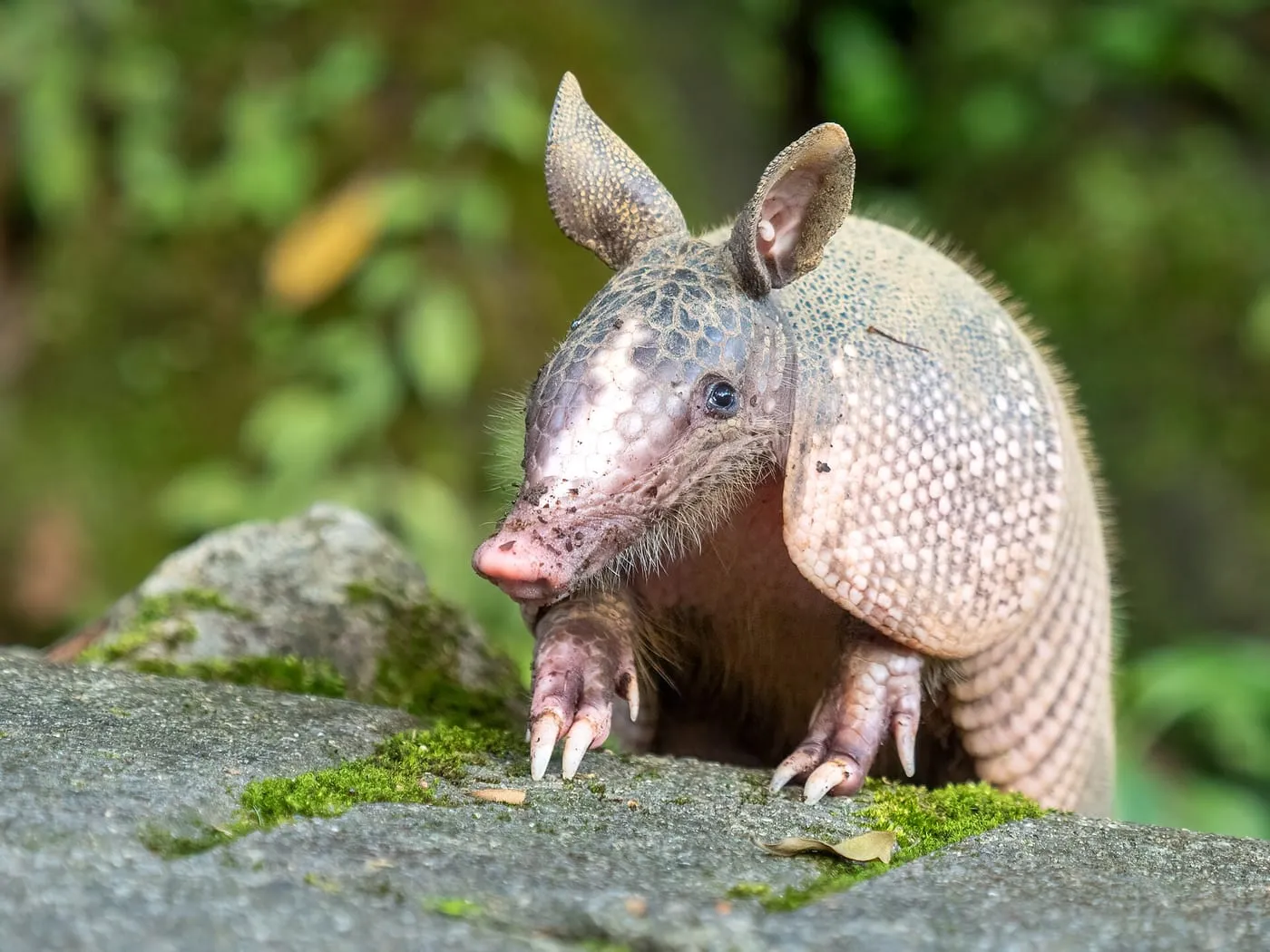
Key signs of armadillos
- Dozens of shallow, cone-shaped holes 1–3 inches wide and deep scattered across the lawn, appearing overnight
- Larger burrow entrances 7–8 inches in diameter with smooth sides, at the base of stumps, brush piles, slabs, or foundations
- Divots and rooted-up patches in mulch beds and soft, moist soil — the easiest digging gets hit hardest
- Uprooted seedlings and disturbed flower beds where the animal plowed its snout through, without the plants being eaten
- Four-toed front and five-toed hind tracks with prominent claw marks, sometimes with a tail-drag line between them
- Grunting, rustling, and surprisingly loud rooting noises at night — armadillos have poor eyesight and don't notice observers
- Damage concentrated after rain, when soil is soft and grubs and earthworms sit near the surface
Compare armadillos with other visitors in our animal tracks chart and yard hole size chart.
What the evidence looks like
| Sign | What it looks like | Where you'll find it |
|---|---|---|
| Cone-shaped snout holes | Neat, conical divots 1–3 inches wide and deep, as if someone pressed an ice-cream cone into the turf — dozens per night | Across the lawn, worst in moist areas, and in mulch and flower beds after rain |
| Burrow entrances | A smooth, rounded opening 7–8 inches across, roughly the size of the animal, often with a shallow dirt apron | Against stumps, rock and brush piles, sidewalk and shed slabs, foundations, and dense shrubs |
| Rooted-up mulch and beds | Mulch flipped and furrowed, seedlings uprooted but uneaten, soil plowed in short snout-width troughs | Flower beds, mulch rings around trees, vegetable garden edges, compost margins |
| Clawed tracks with tail drag | Prints showing three to four long, clawed center toes (hind feet show five), occasionally connected by a thin drag line from the tail | Soft mud near diggings, garden beds, and along fence-line travel routes |
Habits worth knowing
The nine-banded armadillo is a nocturnal insectivore that eats grubs, beetles, earthworms, ants, and other soil invertebrates, located almost entirely by smell — its eyesight is poor. It forages by walking a zigzag and punching its pointed snout into the soil, which is why one animal leaves dozens of small cone-shaped holes in a single night, especially after rain softens the ground.
Armadillos are prolific diggers, maintaining several burrows within a home range — entrances run 7–8 inches wide and tunnels can extend 10–15 feet, up to several feet deep. Burrows placed under slabs, sheds, and foundation edges can undermine them over time, and abandoned burrows get adopted by skunks, rabbits, and snakes.
Originally a Texas and Gulf Coast species, the nine-banded armadillo has been expanding its US range for decades and is now established across the Southeast and reported as far north as the lower Midwest — Missouri, Kansas, southern Illinois — and into North Carolina and Virginia. Mild winters keep pushing the line north, so armadillo damage now shows up in yards where it was unheard of a generation ago.
They are active mostly at night in summer (dodging heat) and shift toward warmer afternoon hours in winter. Females reliably give birth to identical quadruplets in spring, and armadillos startle dramatically — they jump straight up when frightened, which is why road mortality is so high.
Often confused with
- Skunks — Skunks dig similar shallow grub holes, but skunk work is usually fewer, messier divots plus flaps of turf peeled sideways, often with musky odor nearby. Armadillos leave neat cone-shaped punches by the dozen and, unlike skunks, dig large 7–8 inch burrow entrances.
- Moles — Moles work from below, leaving raised surface ridges and volcano-shaped mounds with no open holes; armadillos work from above, punching open cone-shaped holes with no ridges or mounds. If you can see into the hole, it wasn't a mole.
What to do now
- Confirm activity: rake the divots flat and check the next morning — fresh cone-shaped holes overnight, especially after rain or watering, mean an active armadillo
- Fence vulnerable beds with 24-inch fencing buried 12–18 inches and angled outward at the bottom; armadillos are strong diggers but poor climbers, so a buried, out-angled footer defeats them
- Screen the spaces under decks, sheds, and slab edges with hardware cloth trenched 18 inches deep before a burrow starts — prevention is far easier than eviction
- Reduce the draw: cut back on irrigation that keeps soil soft and grub-rich, treat a heavy grub infestation, and clear brush and rock piles that shelter burrow entrances
- If a burrow is active, wait until the animal exits at night (loosely stuff the hole with newspaper to detect passage), then fill it in stages and screen the site
- For a burrow under your foundation, AC pad, or shed slab — or repeated returns despite exclusion — contact a licensed wildlife control professional; armadillo trapping rules vary by state and relocation is often prohibited
What not to do
- Don't handle armadillos or dig one out by hand — beyond the disease consideration, they have strong claws and startle violently, leaping straight upward when grabbed
- Don't rely on repellents, mothballs, or ultrasonic spikes — none have credible evidence against armadillos, and mothball misuse is illegal and toxic to pets and soil
- Don't fill a burrow while the animal is inside — you'll entomb it (or the skunk or snake that moved in) under your slab
- Don't shoot or poison armadillos — discharge is illegal in most residential areas, no toxicant is registered for armadillos, and state rules on lethal control vary widely
- Don't trap and relocate on your own; several states prohibit relocating armadillos precisely because of disease concerns, and rules change — a licensed professional knows the current law
Frequently asked questions
Can I catch leprosy from an armadillo in my yard?
The risk from simply having one visit your yard is close to zero. Nine-banded armadillos can naturally carry the leprosy bacterium, but the rare documented human cases involve handling armadillos or eating their meat. Don't touch them, wear gloves for burrow cleanup, and there's no reason for alarm.
How many armadillos are digging up my lawn?
Usually just one or two. A single foraging armadillo punches dozens of snout holes in a night, so the damage dramatically overstates the headcount. Armadillos are mostly solitary, though a female's litter of identical quadruplets can share her range for a season.
Will an armadillo burrow damage my foundation or AC pad?
It can over time. Burrow entrances are 7–8 inches wide with tunnels reaching 10–15 feet, and when they run under a slab, footing, or AC pad, the moved soil can cause settling and cracking. A burrow against a structure is the one armadillo sign that shouldn't wait.
Why did armadillos suddenly show up in my state?
Their range has been expanding north and east for decades — from Texas and the Gulf Coast across the Southeast, into Missouri, Kansas, southern Illinois, and toward the mid-Atlantic. Milder winters and their fast reproduction keep the line moving, so first-time sightings in new counties are now routine.
Do armadillos bite, and are they dangerous to pets?
They almost never bite — their tiny peg teeth are built for insects, and their defenses are digging in, armor, and a startling vertical jump. Keep dogs from wrestling one (claws and disease caution both apply), but an armadillo poses little direct danger to people or pets.