Animal Tracks in Snow: Identify Your Winter Visitors
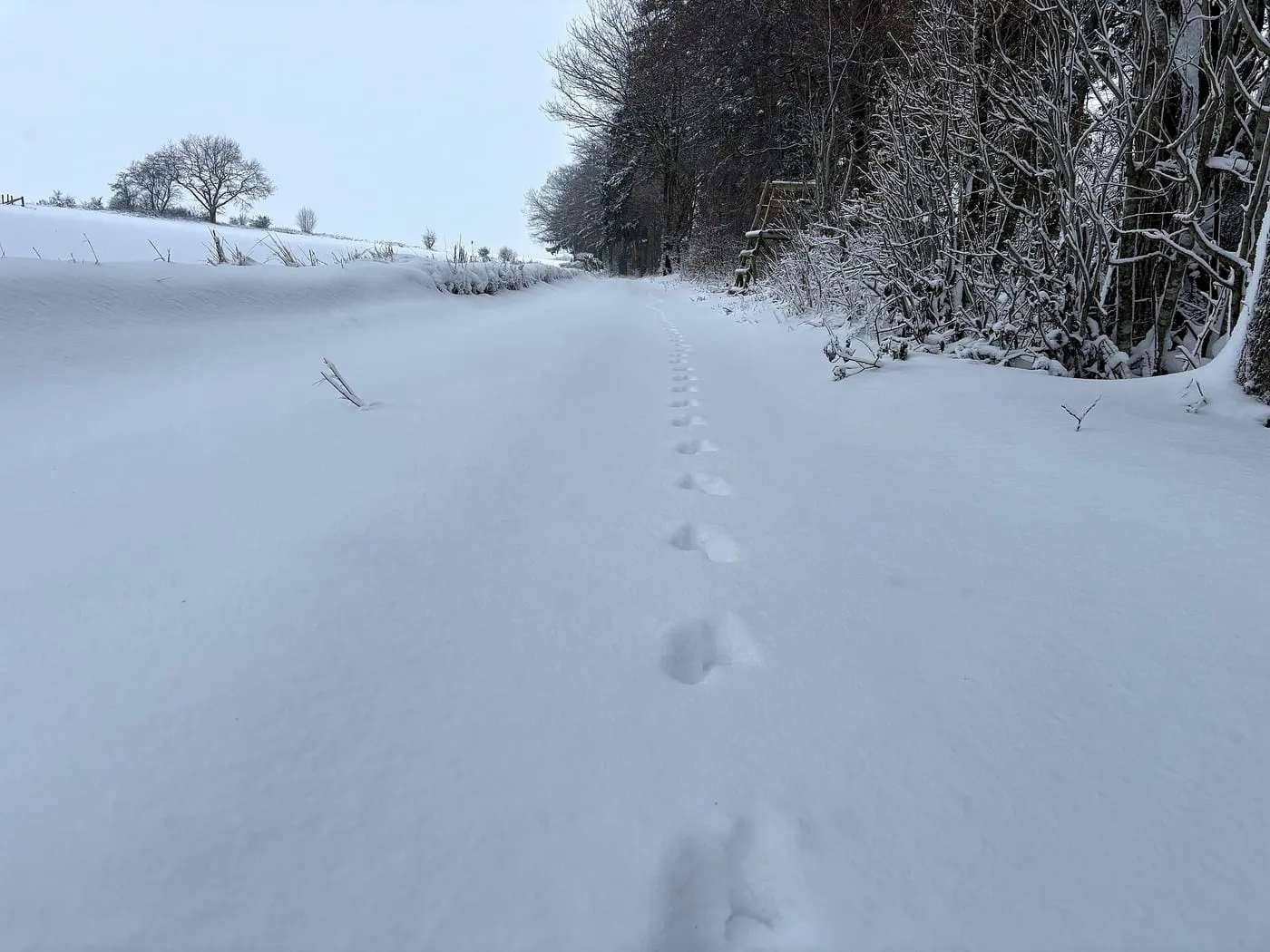
Animal tracks in snow are most often left by rabbits, squirrels, deer, foxes, or a neighborhood cat or dog. Fresh snow is the best tracking surface your yard will ever offer, and the trail pattern — bounding sets, paired feet, heart shapes, or a dead-straight line — usually identifies the animal faster than any single print.
Most likely causes
- Rabbits — repeating Y-shaped bound sets, big back feet landing ahead of the front
- Squirrels — blocky clusters with front feet paired side by side, trail running tree to tree
- Deer — split, heart-shaped prints 2–3.5 inches long
- Foxes and coyotes — small oval canine prints in a remarkably straight single-file line
- Cats and dogs — four-toed prints; no claw marks means cat, claws and a wandering line means dog
- Mice and voles — tiny stitched trails, sometimes with a thin tail-drag line down the middle
Not quite what you're seeing? Answer four quick questions and the clue finder will point you to a closer match. Or compare toe counts, sizes, and trail patterns side by side in our animal tracks identification chart.
Compare the possible causes
| Possible cause | Key signs | When it happens | How likely |
|---|---|---|---|
| Rabbits | Groups of four prints in a repeating Y: two long back-foot prints side by side in front, two smaller front prints staggered behind | All winter, most active at dawn and dusk; trails run between shrubs, brush piles, and feeding spots | Very common |
| Squirrels | Boxy four-print clusters about 4 inches across, with the front feet landing paired side by side rather than staggered | Daytime only — squirrels sleep through winter nights, so tracks appearing overnight rule them out | Very common |
| Deer | Two-toed, heart-shaped prints 2–3.5 inches long with the pointed end aiming in the direction of travel | Overnight and at dawn and dusk; winter yards near woods see far more deer traffic than owners realize | Common |
| Foxes and coyotes | Oval four-toed prints with claw marks, placed almost exactly one in front of the other in a straight, purposeful line | Overnight, all winter; mid-January through February is fox and coyote breeding season, when travel peaks | Common |
| Cats and dogs | Round or oval prints with four toes; clean prints with no claw marks mean a cat, visible claw tips and a sloppy meandering trail mean a dog | Any time; outdoor cats travel most at night and early morning | Very common |
| Mice and voles | Tiny paired prints in a stitched line, often with a fine tail-drag mark between them; trails hug walls and disappear into small holes in the snow | Overnight, all winter; most visible in the day or two after a fresh light snowfall | Common |
Visual clues to check
- Read the pattern before the print: repeating Y-shapes are rabbit, blocky paired clusters are squirrel, a ruler-straight single line is fox or cat, and a meandering mess is a dog
- Measure the clearest print and photograph it straight down with a coin beside it — a quarter is about one inch and makes later ID far easier
- Check for claw marks: canines, squirrels, and rodents show claw tips; a clean clawless round print is almost always a cat
- Look for a tail drag: a thin continuous line between tiny prints points to mice; a wide furrow between larger five-toed prints can mean an opossum or muskrat
- Note where the trail ends: a tree means squirrel, a shrub or brush pile means rabbit, a hole in the snow means vole or mouse, and wing imprints beside a trail that simply stops mean a hawk or owl made a catch
- Track in the first hours after snowfall ends — prints older than a day melt out, enlarge, and start looking like a much bigger animal than actually passed
The causes in detail
Rabbits
Rabbits bound, swinging their 3–4 inch back feet past their front feet with every hop, so the big prints confusingly lead the small ones. In deep powder the individual toes blur into oblong dents, but the repeating Y or triangle marching across the yard is unmistakable. Follow the trail and it will usually end at low cover or a well-nibbled shrub. See all rabbits signs →
Squirrels
Squirrels also bound, and the way to separate them from rabbits is the front feet: squirrels pair theirs neatly side by side, rabbits stagger theirs. A squirrel trail is also a commuter route — it starts at one tree and stops abruptly at another. Since squirrels are strictly diurnal, any bounding trail that appeared overnight was almost certainly a rabbit. See all squirrels signs →
Deer
Nothing else in a residential yard leaves split hearts pressed deep into snow. In powder deeper than a few inches, deer also drag their feet, leaving a furrow connecting each print. Deer tracks crossing to your shrubs are worth noting in winter — arborvitae, yews, and hollies are their favorite cold-weather browse, and a nightly route tends to become a habit. See all deer signs →
Foxes and coyotes
Wild canines direct-register — the back foot lands in the front foot's print — producing a tidy single-file line that looks like the animal walked a tightrope. A red fox print runs about 2 inches, a coyote closer to 2.5–3. Compare that with a pet dog's trail, which wanders, doubles back, and splays. A straight line cutting efficiently across your yard at 3 a.m. was a wild canine on patrol, and it is normal winter behavior.
Cats and dogs
Cats walk with claws retracted, so a 1–1.5 inch four-toed print with no claw tips is the neighborhood cat. Cats also single-file like foxes, but their prints are rounder and the stride shorter. Dog trails, by contrast, look like the animal was having fun — loops, sniff stops, and bounds. If a cat-shaped print measures 2 inches or more, photograph it; bobcats pass through suburban edges in much of the country.
Mice and voles
Deer mice bound, leaving little four-print clusters about an inch wide with a thin tail line dragging behind — like stitching across the snow. Voles tend to tunnel under the snow instead, surfacing briefly and diving back in through neat round holes. Mouse trails that end at your foundation, garage door corner, or siding gap are the useful ones: they map exactly where rodents are entering. See all mice signs →
When to worry
- Mouse trails converging on one spot along your foundation, garage, or siding night after night — rodents may be entering the house
- Tracks disappearing under a deck, shed, or porch repeatedly, which suggests an animal is denning there rather than passing through
- Deer tracks arriving nightly at evergreen shrubs — browse damage compounds quickly over a long winter
- Coyote tracks in the yard if you have small pets — walk small dogs on a leash at dawn and dusk during midwinter breeding season
- Any tracks paired with a wild mammal you see wandering in daylight, stumbling, or acting unafraid — keep pets in and call animal control
What to do now
- Photograph fresh prints with a coin or ruler for scale before sun and wind distort them — melted-out tracks are the number one cause of misidentification
- Follow the trail in both directions: where the animal came from and where it went tells you more than the prints themselves
- Check the morning after every fresh snowfall for a few days to learn who your regular nighttime visitors actually are
- If mouse trails point at your foundation, inspect that spot for gaps and seal openings larger than a pencil width with steel wool and sealant or hardware cloth
- If deer are hitting shrubs nightly, wrap vulnerable evergreens in burlap or netting for the rest of the winter
- If tracks show an animal denning under a structure, wait for it to leave and have a wildlife control professional handle exclusion rather than sealing it in
What not to do
- Don't judge size from old tracks — a melted-out house cat print can look like a mountain lion's by day three
- Don't follow large canine tracks off your property with a dog off-leash during winter breeding season
- Don't put out poison for rodents you've tracked to the foundation; secondary poisoning kills the owls, hawks, and foxes whose tracks you're also seeing
- Don't seal a foundation gap or crawl-space vent the same day you find tracks entering it — confirm the animal is out first
- Don't handle or corner any wild animal you track down, no matter how small
Think you know the suspect?
These animals commonly cause this clue — see their full sign profiles:
Frequently asked questions
Why is snow so much better for identifying tracks than mud or grass?
Snow records the whole story, not just single prints. A quarter inch of fresh snow captures toe detail, claw marks, tail drags, stride length, and the full trail pattern across the entire yard — so you can read how the animal moved, which is usually more diagnostic than what one footprint looks like.
The tracks just stop in the middle of the yard. Where did the animal go?
Either up or away by air. Squirrel trails end at tree trunks, and bird tracks end where the bird took off. If a small mammal's trail stops beside brushed marks or wing imprints in the snow, a hawk or owl likely picked it up — a surprisingly common winter sight.
How can I tell fox tracks from my neighbor's dog?
Efficiency. A fox travels in a nearly perfect straight line with each print landing in front of the last, because wild canines can't afford wasted calories in winter. Dogs loop, zigzag, stop to sniff, and splay their toes. Fox prints are also smaller and more slender than most pet dogs' — about 2 inches long.
There's a straight line dragged through the tracks — what makes that?
A fine line between tiny prints is a mouse's tail. A wider drag between hand-like five-toed prints suggests an opossum. Deer also leave drag marks in deep snow, but those are foot furrows connecting big heart-shaped prints. The size of the prints on either side of the drag settles it.
Should I be worried about coyote tracks in my yard?
Not usually — coyotes patrol suburban neighborhoods across the entire country, mostly passing through at night without incident. The sensible precautions are supervising small pets outdoors, especially at dawn and dusk in midwinter, and never leaving pet food outside. Repeated daytime sightings or bold behavior are worth a call to animal control.