Grass-Lined Nest in Your Lawn? It's Probably Baby Rabbits
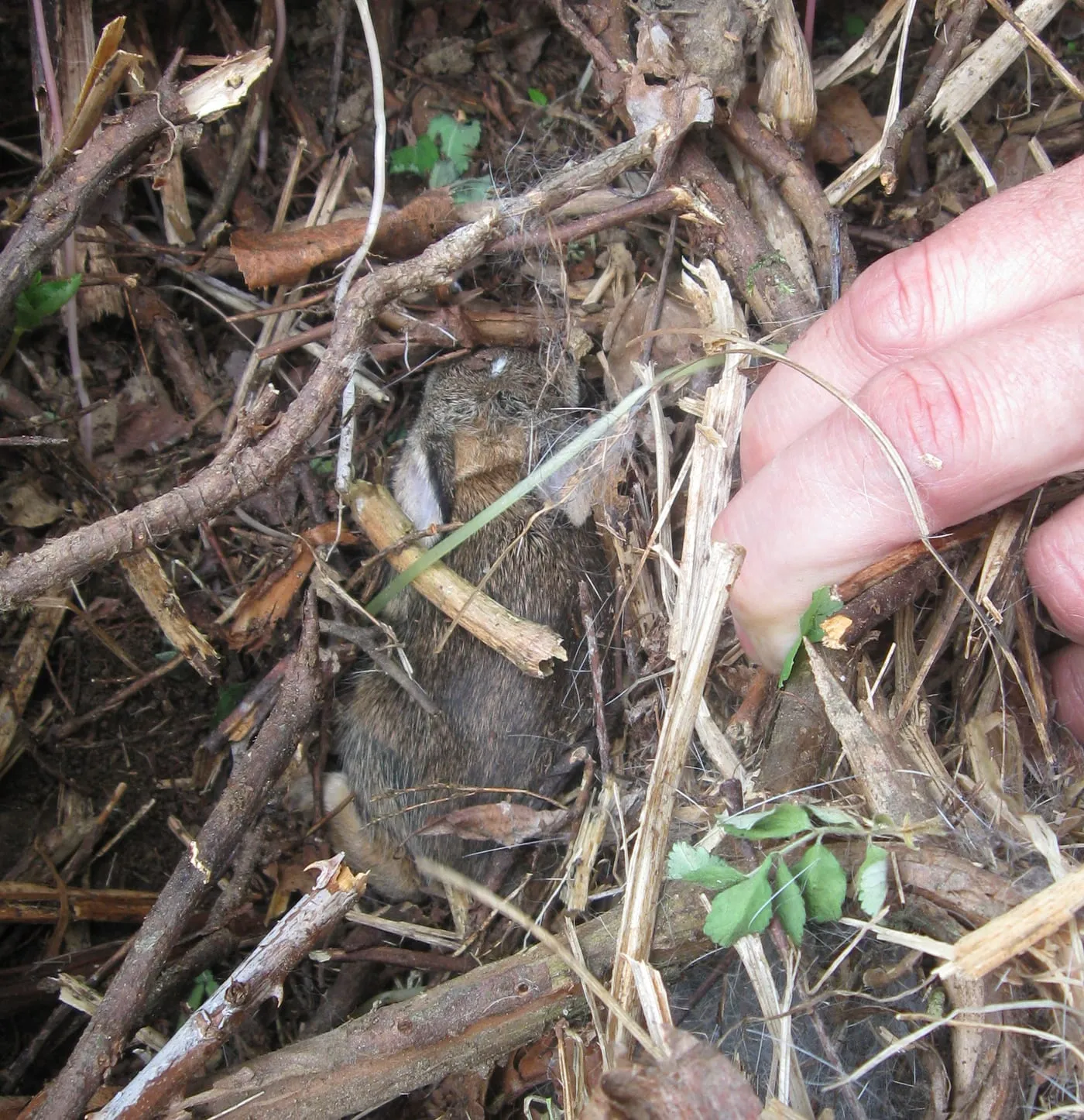
A shallow, grass-and-fur-lined depression in your lawn is almost always an eastern cottontail rabbit nest, and it is very rarely abandoned — mother rabbits visit only at dawn and dusk to avoid leading predators to their babies. A nest of speckled eggs on open ground, by contrast, usually belongs to a killdeer or another ground-nesting bird. In both cases the right move is to leave it alone and protect the spot for a few weeks.
Most likely causes
- Eastern cottontail rabbit nest — shallow scrape lined with dried grass and the mother's fur, often capped with a grass 'lid'
- Killdeer nest — four speckled eggs in a bare gravel scrape, with a parent nearby faking a broken wing
- Other ground-nesting birds — mallards and sparrows occasionally nest in landscaping near lawns
- Vole nests — softball-size grass balls revealed when snow melts, usually already empty
Not quite what you're seeing? Answer four quick questions and the clue finder will point you to a closer match.
Compare the possible causes
| Possible cause | Key signs | When it happens | How likely |
|---|---|---|---|
| Eastern cottontail rabbit nest | A shallow depression 4–6 inches across, lined with dried grass and soft fur, often covered with a loose cap of grass that blends into the lawn | February through September, with multiple litters per season; often discovered while mowing | Very common |
| Killdeer nest | Four buff, dark-speckled eggs in a bare scrape on gravel, mulch, or thin turf — no real nest material — with a loud adult running the broken-wing act nearby | Spring through mid-summer | Common |
| Other ground-nesting birds | A cup of grass or down hidden at the base of shrubs, in tall groundcover, or against the house, containing eggs rather than fur | Spring and early summer nesting season | Less common |
| Vole nests and winter runways | Softball-size balls of shredded dry grass sitting on the lawn surface when snow melts, connected by narrow worn paths in the turf | Discovered in late winter and early spring at snowmelt | Less common |
Visual clues to check
- Look for fur: a lining of soft gray-brown fur mixed with dried grass means rabbits — mothers pluck their own fur to line the nest
- Check for a cap: cottontails cover the nest opening with a woven lid of grass, so an intact, tidy cap means mom has been back
- Count and inspect eggs: four pebble-colored speckled eggs on bare ground is the killdeer signature
- Watch from a window at dawn or dusk: rabbit mothers feed at first and last light and stay under five minutes, so you'll only catch it if you're looking
- Try the string test: lay two pieces of yarn or light string in an X over a rabbit nest in the evening — if the X is pushed aside by morning, the mother visited overnight
- Look at the babies' bellies if visible: plump, round bellies and quiet kits mean they're being fed; wrinkled, cold, crying kits suggest genuine trouble
The causes in detail
Eastern cottontail rabbit nest
Cottontails deliberately nest in open lawns because most predators avoid exposed ground, and the mother stays away all day for the same reason — she nurses her kits only around dawn and dusk, for just a few minutes. Babies' eyes open at about 10 days, and by roughly 3 weeks they're fully independent and gone. A nest of quiet, warm, round-bellied babies with no mother in sight is a nest that is working exactly as designed. See all rabbits signs →
Killdeer nest
Killdeer are plovers that skip trees entirely and lay their eggs in the open, counting on camouflage. The eggs look so much like pebbles that most people find the nest only when a shrieking parent drags a 'broken' wing away from it — a bluff to lure you off. Incubation runs about 24 to 28 days, and the chicks walk away from the nest within hours of hatching, so the disruption window is short.
Other ground-nesting birds
Mallards sometimes nest in foundation plantings surprisingly far from water, and song sparrows and juncos tuck grass-cup nests into low landscaping at lawn edges. Eggs instead of fur is the quick way to tell any bird nest from a rabbit nest. Like rabbit nests, these resolve themselves within weeks if left undisturbed.
Vole nests and winter runways
Meadow voles live under the snowpack all winter, building surface nests and trampling runway networks that only become visible in March. By the time you find them, the voles have usually moved back to underground burrows. Rake out the dead material and overseed; the runways almost always fill in on their own by early summer. See all voles signs →
When to worry
- The string-test X sits undisturbed for two consecutive nights and the kits look thin, cold, or are crying — the nest may truly be orphaned
- A baby has visible wounds, was carried off by a dog or cat, or is covered in flies or insects
- The nest was torn open by a mower or a pet and the babies are scattered or exposed
- You find a dead adult rabbit on or near the property during nesting weeks
- Eggs or chicks are directly in the path of unavoidable construction or vehicle traffic
What to do now
- Leave the nest exactly where it is — rabbit and bird nests on the ground are normal, temporary, and legally protected in the case of native birds
- Mark the spot with a flag or an upside-down laundry basket weighted on one side (with a gap for the mother) so no one steps or mows over it
- Mow around the nest and skip the trimmer within a few feet; the whole occupancy is only about three weeks for rabbits
- Keep dogs on a leash in that part of the yard and keep cats indoors until the babies are gone — pets are the number-one cause of nest failure in lawns
- If a mower or pet opens the nest but the kits are unhurt, put the grass and fur back over them; the mother will still return, even after human touch
- If the string test fails two nights running or a baby is clearly injured, call a licensed wildlife rehabilitator — search your state wildlife agency's rehabilitator list — rather than attempting care yourself
What not to do
- Don't move or 'relocate' the nest, even a few feet — mother rabbits return to the exact spot and will not search for a moved nest
- Don't assume an unattended nest is abandoned; seeing no mother all day is exactly how a healthy rabbit nest is supposed to look
- Don't try to bottle-feed baby rabbits yourself — wild cottontails have extremely poor survival in untrained hands, and possession of wildlife without a permit is illegal in most states
- Don't hover, check hourly, or let kids handle the babies; repeated disturbance can cause the mother to stay away and near-independent kits to bolt early
- Don't disturb or move bird eggs — native birds, their nests, and eggs are federally protected under the Migratory Bird Treaty Act
Think you know the suspect?
These animals commonly cause this clue — see their full sign profiles:
Frequently asked questions
I found a nest of baby bunnies and haven't seen the mother — is it abandoned?
Almost certainly not. Cottontail mothers stay away from the nest all day on purpose and return only around dawn and dusk for a few minutes of nursing. Use the string test: lay string in an X over the nest at dusk, and if it's disturbed by morning, she's coming back. Only two failed nights plus thin, cold, or crying babies suggest a real problem.
I touched the babies — will the mother reject them now?
No. The idea that human scent makes rabbit or bird mothers abandon their young is a myth. If you or a pet uncovered the nest, tuck the babies back, replace the grass-and-fur covering, and leave the area. The mother will resume her normal feeding schedule.
How long will the rabbit nest be in my lawn?
About three weeks from birth. Kits open their eyes around day 10, start venturing out around two weeks, and are fully independent at roughly three weeks old, when they leave for good. Mowing around one spot for that long is the entire cost of hosting them.
How do I keep rabbits from nesting in my yard again?
After the nest is empty, fill the depression and reduce what attracted her: trim tall grass edges, close gaps under sheds and brush piles, and consider low fencing around garden beds. There's no reliable way to prevent it entirely — open suburban lawns are exactly the habitat cottontails evolved to use.
A bird keeps screaming and dragging its wing when I mow one part of the yard. What's going on?
That's a killdeer performing its broken-wing display, which means you're close to its ground nest. Look carefully for four speckled, pebble-like eggs on bare ground nearby, mark the spot, and give it a wide berth. The eggs hatch in about four weeks and the chicks leave the nest almost immediately.